Pygmy spiny-tailed skink (Egernia depressa)
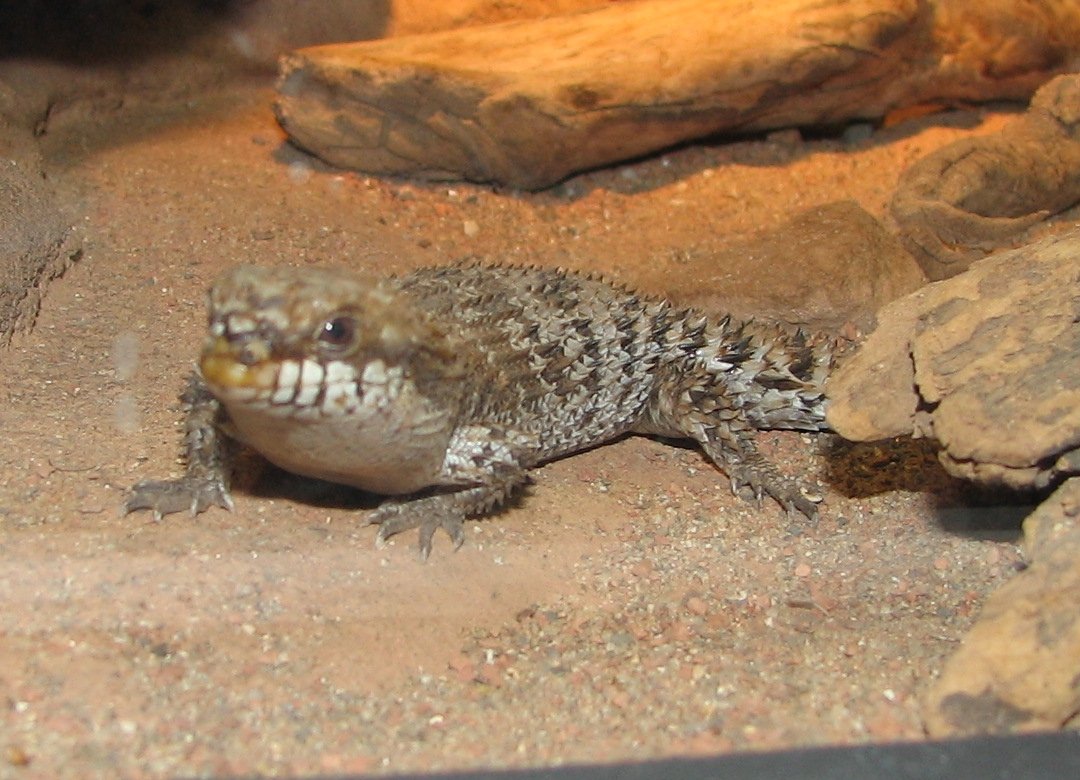
Skinks · Difficulty: Intermediate
Key facts and care guidance for Pygmy spiny-tailed skink (Egernia depressa) (origin: Central to southern Western Australia, mulga scrubland; lives in and on mulga acacias (hollow trunks and branches)). Adult size around 11–16 cm total length depending on locality form (snout–vent length up to 10.8 cm). Life expectancy up to 20 years. The values below are carefully researched guidance.
Short answers
Pygmy spiny-tailed skink: How big does the enclosure need to be?
120 × 60 × 60 cm (pair), use the height with climbing branches and elevated hides; absolute minimum 60 × 50 × 60 cm for a single animal.
Pygmy spiny-tailed skink: What temperature does it need?
Daytime 26–32 °C, basking spot 40–45 °C (basking spot on rock), at night 18–22 °C.
Pygmy spiny-tailed skink: Does it need UVB lighting?
UVB: Essential (desert-grade UVB, high UVB).
Pygmy spiny-tailed skink: How long do they live?
Life expectancy: up to 20 years.
Pygmy spiny-tailed skink: Is it suitable for beginners?
Rather not – it is considered an intermediate species (difficulty: Intermediate).
Climate
- Daytime temperature
- 26–32 °C
- Night temperature
- 18–22 °C
- Basking spot
- 40–45 °C (basking spot on rock)
- Humidity
- 30–50 % (arid species)
- UVB
- Essential (desert-grade UVB, high UVB)
Enclosure
- Minimum size
- 120 × 60 × 60 cm (pair), use the height with climbing branches and elevated hides; absolute minimum 60 × 50 × 60 cm for a single animal
- Substrate
- Sand-clay mix on the floor, plus climbing branches, cork tubes, small tree hollows and bark on the walls as elevated hides
Feeding
- Food
- Mostly insects plus plant food (omnivorous)
- Feeding interval
- 2–3×/week
Key facts
- Adult size
- 11–16 cm total length depending on locality form (snout–vent length up to 10.8 cm)
- Life expectancy
- up to 20 years
- Origin
- Central to southern Western Australia, mulga scrubland; lives in and on mulga acacias (hollow trunks and branches)
- Protection status
- —
- Brumation
- A slight winter rest of ~6–8 weeks (cooler) is recommended
- Cohabitation
- Live-bearing and family-forming; strongly territorial – only a harmonious pair or family
Notes
An arid rock dweller: narrow rock crevices as hides plus a high UVB and warmth requirement are essential. Very territorial towards strange animals of its own kind.
Do you keep this species?
Add your animal to Reptoria – Reptoria reminds you about feeding and shedding. Add your animal for free →
Pygmy spiny-tailed skink (Egernia depressa) currently offered
- Egernia depressa Nz ^26 – Wetzlar · 1,600 €
Related species
- Tree skink (Egernia striolata) – Beginner
- Cunningham's skink (Egernia cunninghami) – Intermediate
- Black rock skink (Egernia saxatilis) – Intermediate
- Hosmer's spiny-tailed skink (Egernia hosmeri) – Intermediate
- Desert skink (Egernia formosa) – Intermediate
- King's skink (Egernia kingii) – Intermediate
- Eastern crevice skink (Egernia mcpheei) – Intermediate
- Richard's crevice skink (Egernia richardi) – Intermediate
What you need to start
To keep Pygmy spiny-tailed skink (Egernia depressa) you typically need: a suitable enclosure (120 × 60 × 60 cm (pair), use the height with climbing branches and elevated hides; absolute minimum 60 × 50 × 60 cm for a single animal), substrate (Sand-clay mix on the floor, plus climbing branches, cork tubes, small tree hollows and bark on the walls as elevated hides), a heat source with a thermostat, UVB lighting, thermometer and hygrometer, a water dish and hides. You will find equipment in the Reptoria marketplace.
The complete, interactive care database is in the Reptoria app.
Last updated: 9 October 2026 · Editor: Reptoria editorial team · Sources include: museum.wa.gov.au (Doughty et al. 2011), reptile-care.de, egernia.de, Wikipedia EN, echsen.net
All values are non-binding guidance and do not replace expert advice. Research thoroughly from several sources before acquiring and keeping an animal, and observe the applicable law (species and animal protection in particular).