Gold dust day gecko (Phelsuma laticauda)
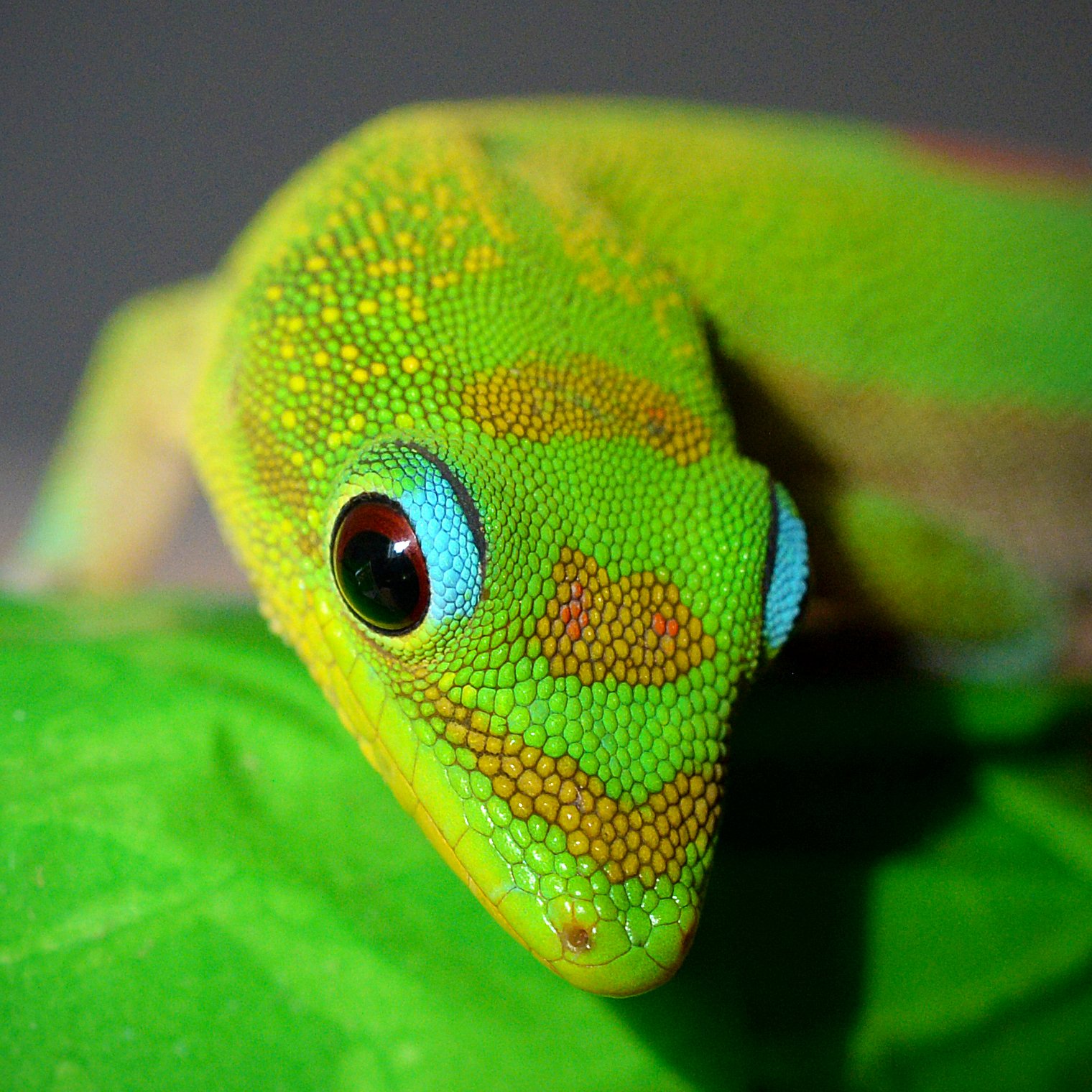
Geckos · Difficulty: Beginner to intermediate
Key facts and care guidance for Gold dust day gecko (Phelsuma laticauda) (origin: Northern Madagascar, the Comoros (introduced to Hawaii among others)). Adult size around approx. 10–13 cm. Life expectancy 8–10 years (up to 15). The values below are carefully researched guidance.
Short answers
Gold dust day gecko: What temperature does it need?
Daytime 24–30 °C (gradient from floor to top), basking spot 32–40 °C basking spot, at night ~20 °C.
Gold dust day gecko: Does it need UVB lighting?
UVB: Recommended (UVB 5–10 %).
Gold dust day gecko: How long do they live?
Life expectancy: 8–10 years (up to 15).
Gold dust day gecko: Is it suitable for beginners?
Partly – manageable with some prior knowledge (difficulty: Beginner to intermediate).
Gold dust day gecko: Can several be kept together?
In pairs (one male, one female) in a large, densely planted enclosure is the usual set-up; the female needs places to escape to, because males can seriously injure her in enclosures that are too small.
Climate
- Daytime temperature
- 24–30 °C (gradient from floor to top)
- Night temperature
- ~20 °C
- Basking spot
- 32–40 °C basking spot
- Humidity
- day 50–60 %, night 80–90 %
- UVB
- Recommended (UVB 5–10 %)
Enclosure
- Minimum size
- ab 45×45×60 cm für ein Tier; Paar ab 60×50×80 cm
- Substrate
- Coco humus and planting, bamboo and cork
Feeding
- Food
- Insects plus fruit or nectar purée
- Feeding interval
- insects several times a week, fruit purée ~1×/week
Key facts
- Adult size
- approx. 10–13 cm
- Life expectancy
- 8–10 years (up to 15)
- Origin
- Northern Madagascar, the Comoros (introduced to Hawaii among others)
- Protection status
- CITES Appendix II / EU Annex B – registration required
- Brumation
- None
- Cohabitation
- In pairs (one male, one female) in a large, densely planted enclosure is the usual set-up; the female needs places to escape to, because males can seriously injure her in enclosures that are too small. Keeping it singly is equally appropriate and the least stressful choice for non-breeders. A trio (1.2) is possible – drawback: more competition and more clutches. Never keep two males together, and separate juveniles early.
Notes
One of the most robust day gecko species and a good way into Phelsuma; not tame to the hand. UVB plus calcium matter against rickets.
Do you keep this species?
Add your animal to Reptoria – Reptoria reminds you about feeding and shedding. Add your animal for free →
Look for Gold dust day gecko (Phelsuma laticauda) in the marketplace →
Related species
- Abbott's day gecko (Phelsuma abbotti) – Intermediate
- Barbour's day gecko (Phelsuma barbouri) – Intermediate
- Blue-tailed day gecko (Phelsuma cepediana) – Intermediate
- Lined day gecko (Phelsuma lineata) – Beginner
- Giant day gecko (Phelsuma grandis) – Beginner
- Seychelles giant day gecko (Phelsuma sundbergi) – Intermediate
- Comoros day gecko (Phelsuma v-nigra) – Intermediate
- Neon day gecko (Phelsuma pusilla) – Intermediate
What you need to start
To keep Gold dust day gecko (Phelsuma laticauda) you typically need: a suitable enclosure (ab 45×45×60 cm für ein Tier; Paar ab 60×50×80 cm), substrate (Coco humus and planting, bamboo and cork), a heat source with a thermostat, UVB lighting, thermometer and hygrometer, a water dish and hides. You will find equipment in the Reptoria marketplace.
The complete, interactive care database is in the Reptoria app.
Last updated: 9 October 2026 · Editor: Reptoria editorial team · Sources include: http://www.ig-phelsuma.de/?page_id=960, https://en.wikipedia.org/wiki/Gold_dust_day_gecko, https://reptifiles.com/gold-dust-day-gecko-care-sheet/, https://reptile-database.reptarium.cz/species?genus=Phelsuma&species=laticauda, https://taggecko.ch/die-arten/steckbrief-der-arten/
All values are non-binding guidance and do not replace expert advice. Research thoroughly from several sources before acquiring and keeping an animal, and observe the applicable law (species and animal protection in particular).