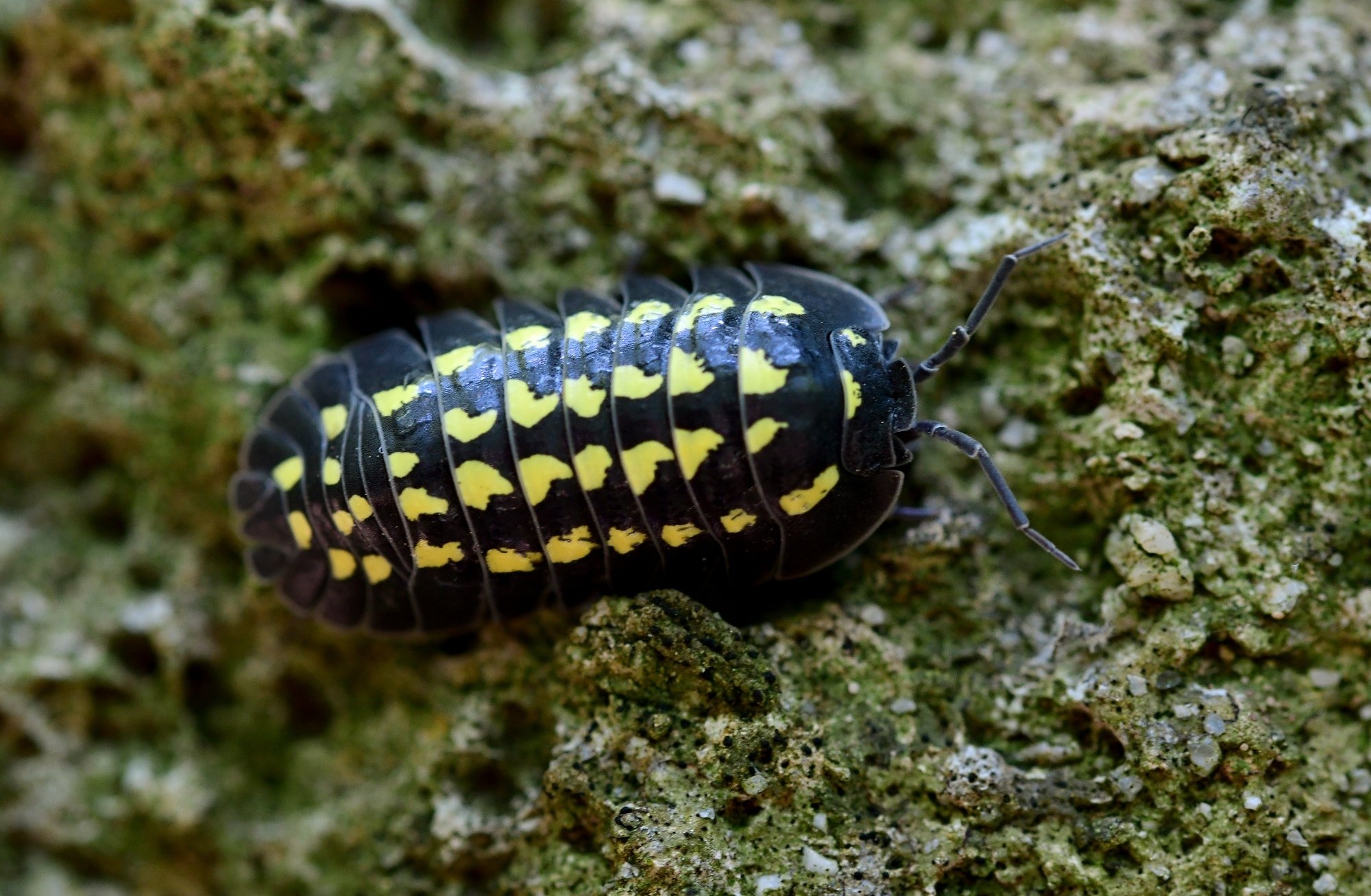
Greek pill woodlouse (Armadillidium gestroi)
Invertebrates · Difficulty: Beginner
Key facts and care guidance for Greek pill woodlouse (Armadillidium gestroi) (origin: Nordwest-Italien: nur an einem kurzen Küstenstreifen Liguriens (Riviera di Ponente) – der Handelsname „Griechische“ ist irreführend). Adult size around approx. 1.5–2.0 cm (one of the largest Armadillidium). Life expectancy approx. 2–3 years. The values below are carefully researched guidance.
Short answers
Greek pill woodlouse: How big does the enclosure need to be?
A box from 25×20×15 cm for a colony (a larger species); a colony animal.
Greek pill woodlouse: What temperature does it need?
Daytime 21–26 °C, at night 18–22 °C.
Greek pill woodlouse: Does it need UVB lighting?
UVB: No UVB needed.
Greek pill woodlouse: How long do they live?
Life expectancy: approx. 2–3 years.
Greek pill woodlouse: Is it suitable for beginners?
Yes – it is considered suitable for beginners (difficulty: Beginner).
Climate
- Daytime temperature
- 21–26 °C
- Night temperature
- 18–22 °C
- Basking spot
- —
- Humidity
- 55–70 % (with one humid area)
- UVB
- No UVB needed
Enclosure
- Minimum size
- a box from 25×20×15 cm for a colony (a larger species); a colony animal
- Substrate
- Soil or coco with plenty of leaf litter, rotten pale wood and cork bark; one damp corner (sphagnum); it likes things a little damper and less ventilated than other pill woodlice
Feeding
- Food
- Fallen leaves, rotten pale wood, vegetables; protein (dried shrimp) and calcium (cuttlebone or shell grit)
- Feeding interval
- protein and vegetables 1–2×/week, leaf litter and wood always available
Key facts
- Adult size
- approx. 1.5–2.0 cm (one of the largest Armadillidium)
- Life expectancy
- approx. 2–3 years
- Origin
- Nordwest-Italien: nur an einem kurzen Küstenstreifen Liguriens (Riviera di Ponente) – der Handelsname „Griechische“ ist irreführend
- Protection status
- Not protected (no CITES, no German Federal Nature Conservation Act listing)
- Brumation
- None (a European species; a cooler overwintering is possible but not essential)
- Cohabitation
- Colony. Isopods are gregarious and are kept as a group – 10 to 15 animals to start; a single animal cannot breed. Provide plenty of hides so adult males can avoid each other. Only this one species per tub: a faster-breeding isopod will crowd out the rather slow gestroi in the long run.
Notes
A robust, diurnal pill woodlouse with striking black-and-yellow markings; it rolls into a ball. It likes it damper and more sheltered than, for example, zebra isopods. Note the discrepancy between the name and the origin (its scientific distribution is Italy and France).
Do you keep this species?
Add your animal to Reptoria – Reptoria reminds you about feeding and shedding. Add your animal for free →
Look for Greek pill woodlouse (Armadillidium gestroi) in the marketplace →
Related species
- Common pill woodlouse (Armadillidium vulgare) – Beginner
- Marbled pill woodlouse (Armadillidium granulatum) – Beginner
- Clown isopod (Armadillidium klugii) – Beginner
- Nosy pill woodlouse (Armadillidium nasatum) – Beginner
- Werner's isopod (Armadillidium werneri) – Beginner to intermediate
- Zebra pill woodlouse (Armadillidium maculatum) – Beginner
- Little sea isopod (Cubaris murina) – Beginner
- Giant canyon isopod (Porcellio dilatatus) – Beginner
What you need to start
To keep Greek pill woodlouse (Armadillidium gestroi) you typically need: a suitable enclosure (a box from 25×20×15 cm for a colony (a larger species); a colony animal), substrate (Soil or coco with plenty of leaf litter, rotten pale wood and cork bark; one damp corner (sphagnum); it likes things a little damper and less ventilated than other pill woodlice), a heat source with a thermostat, UVB lighting, thermometer and hygrometer, a water dish and hides. You will find equipment in the Reptoria marketplace.
The complete, interactive care database is in the Reptoria app.
Last updated: 9 October 2026 · Editor: Reptoria editorial team · Sources include: https://en.wikipedia.org/wiki/Armadillidium_gestroi, https://postpods.co.uk/blogs/isopods-useful-articles/gestroi-isopod-care, https://en.wikipedia.org/wiki/Woodlouse, https://postpods.co.uk/blogs/isopods-useful-articles/care-for-armadillidium-isopods, https://postpods.co.uk/blogs/isopods-useful-articles/keeping-different-isopods-together
All values are non-binding guidance and do not replace expert advice. Research thoroughly from several sources before acquiring and keeping an animal, and observe the applicable law (species and animal protection in particular).