Ionides' white-throated monitor (Varanus albigularis ionidesi)
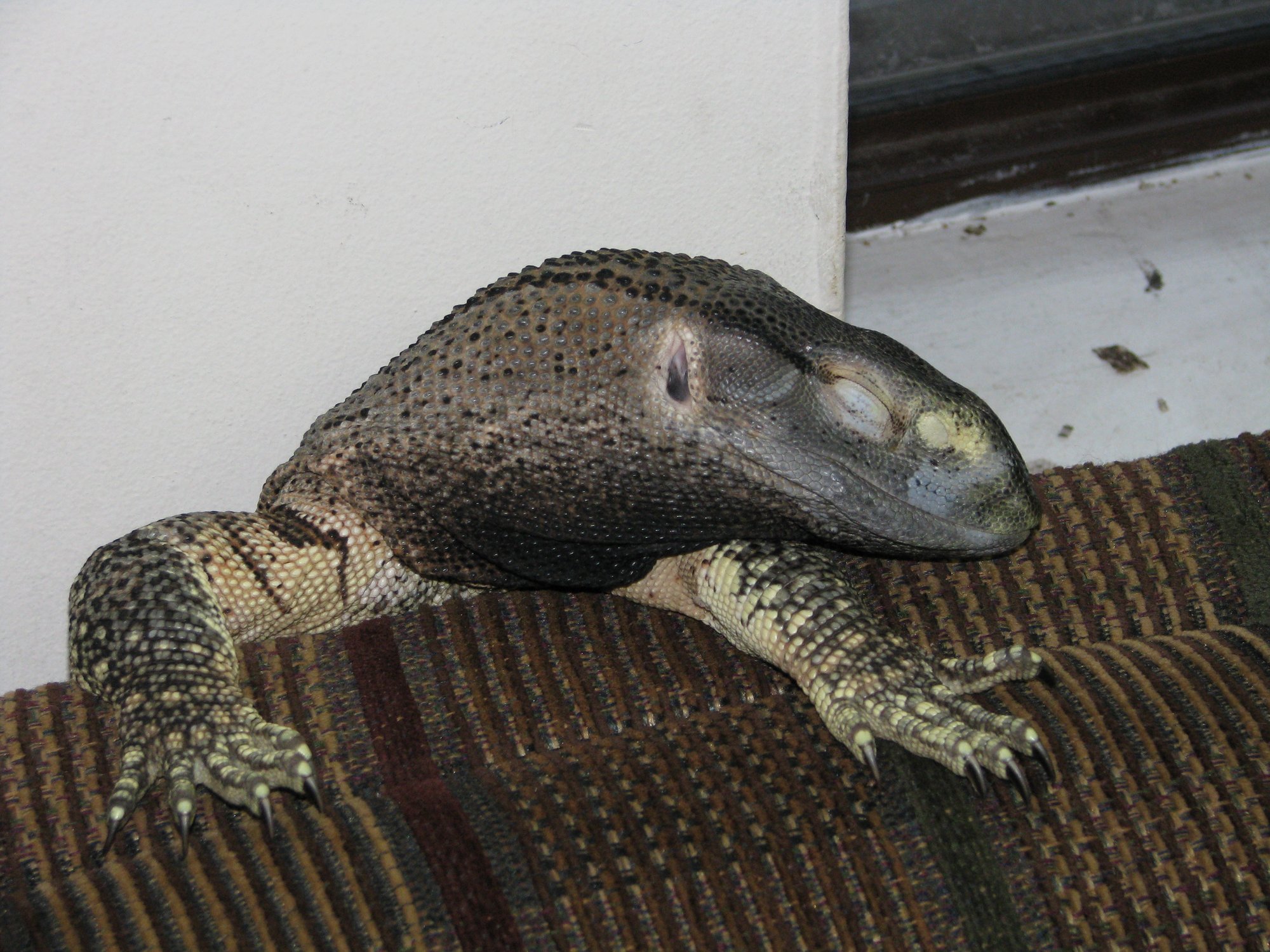
Monitors & tegus · Difficulty: Expert
Key facts and care guidance for Ionides' white-throated monitor (Varanus albigularis ionidesi) (origin: Tanzania (East Africa); the black-throated monitor form from dry savannah and bushland). Adult size around approx. 1.2–1.8 m (up to ~2 m) including the tail, very bulky. Life expectancy up to 20–25 years. The values below are carefully researched guidance.
Short answers
Ionides' white-throated monitor: How big does the enclosure need to be?
300×150×150 cm (at least 8×4×4 ft) for one adult animal.
Ionides' white-throated monitor: What temperature does it need?
Daytime 28–35 °C, basking spot 45–50 °C, at night 22–25 °C.
Ionides' white-throated monitor: Does it need UVB lighting?
UVB: UVB needed (Ferguson zone 2–3, UV index 3–5; a savannah species).
Ionides' white-throated monitor: How long do they live?
Life expectancy: up to 20–25 years.
Ionides' white-throated monitor: Is it suitable for beginners?
No – better suited to experienced keepers (difficulty: Expert).
Climate
- Daytime temperature
- 28–35 °C
- Night temperature
- 22–25 °C
- Basking spot
- 45–50 °C
- Humidity
- 50–70 %
- UVB
- UVB needed (Ferguson zone 2–3, UV index 3–5; a savannah species)
Enclosure
- Minimum size
- 300×150×150 cm (at least 8×4×4 ft) for one adult animal
- Substrate
- A deep, diggable sand-loam mix (compactable for caves), a large water basin
Feeding
- Food
- Rodents (mice or rats), chicks, large insects or roaches, snails, eggs
- Feeding interval
- adults 1–2×/week (risk of obesity!), juveniles more often
Key facts
- Adult size
- approx. 1.2–1.8 m (up to ~2 m) including the tail, very bulky
- Life expectancy
- up to 20–25 years
- Origin
- Tanzania (East Africa); the black-throated monitor form from dry savannah and bushland
- Protection status
- CITES Appendix II / EU Annex B – proof of origin required
- Brumation
- Not essential (reduced activity or aestivation is possible in the dry season)
- Cohabitation
- Single housing – territorial; never males together. The reason is territory: two animals will not voluntarily share a basking spot or a hiding place. They fight until one is seriously injured or permanently confined to a corner — and that second animal then eats worse, without showing any visible wound.
Notes
The black-throated monitor, one of the heaviest monitors. Very powerful and potentially dangerous. The commonest mistake: overfeeding and obesity, and an enclosure that is too small and unstructured. It needs deep, diggable substrate.
Do you keep this species?
Add your animal to Reptoria – Reptoria reminds you about feeding and shedding. Add your animal for free →
Look for Ionides' white-throated monitor (Varanus albigularis ionidesi) in the marketplace →
Related species
- Argus monitor (Varanus panoptes) – Expert
- Bengal monitor (Varanus bengalensis) – Expert
- Blue tree monitor (Varanus macraei) – Expert
- Blue-tailed monitor (Varanus doreanus) – Intermediate to expert
- Finsch's monitor (Varanus doreanus finschi) – Expert
- Boatsi tree monitor (Varanus boatsi) – Expert
- Bogert's tree monitor (Varanus bogerti) – Expert
- Lace monitor (Varanus varius) – Expert
What you need to start
To keep Ionides' white-throated monitor (Varanus albigularis ionidesi) you typically need: a suitable enclosure (300×150×150 cm (at least 8×4×4 ft) for one adult animal), substrate (A deep, diggable sand-loam mix (compactable for caves), a large water basin), a heat source with a thermostat, UVB lighting, thermometer and hygrometer, a water dish and hides. You will find equipment in the Reptoria marketplace.
The complete, interactive care database is in the Reptoria app.
Last updated: 9 October 2026 · Editor: Reptoria editorial team · Sources include: https://en.wikipedia.org/wiki/Black-throated_monitor, https://reptile-database.reptarium.cz/species?genus=Varanus&species=albigularis
All values are non-binding guidance and do not replace expert advice. Research thoroughly from several sources before acquiring and keeping an animal, and observe the applicable law (species and animal protection in particular).