Kingorum monitor (Varanus kingorum)
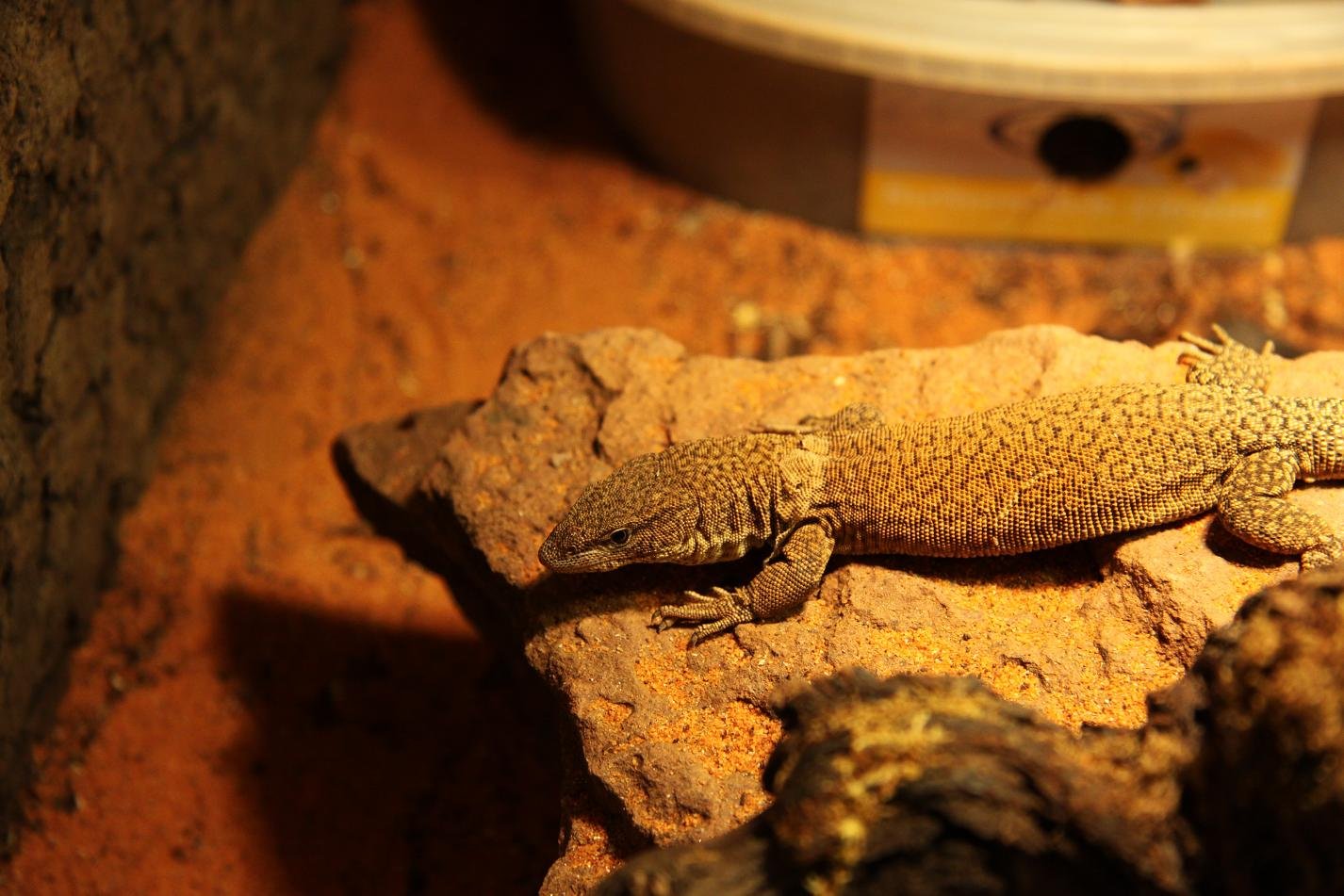
Monitors & tegus · Difficulty: Intermediate
Key facts and care guidance for Kingorum monitor (Varanus kingorum) (origin: North-western Northern Territory / north-eastern Western Australia (rocky savannah, a rock dweller)). Adult size around approx. 9–12 cm SVL, ~25–30 cm total length (the smallest rock monitor). Life expectancy over 8 years in captivity. The values below are carefully researched guidance.
Short answers
Kingorum monitor: How big does the enclosure need to be?
At least 80×45×45 cm for one animal or a pair; a rock structure with crevices is essential (more floor area is better).
Kingorum monitor: What temperature does it need?
Daytime 28–33 °C, basking spot 45–55 °C (on a rock stack or tile), at night 20–24 °C.
Kingorum monitor: Does it need UVB lighting?
UVB: UVB needed (Ferguson zone 3, UV index 3–5).
Kingorum monitor: How long do they live?
Life expectancy: over 8 years in captivity.
Kingorum monitor: Is it suitable for beginners?
Rather not – it is considered an intermediate species (difficulty: Intermediate).
Climate
- Daytime temperature
- 28–33 °C
- Night temperature
- 20–24 °C
- Basking spot
- 45–55 °C (on a rock stack or tile)
- Humidity
- 40–60 % (a humid crevice or hide microclimate)
- UVB
- UVB needed (Ferguson zone 3, UV index 3–5)
Enclosure
- Minimum size
- at least 80×45×45 cm for one animal or a pair; a rock structure with crevices is essential (more floor area is better)
- Substrate
- Sand, coarse gravel or sand-loam; stacked flat stones, hollow logs, rock crevices
Feeding
- Food
- Insects (crickets, roaches), occasionally small vertebrates or eggs; calcium and vitamins
- Feeding interval
- adults 2–3×/week, juveniles daily
Key facts
- Adult size
- approx. 9–12 cm SVL, ~25–30 cm total length (the smallest rock monitor)
- Life expectancy
- over 8 years in captivity
- Origin
- North-western Northern Territory / north-eastern Western Australia (rocky savannah, a rock dweller)
- Protection status
- CITES Appendix II / EU Annex B → registration required, proof of origin required
- Brumation
- a slight winter drop and shorter day length to stimulate breeding; no true brumation
- Cohabitation
- Paired or as a trio (1.1 or 1.2) is possible given enough space and plenty of crevice hides - more tolerant than large monitors. Use only one male and monitor for aggression.
Notes
The smallest rock monitor; it becomes tame once settled in (tong feeding). Stacked stones and crevices are essential. A common mistake: too few hides and too cool a basking spot.
Do you keep this species?
Add your animal to Reptoria – Reptoria reminds you about feeding and shedding. Add your animal for free →
Look for Kingorum monitor (Varanus kingorum) in the marketplace →
Related species
- Argus monitor (Varanus panoptes) – Expert
- Bengal monitor (Varanus bengalensis) – Expert
- Blue tree monitor (Varanus macraei) – Expert
- Blue-tailed monitor (Varanus doreanus) – Intermediate to expert
- Finsch's monitor (Varanus doreanus finschi) – Expert
- Boatsi tree monitor (Varanus boatsi) – Expert
- Bogert's tree monitor (Varanus bogerti) – Expert
- Lace monitor (Varanus varius) – Expert
What you need to start
To keep Kingorum monitor (Varanus kingorum) you typically need: a suitable enclosure (at least 80×45×45 cm for one animal or a pair; a rock structure with crevices is essential (more floor area is better)), substrate (Sand, coarse gravel or sand-loam; stacked flat stones, hollow logs, rock crevices), a heat source with a thermostat, UVB lighting, thermometer and hygrometer, a water dish and hides. You will find equipment in the Reptoria marketplace.
The complete, interactive care database is in the Reptoria app.
Last updated: 2 November 2026 · Editor: Reptoria editorial team · Sources include: https://de.wikipedia.org/wiki/Kings_Waran, https://reptile-database.reptarium.cz/species?genus=Varanus&species=kingorum
All values are non-binding guidance and do not replace expert advice. Research thoroughly from several sources before acquiring and keeping an animal, and observe the applicable law (species and animal protection in particular).