Macklot's python (Liasis mackloti)
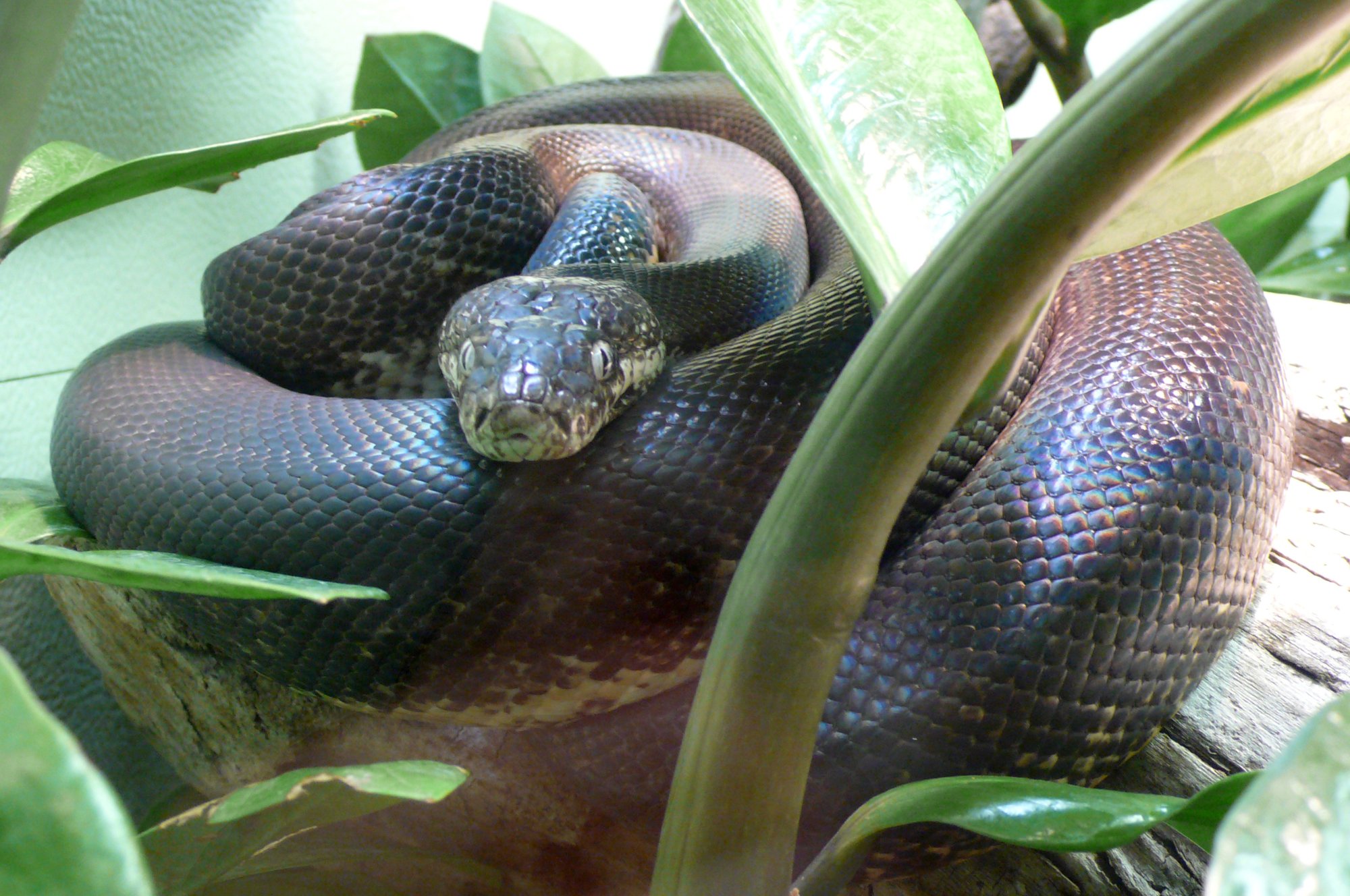
Snakes · Difficulty: Intermediate
Key facts and care guidance for Macklot's python (Liasis mackloti) (origin: The Lesser Sunda Islands (Timor, Roti, Semau) / Indonesia; related forms as far as New Guinea). Adult size around 150–210 cm, up to approx. 240 cm. Life expectancy 15–25 years. The values below are carefully researched guidance.
Short answers
Macklot's python: How big does the enclosure need to be?
From 180×120×180 cm (minimum size according to the 1997 expert report, Australian rock pythons); a large, sturdy water pool.
Macklot's python: What temperature does it need?
Daytime 27–30 °C, basking spot 31–33 °C (max. ~34 °C, do not exceed for long), at night 24–26 °C.
Macklot's python: Does it need UVB lighting?
UVB: UVB not essential.
Macklot's python: How long do they live?
Life expectancy: 15–25 years.
Macklot's python: Is it suitable for beginners?
Rather not – it is considered an intermediate species (difficulty: Intermediate).
Climate
- Daytime temperature
- 27–30 °C
- Night temperature
- 24–26 °C
- Basking spot
- 31–33 °C (max. ~34 °C, do not exceed for long)
- Humidity
- 60–70 %
- UVB
- UVB not essential
Enclosure
- Minimum size
- from 180×120×180 cm (minimum size according to the 1997 expert report, Australian rock pythons); a large, sturdy water pool
- Substrate
- Moisture-retaining bark mulch or coco humus; a damp shedding box for the moult
Feeding
- Food
- Rodents (mice or rats), chicks; large animals also take rabbits
- Feeding interval
- adults 1× every 10–14 days, juveniles 1× every 7 days
Key facts
- Adult size
- 150–210 cm, up to approx. 240 cm
- Life expectancy
- 15–25 years
- Origin
- The Lesser Sunda Islands (Timor, Roti, Semau) / Indonesia; related forms as far as New Guinea
- Protection status
- CITES Appendix II / EU Regulation Annex B – registration required, proof of origin.
- Brumation
- None
- Cohabitation
- Keep them singly – solitary and with a very strong feeding and biting response; put them together only briefly for supervised breeding
Notes
A robust, active species with a pronounced bite reflex and feeding response (take care when feeding). A good climber despite its ground-oriented way of life – offer branches. Do not exceed about 34 °C on the warm side.
Do you keep this species?
Add your animal to Reptoria – Reptoria reminds you about feeding and shedding. Add your animal for free →
Look for Macklot's python (Liasis mackloti) in the marketplace →
Related species
- Olive python (Liasis olivaceus) – Intermediate
- Water python (Liasis fuscus) – Intermediate
- Amethystine python (Simalia amethistina) – Intermediate to expert
- Angolan python (Python anchietae) – Intermediate
- Australian scrub python (Simalia kinghorni) – Intermediate
- Black-headed python (Aspidites melanocephalus) – Intermediate
- Boelen's python (Simalia boeleni) – Expert
- Burmese python (Python bivittatus) – Expert
What you need to start
To keep Macklot's python (Liasis mackloti) you typically need: a suitable enclosure (from 180×120×180 cm (minimum size according to the 1997 expert report, Australian rock pythons); a large, sturdy water pool), substrate (Moisture-retaining bark mulch or coco humus; a damp shedding box for the moult), a heat source with a thermostat, UVB lighting, thermometer and hygrometer, a water dish and hides. You will find equipment in the Reptoria marketplace.
The complete, interactive care database is in the Reptoria app.
Last updated: 9 October 2026 · Editor: Reptoria editorial team · Sources include: https://en.wikipedia.org/wiki/Liasis_mackloti, https://reptile-database.reptarium.cz/species?genus=Liasis&species=mackloti, https://static1.squarespace.com/static/666f16c7538ff80c8403c5a5/t/6676321b2a0dfe0ec37daf02/1719022107814/Macklots-Savu+Python.pdf, https://www.reptco.co.uk/images/files/Macklots%20Python%20Care%20Sheet.pdf
All values are non-binding guidance and do not replace expert advice. Research thoroughly from several sources before acquiring and keeping an animal, and observe the applicable law (species and animal protection in particular).