Black-headed python (Aspidites melanocephalus)
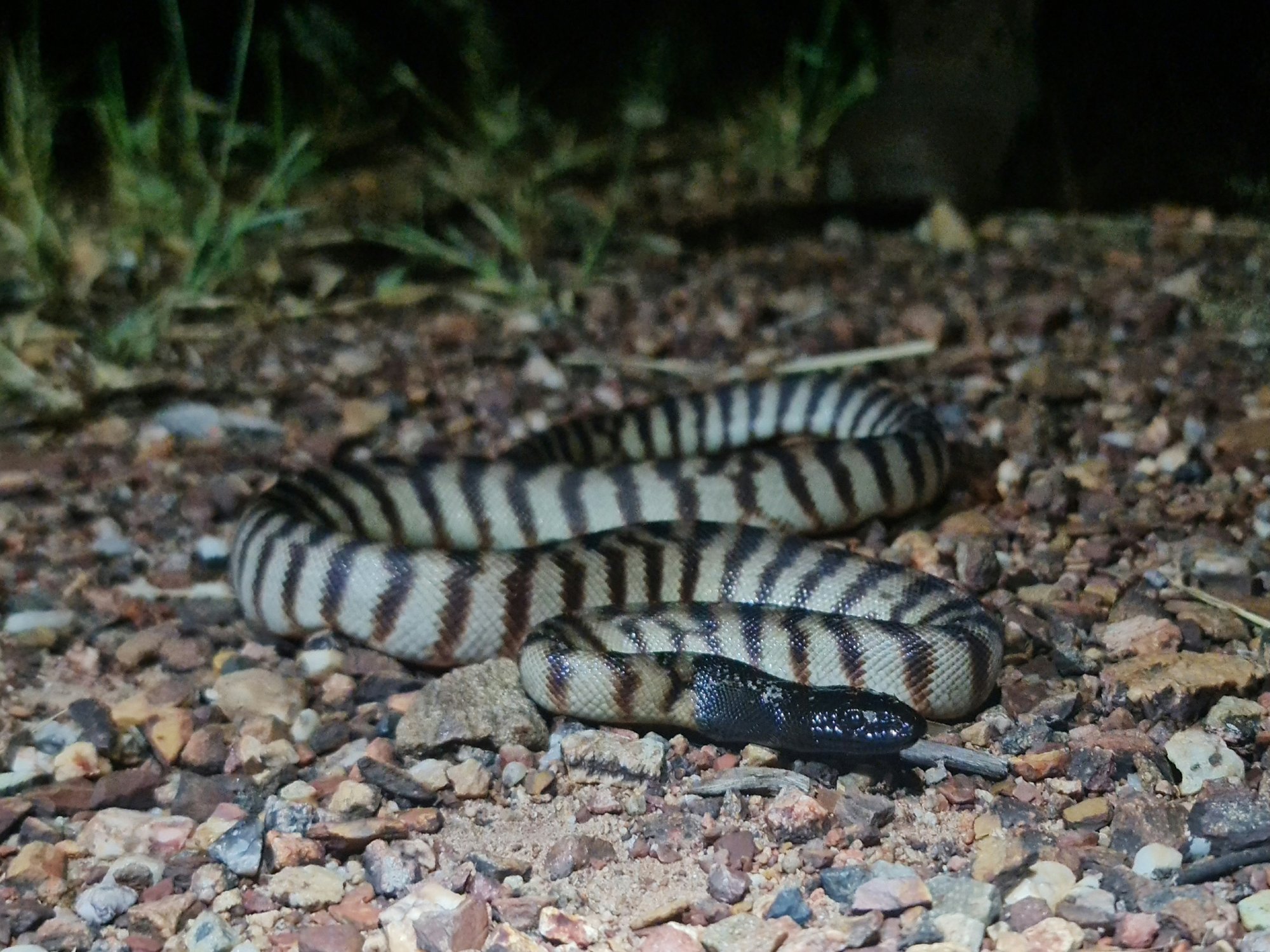
Snakes · Difficulty: Intermediate
Key facts and care guidance for Black-headed python (Aspidites melanocephalus) (origin: Northern Australia (arid to tropical zones)). Adult size around usually 150–200 cm, not uncommonly over 250 cm, exceptionally up to 350 cm. Life expectancy 20–30 years. The values below are carefully researched guidance.
Short answers
Black-headed python: How big does the enclosure need to be?
From 300×150×200 cm (minimum size per the 1997 expert report, woma and black-headed python); ground-oriented, height less important.
Black-headed python: What temperature does it need?
Daytime 26–32 °C, basking spot 32–36 °C (prefers floor heat), at night 22–24 °C.
Black-headed python: Does it need UVB lighting?
UVB: UVB not essential, low UVB recommended.
Black-headed python: How long do they live?
Life expectancy: 20–30 years.
Black-headed python: Is it suitable for beginners?
Rather not – it is considered an intermediate species (difficulty: Intermediate).
Climate
- Daytime temperature
- 26–32 °C
- Night temperature
- 22–24 °C
- Basking spot
- 32–36 °C (prefers floor heat)
- Humidity
- 40–60 % (rather dry, mist occasionally)
- UVB
- UVB not essential, low UVB recommended
Enclosure
- Minimum size
- from 300×150×200 cm (minimum size per the 1997 expert report, woma and black-headed python); ground-oriented, height less important
- Substrate
- Aspen shavings or absorbent digging substrate; they like to dig
Feeding
- Food
- Rodents (mice or rats); reptile-eating in the wild, rodents in captivity
- Feeding interval
- adults 1× every 10–14 days, juveniles 1× every 7 days
Key facts
- Adult size
- usually 150–200 cm, not uncommonly over 250 cm, exceptionally up to 350 cm
- Life expectancy
- 20–30 years
- Origin
- Northern Australia (arid to tropical zones)
- Protection status
- CITES Appendix II / EU Regulation Annex B – registration required, proof of origin. An Australian export ban → only captive-bred animals in the trade.
- Brumation
- None as such; a slight winter night-time drop or shorter photoperiod to stimulate breeding
- Cohabitation
- Keep them singly – solitary and ophiophagous (it eats reptiles and snakes) → a risk of cannibalism; put them together only briefly for supervised breeding
Notes
Almost purely ground-living; it thermoregulates via floor heat (a heat mat or cable rather than a strong spot lamp). Robust and usually calm, but in need of warmth – keep the temperature exactly.
Do you keep this species?
Add your animal to Reptoria – Reptoria reminds you about feeding and shedding. Add your animal for free →
Look for Black-headed python (Aspidites melanocephalus) in the marketplace →
Related species
- Woma python (Aspidites ramsayi) – Intermediate
- Amethystine python (Simalia amethistina) – Intermediate to expert
- Angolan python (Python anchietae) – Intermediate
- Australian scrub python (Simalia kinghorni) – Intermediate
- Boelen's python (Simalia boeleni) – Expert
- Burmese python (Python bivittatus) – Expert
- Indian python (Python molurus) – Expert
- Ball python (Python regius) – Beginner to intermediate
What you need to start
To keep Black-headed python (Aspidites melanocephalus) you typically need: a suitable enclosure (from 300×150×200 cm (minimum size per the 1997 expert report, woma and black-headed python); ground-oriented, height less important), substrate (Aspen shavings or absorbent digging substrate; they like to dig), a heat source with a thermostat, UVB lighting, thermometer and hygrometer, a water dish and hides. You will find equipment in the Reptoria marketplace.
The complete, interactive care database is in the Reptoria app.
Last updated: 9 October 2026 · Editor: Reptoria editorial team · Sources include: Wikipedia EN, aquarium-bbs.de, bmleh.de (Gutachten Reptilien 1997, lokal), chondropythons.beepworld.de, eu_annex.txt (lokal, VO (EU) 2026/1383)
All values are non-binding guidance and do not replace expert advice. Research thoroughly from several sources before acquiring and keeping an animal, and observe the applicable law (species and animal protection in particular).