Ball python (Python regius)
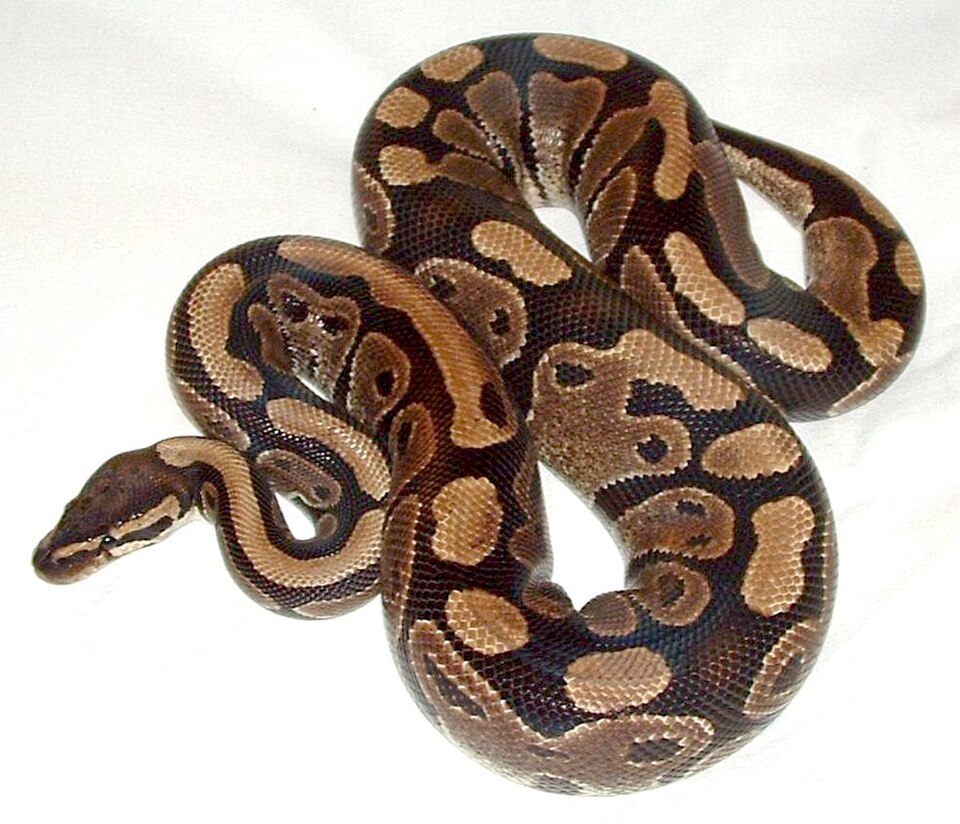
Snakes · Difficulty: Beginner to intermediate
Key facts and care guidance for Ball python (Python regius) (origin: West and Central Africa). Adult size around 100–150 cm. Life expectancy 20–30 years. The values below are carefully researched guidance.
Short answers
Ball python: How big does the enclosure need to be?
From 150×80×115 cm (minimum size per the 1997 expert report, up to 2.5 m).
Ball python: What temperature does it need?
Daytime 28–31 °C, basking spot 32–35 °C (local warm spot), at night 24–26 °C.
Ball python: Does it need UVB lighting?
UVB: Optional.
Ball python: How long do they live?
Life expectancy: 20–30 years.
Ball python: Is it suitable for beginners?
Partly – manageable with some prior knowledge (difficulty: Beginner to intermediate).
Climate
- Daytime temperature
- 28–31 °C
- Night temperature
- 24–26 °C
- Basking spot
- 32–35 °C (local warm spot)
- Humidity
- 60–80 % (higher at night, up to 90 % for shedding)
- UVB
- Optional
Enclosure
- Minimum size
- from 150×80×115 cm (minimum size per the 1997 expert report, up to 2.5 m)
- Substrate
- Bark mulch or terrarium soil, at least 10 cm deep for burrowing. Plus several tight-fitting hides — a ball python wants to feel contact on all sides, and a wide, empty enclosure stresses it. A water dish large enough for the whole animal to fit in: it bathes mainly before shedding. Climbing branches aren't essential but are used; the expert report explicitly notes this species as more inclined to climb than other pythons.
Feeding
- Food
- Mice or small rats (frozen-thawed)
- Feeding interval
- adults every 14–21 days, subadults every 10–14 days, juveniles up to 6 months every 5–7 days
Key facts
- Adult size
- 100–150 cm
- Life expectancy
- 20–30 years
- Origin
- West and Central Africa
- Protection status
- Annex B — observe the EU certificate and proof of origin
- Brumation
- None (a slight cool-down for breeding)
- Cohabitation
- Keep them singly. Snakes are solitary and do not seek company — a shared hide is competition for the best spot, not social behaviour. The concrete reason is the feeding accident: if two animals grab the same food item, one can swallow the other along with it. On top of that, once they are kept together you can no longer tell which animal has eaten and which is losing weight. For breeding, put them together under supervision and separate them again afterwards.
Notes
A calm beginner's snake, though it takes normal fasting breaks lasting weeks to months. Provide plenty of tight hides, and make sure the enclosure is escape-proof. EU Annex B: check for proof of origin when buying.
Do you keep this species?
Add your animal to Reptoria – Reptoria reminds you about feeding and shedding. Add your animal for free →
Ball python (Python regius) currently offered
- Albino Het Pied – Untermünkheim · 150 €
- Königspython 0.1 – Bongo poss het clown · Neustadt an der Weinstraße · 150 €
- Königspython Phantom Pinstripe 1.0 – Phantom Pinstripe · Oldenburg · 260 €
- 0.1 Pastel Yellowbelly Leopard Trick Piebald het. Clown – Pastel Yellowbelly Leopard Trick Piebald het. Clown · Dortmund · 350 €
- Nachzuchten 2026 – Cinnamon Fire, Cinnamon · Bad Salzschlirf · 50 €
- 1.0 Stranger 66% dh Monsoon Clown – Stranger 66% dh Monsoon Clown · Bad Salzschlirf · 200 €
Related species
- Angolan python (Python anchietae) – Intermediate
- Red blood python (Python brongersmai) – Intermediate
- Sumatran short-tailed python (Python curtus) – Intermediate
- Borneo short-tailed python (Python breitensteini) – Intermediate
- Burmese python (Python bivittatus) – Expert
- Indian python (Python molurus) – Expert
- African rock python (Python sebae) – Expert
- Southern African rock python (Python natalensis) – Expert
What you need to start
To keep Ball python (Python regius) you typically need: a suitable enclosure (from 150×80×115 cm (minimum size per the 1997 expert report, up to 2.5 m)), substrate (Bark mulch or terrarium soil, at least 10 cm deep for burrowing. Plus several tight-fitting hides — a ball python wants to feel contact on all sides, and a wide, empty enclosure stresses it. A water dish large enough for the whole animal to fit in: it bathes mainly before shedding. Climbing branches aren't essential but are used; the expert report explicitly notes this species as more inclined to climb than other pythons.), a heat source with a thermostat, UVB lighting, thermometer and hygrometer, a water dish and hides. You will find equipment in the Reptoria marketplace.
The complete, interactive care database is in the Reptoria app.
Last updated: 4 November 2026 · Editor: Reptoria editorial team · Sources include: drta-archiv.de, einrichtungsbeispiele.de, exotische-tierwelt.de, koenigspython.com, tropic-shop.de
All values are non-binding guidance and do not replace expert advice. Research thoroughly from several sources before acquiring and keeping an animal, and observe the applicable law (species and animal protection in particular).