Marsh frog (Pelophylax ridibundus)
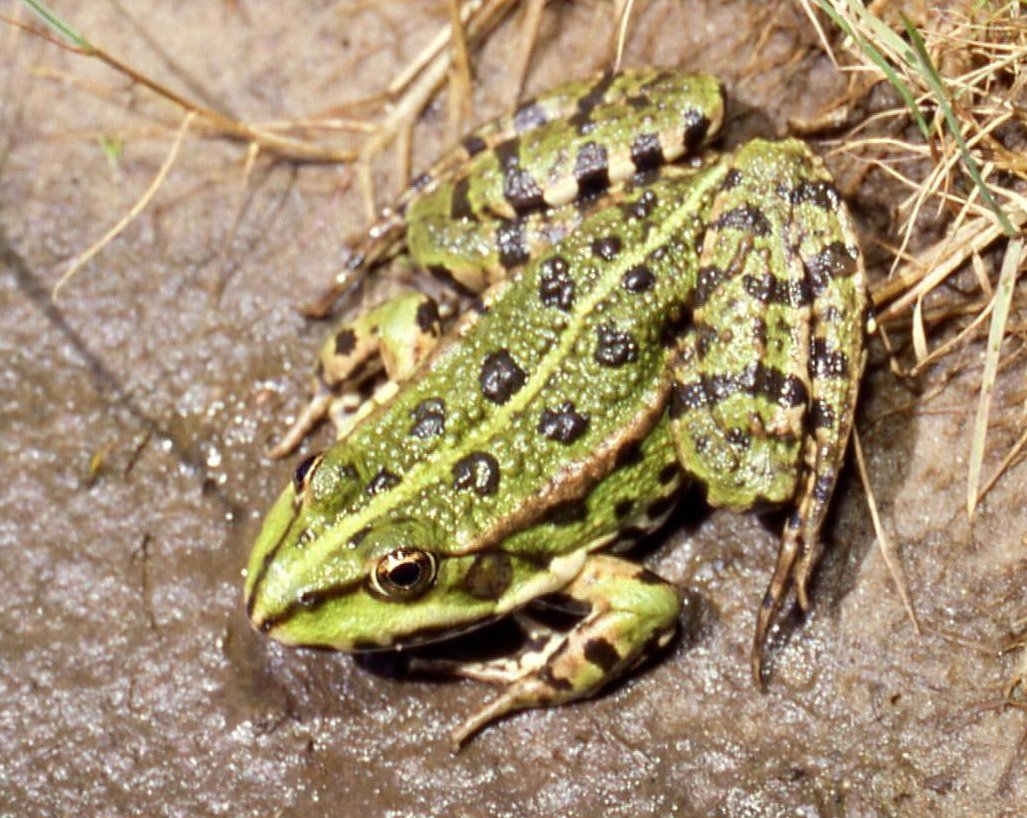
Amphibians · Difficulty: Intermediate
Key facts and care guidance for Marsh frog (Pelophylax ridibundus) (origin: Eastern and south-eastern Europe, the Near East; naturalised in many parts of central Europe). Adult size around 9–17 cm. Life expectancy 10–15 years. The values below are carefully researched guidance.
Short answers
Marsh frog: How big does the enclosure need to be?
A garden pond or a 150×60 cm aqua-terrarium.
Marsh frog: What temperature does it need?
Daytime 15–26 °C, basking spot Basking spot on the bank, at night 8–16 °C.
Marsh frog: Does it need UVB lighting?
UVB: Essential when kept indoors (UVB 5.0).
Marsh frog: How long do they live?
Life expectancy: 10–15 years.
Marsh frog: Is it suitable for beginners?
Rather not – it is considered an intermediate species (difficulty: Intermediate).
Climate
- Daytime temperature
- 15–26 °C
- Night temperature
- 8–16 °C
- Basking spot
- Basking spot on the bank
- Humidity
- Aqua-terrarium / garden pond
- UVB
- Essential when kept indoors (UVB 5.0)
Enclosure
- Minimum size
- a garden pond or a 150×60 cm aqua-terrarium
- Substrate
- A large, deep water section, a shallow bank, reeds
Feeding
- Food
- Insects, earthworms, fish, small frogs
- Feeding interval
- 3×/week
Key facts
- Adult size
- 9–17 cm
- Life expectancy
- 10–15 years
- Origin
- Eastern and south-eastern Europe, the Near East; naturalised in many parts of central Europe
- Protection status
- Specially protected (BArtSchV); non-native populations are considered problematic - never release. From 5 June 2027 it will be listed in EU Annex B (CITES II): a proof-of-origin requirement will then apply. Anyone planning captive breeding now should already be able to document the origin of their animals today.
- Brumation
- A winter rest of 12–16 weeks
- Cohabitation
- Keeping singly is safest, because marsh frogs eat smaller conspecifics. Groups only of animals of equal size, in a large body of water with many hides so each animal can get out of the way.
Notes
Europe's largest frog and decidedly predatory – it eats smaller animals of its own kind too. Only put together animals of the same size. It needs plenty of water volume.
Do you keep this species?
Add your animal to Reptoria – Reptoria reminds you about feeding and shedding. Add your animal for free →
Look for Marsh frog (Pelophylax ridibundus) in the marketplace →
Related species
- Edible frog (Pelophylax kl. esculentus) – Intermediate
- Carvalho's Surinam toad (Pipa carvalhoi) – Intermediate
- African clawed frog (Xenopus laevis) – Beginner
- Western clawed frog (Xenopus tropicalis) – Beginner
- Surinam toad (Pipa pipa) – Expert
- Dwarf Surinam toad (Pipa parva) – Intermediate
- Dwarf clawed frog (Hymenochirus boettgeri) – Beginner
- Italian crested newt (Triturus carnifex) – Intermediate
What you need to start
To keep Marsh frog (Pelophylax ridibundus) you typically need: a suitable enclosure (a garden pond or a 150×60 cm aqua-terrarium), substrate (A large, deep water section, a shallow bank, reeds), a heat source with a thermostat, UVB lighting, thermometer and hygrometer, a water dish and hides. You will find equipment in the Reptoria marketplace.
The complete, interactive care database is in the Reptoria app.
Last updated: 8 November 2026 · Editor: Reptoria editorial team · Sources include: https://animaldiversity.org/accounts/Pelophylax_ridibundus/, https://de.wikipedia.org/wiki/Seefrosch, https://en.wikipedia.org/wiki/Pelophylax_ridibundus, https://www.infofauna.ch/sites/default/files/files/publications/wasserfroesche.pdf
All values are non-binding guidance and do not replace expert advice. Research thoroughly from several sources before acquiring and keeping an animal, and observe the applicable law (species and animal protection in particular).