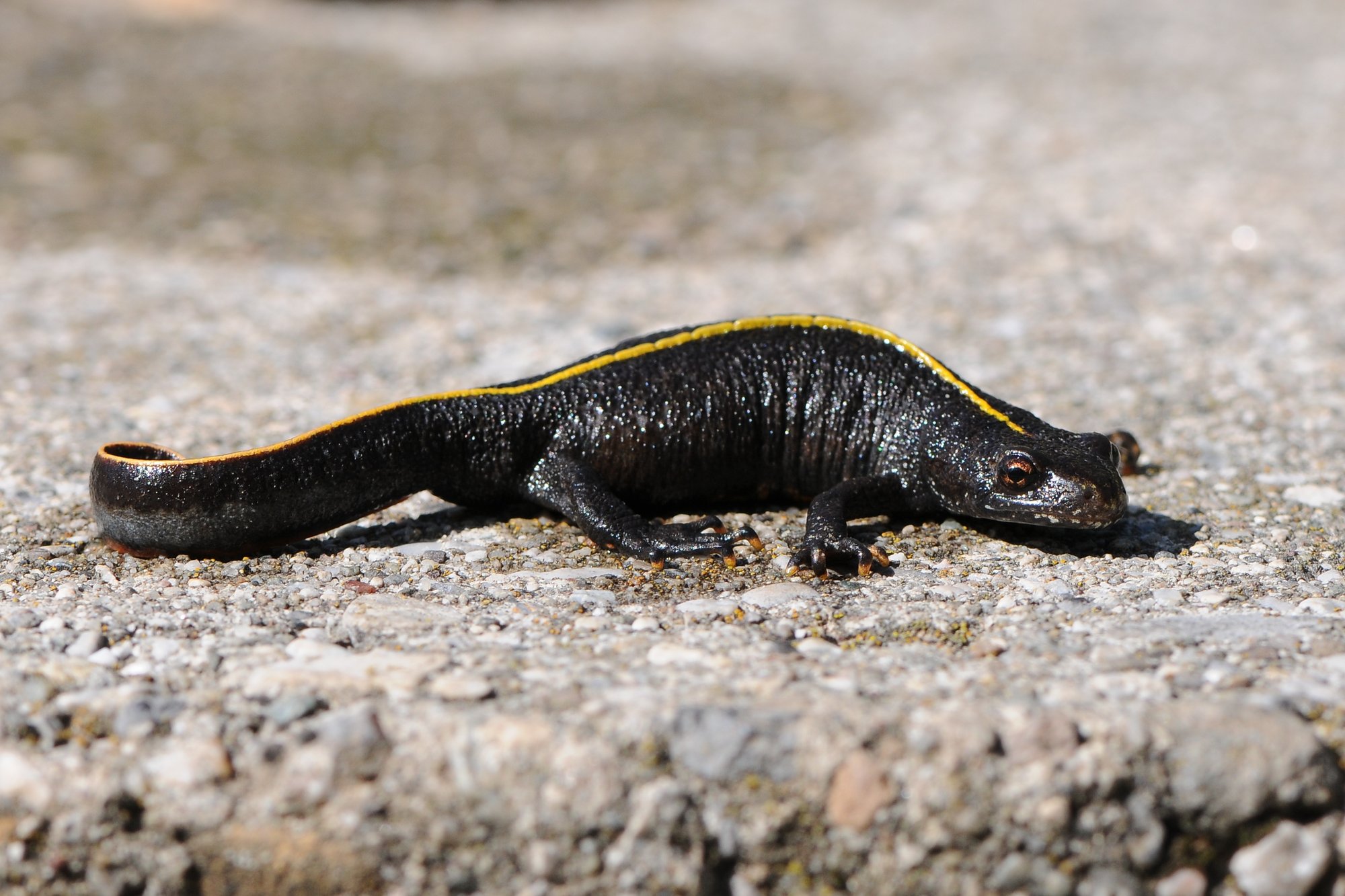
Italian crested newt (Triturus carnifex)
Amphibians · Difficulty: Intermediate
Key facts and care guidance for Italian crested newt (Triturus carnifex) (origin: The southern Alps, Italy, the Balkans). Adult size around 12–18 cm total length (females exceptionally over 20 cm). Life expectancy 12–20 years. The values below are carefully researched guidance.
Short answers
Italian crested newt: How big does the enclosure need to be?
100×40×40 cm with about two-thirds water area — enough for 2 to 4 animals; each additional animal adds around a quarter more floor space.
Italian crested newt: What temperature does it need?
Daytime 14–22 °C, never permanently above 24 °C, basking spot No basking spot, at night 8–15 °C.
Italian crested newt: Does it need UVB lighting?
UVB: Not required.
Italian crested newt: How long do they live?
Life expectancy: 12–20 years.
Italian crested newt: Is it suitable for beginners?
Rather not – it is considered an intermediate species (difficulty: Intermediate).
Climate
- Daytime temperature
- 14–22 °C, never permanently above 24 °C
- Night temperature
- 8–15 °C
- Basking spot
- No basking spot
- Humidity
- Aqua-terrarium
- UVB
- Not required
Enclosure
- Minimum size
- 100×40×40 cm with about two-thirds water area — enough for 2 to 4 animals; each additional animal adds around a quarter more floor space
- Substrate
- A water section 25–35 cm deep and densely planted, a land section with moss
Feeding
- Food
- Earthworms, freshwater shrimp, frozen food
- Feeding interval
- 2–3×/week
Key facts
- Adult size
- 12–18 cm total length (females exceptionally over 20 cm)
- Life expectancy
- 12–20 years
- Origin
- The southern Alps, Italy, the Balkans
- Protection status
- Protected (Habitats Directive Annex IV) – proof of captive breeding required
- Brumation
- Winter dormancy 12–16 weeks at 4–8 °C, in water or on land in damp moss; no feeding during this period
- Cohabitation
- Group. Only keep animals of the same species and roughly the same size together — smaller ones will otherwise be treated as food. Different crested newt species must never be kept together: they will hybridise, and such hybrids are unsuitable for both breeding and rehoming. Provide plenty of hiding places and dense planting so that every animal can retreat, and feed separately if there is a size difference.
Notes
A large crested newt with a tall dorsal crest in its aquatic dress. It spends the mating season entirely in the water – the water section has to be correspondingly large and well planted.
Do you keep this species?
Add your animal to Reptoria – Reptoria reminds you about feeding and shedding. Add your animal for free →
Look for Italian crested newt (Triturus carnifex) in the marketplace →
Related species
- Marbled newt (Triturus marmoratus) – Intermediate
- Great crested newt (Triturus cristatus) – Intermediate
- Alpine salamander (Salamandra atra) – Expert
- Anderson's crocodile newt (Echinotriton andersoni) – Expert
- Anderson's salamander (Ambystoma andersoni) – Intermediate
- Axolotl (Ambystoma mexicanum) – Beginner to intermediate
- Alpine newt (Ichthyosaura alpestris) – Beginner
- Blue-tailed fire-bellied newt (Cynops cyanurus) – Beginner
What you need to start
To keep Italian crested newt (Triturus carnifex) you typically need: a suitable enclosure (100×40×40 cm with about two-thirds water area — enough for 2 to 4 animals; each additional animal adds around a quarter more floor space), substrate (A water section 25–35 cm deep and densely planted, a land section with moss), a heat source with a thermostat, thermometer and hygrometer, a water dish and hides. You will find equipment in the Reptoria marketplace.
The complete, interactive care database is in the Reptoria app.
Last updated: 9 October 2026 · Editor: Reptoria editorial team · Sources include: Wikipedia DE, Wikipedia EN (Batrachochytrium salamandrivorans), ag-urodela.de (DGHT AG Urodela, Haltungsrichtlinien), bfn.de (amtlich, BfN-Artenportrait), eu_annex.txt (lokal, VO (EU) 2026/1383)
All values are non-binding guidance and do not replace expert advice. Research thoroughly from several sources before acquiring and keeping an animal, and observe the applicable law (species and animal protection in particular).