Anderson's salamander (Ambystoma andersoni)
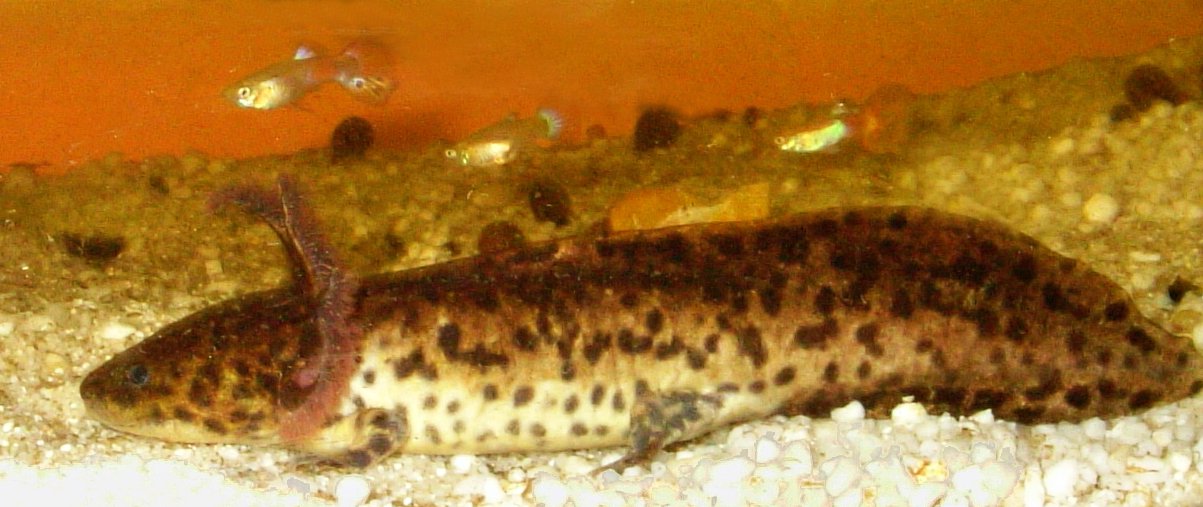
Amphibians · Difficulty: Intermediate
Key facts and care guidance for Anderson's salamander (Ambystoma andersoni) (origin: Mexico, Michoacán — exclusively Lake Zacapu and its inflows and outflows, at 2000 m altitude; total range only 0.35 km²). Adult size around 20–28 cm total length (snout–vent length 10–14 cm), up to 300 g. Life expectancy 10–15 years. The values below are carefully researched guidance.
Short answers
Anderson's salamander: How big does the enclosure need to be?
Cold-water aquarium from 200 litres, about 100–120×40×50 cm, for 2–5 animals; fill only to 10 cm below the rim and cover it, as these animals jump.
Anderson's salamander: What temperature does it need?
Daytime 16–20 °C water temperature; permanently above 22 °C becomes dangerous, not even briefly above 24 °C, basking spot No basking spot, at night 12–17 °C.
Anderson's salamander: Does it need UVB lighting?
UVB: Not required.
Anderson's salamander: How long do they live?
Life expectancy: 10–15 years.
Anderson's salamander: Is it suitable for beginners?
Rather not – it is considered an intermediate species (difficulty: Intermediate).
Climate
- Daytime temperature
- 16–20 °C water temperature; permanently above 22 °C becomes dangerous, not even briefly above 24 °C
- Night temperature
- 12–17 °C
- Basking spot
- No basking spot
- Humidity
- Fully aquatic
- UVB
- Not required
Enclosure
- Minimum size
- cold-water aquarium from 200 litres, about 100–120×40×50 cm, for 2–5 animals; fill only to 10 cm below the rim and cover it, as these animals jump
- Substrate
- Sand, roots, robust plants, water 25–35 cm deep, strong filtration
Feeding
- Food
- Earthworms, frozen food, axolotl pellets
- Feeding interval
- 2–3×/week
Key facts
- Adult size
- 20–28 cm total length (snout–vent length 10–14 cm), up to 300 g
- Life expectancy
- 10–15 years
- Origin
- Mexico, Michoacán — exclusively Lake Zacapu and its inflows and outflows, at 2000 m altitude; total range only 0.35 km²
- Protection status
- CITES II; IUCN "Critically Endangered" – only documented captive-bred animals
- Brumation
- None
- Cohabitation
- A group of similarly sized animals. Only put together animals of the same species and roughly the same size — smaller ones will otherwise be treated as food. Enough hides so that every animal can get out of the way.
Notes
A neotenic relative of the axolotl with a brownish-red tone. Requirements as for the axolotl: cool, clean, and no gravel chunks (a swallowing risk). Practically extinct in the wild.
Do you keep this species?
Add your animal to Reptoria – Reptoria reminds you about feeding and shedding. Add your animal for free →
Look for Anderson's salamander (Ambystoma andersoni) in the marketplace →
Related species
- Axolotl (Ambystoma mexicanum) – Beginner to intermediate
- Spotted salamander (Ambystoma maculatum) – Intermediate
- Marbled salamander (Ambystoma opacum) – Intermediate
- Tiger salamander (Ambystoma tigrinum) – Beginner
- Italian crested newt (Triturus carnifex) – Intermediate
- Alpine salamander (Salamandra atra) – Expert
- Anderson's crocodile newt (Echinotriton andersoni) – Expert
- Alpine newt (Ichthyosaura alpestris) – Beginner
What you need to start
To keep Anderson's salamander (Ambystoma andersoni) you typically need: a suitable enclosure (cold-water aquarium from 200 litres, about 100–120×40×50 cm, for 2–5 animals; fill only to 10 cm below the rim and cover it, as these animals jump), substrate (Sand, roots, robust plants, water 25–35 cm deep, strong filtration), a heat source with a thermostat, thermometer and hygrometer, a water dish and hides. You will find equipment in the Reptoria marketplace.
The complete, interactive care database is in the Reptoria app.
Last updated: 2 November 2026 · Editor: Reptoria editorial team · Sources include: citizen-conservation.org (Haltungsempfehlung 10/2022), Wikipedia DE, EUR-Lex VO (EU) 2026/1383, Wikipedia EN, caudata.org
All values are non-binding guidance and do not replace expert advice. Research thoroughly from several sources before acquiring and keeping an animal, and observe the applicable law (species and animal protection in particular).