Alpine salamander (Salamandra atra)
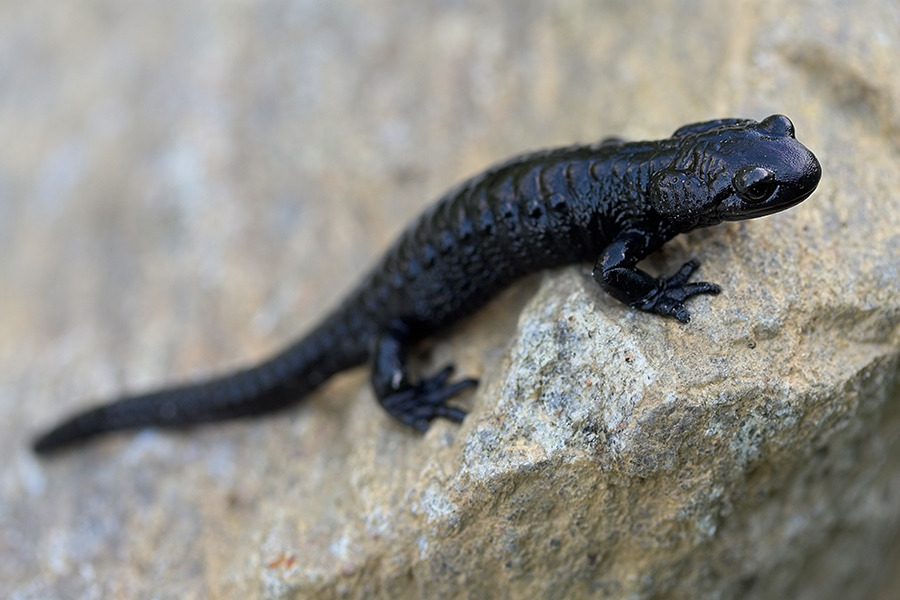
Amphibians · Difficulty: Expert
Key facts and care guidance for Alpine salamander (Salamandra atra) (origin: Alps and Dinaric Alps — montane forests, alpine pastures and scree slopes, mostly 800–2000 m, occasionally up to 2430 m and down to 420 m; prefers limestone). Adult size around 9–15 cm. Life expectancy 10–20 years. The values below are carefully researched guidance.
Short answers
Alpine salamander: How big does the enclosure need to be?
60×40×30 cm for 1 to 3 animals; each additional animal adds around a quarter more floor space, height is secondary.
Alpine salamander: What temperature does it need?
Daytime 8–16 °C, briefly up to 18 °C, never permanently above 20 °C, basking spot No basking spot, at night 5–10 °C.
Alpine salamander: Does it need UVB lighting?
UVB: Not required.
Alpine salamander: How long do they live?
Life expectancy: 10–20 years.
Alpine salamander: Is it suitable for beginners?
No – better suited to experienced keepers (difficulty: Expert).
Climate
- Daytime temperature
- 8–16 °C, briefly up to 18 °C, never permanently above 20 °C
- Night temperature
- 5–10 °C
- Basking spot
- No basking spot
- Humidity
- 85–95 %
- UVB
- Not required
Enclosure
- Minimum size
- 60×40×30 cm for 1 to 3 animals; each additional animal adds around a quarter more floor space, height is secondary
- Substrate
- Damp forest floor, moss, stone slabs; no water section needed
Feeding
- Food
- Earthworms, small slugs, woodlice, springtails, spiders, soft insects and insect larvae
- Feeding interval
- 2×/week
Key facts
- Adult size
- 9–15 cm
- Life expectancy
- 10–20 years
- Origin
- Alps and Dinaric Alps — montane forests, alpine pastures and scree slopes, mostly 800–2000 m, occasionally up to 2430 m and down to 420 m; prefers limestone
- Protection status
- STRICTLY protected (Habitats Directive Annex IV, German Federal Species Protection Ordinance) – registration required; keeping it only with proof of captive breeding
- Brumation
- Winter dormancy 16–24 weeks at 2–6 °C, frost-free, in moss, leaf litter, deadwood and rock crevices; no feeding during this period
- Cohabitation
- Solitary or in twos to threes, only animals of the same species and roughly the same size. There is no territorial behaviour; the animals simply avoid one another — so each animal needs its own hiding place and its own cool retreat area. Group housing is not a need for this species but a decision made by the keeper; kept singly, an Alpine Salamander lacks nothing. Young are born at four to five centimetres and are raised separately from the adults.
Notes
Live-bearing: after a gestation of 2–3 years it gives birth to fully developed young – no water section is needed. It needs permanently low temperatures; ordinary living rooms are unsuitable.
Do you keep this species?
Add your animal to Reptoria – Reptoria reminds you about feeding and shedding. Add your animal for free →
Look for Alpine salamander (Salamandra atra) in the marketplace →
Related species
- Fire salamander (Salamandra salamandra) – Beginner to intermediate
- North African fire salamander (Salamandra algira) – Intermediate
- Italian crested newt (Triturus carnifex) – Intermediate
- Anderson's crocodile newt (Echinotriton andersoni) – Expert
- Anderson's salamander (Ambystoma andersoni) – Intermediate
- Axolotl (Ambystoma mexicanum) – Beginner to intermediate
- Alpine newt (Ichthyosaura alpestris) – Beginner
- Blue-tailed fire-bellied newt (Cynops cyanurus) – Beginner
What you need to start
To keep Alpine salamander (Salamandra atra) you typically need: a suitable enclosure (60×40×30 cm for 1 to 3 animals; each additional animal adds around a quarter more floor space, height is secondary), substrate (Damp forest floor, moss, stone slabs; no water section needed), a heat source with a thermostat, thermometer and hygrometer, a water dish and hides. You will find equipment in the Reptoria marketplace.
The complete, interactive care database is in the Reptoria app.
Last updated: 9 October 2026 · Editor: Reptoria editorial team · Sources include: froschnetz.ch, Wikipedia DE, lfu.bayern.de (amtlich), waldwissen.net, feldherpetologie.de
All values are non-binding guidance and do not replace expert advice. Research thoroughly from several sources before acquiring and keeping an animal, and observe the applicable law (species and animal protection in particular).