Anderson's crocodile newt (Echinotriton andersoni)
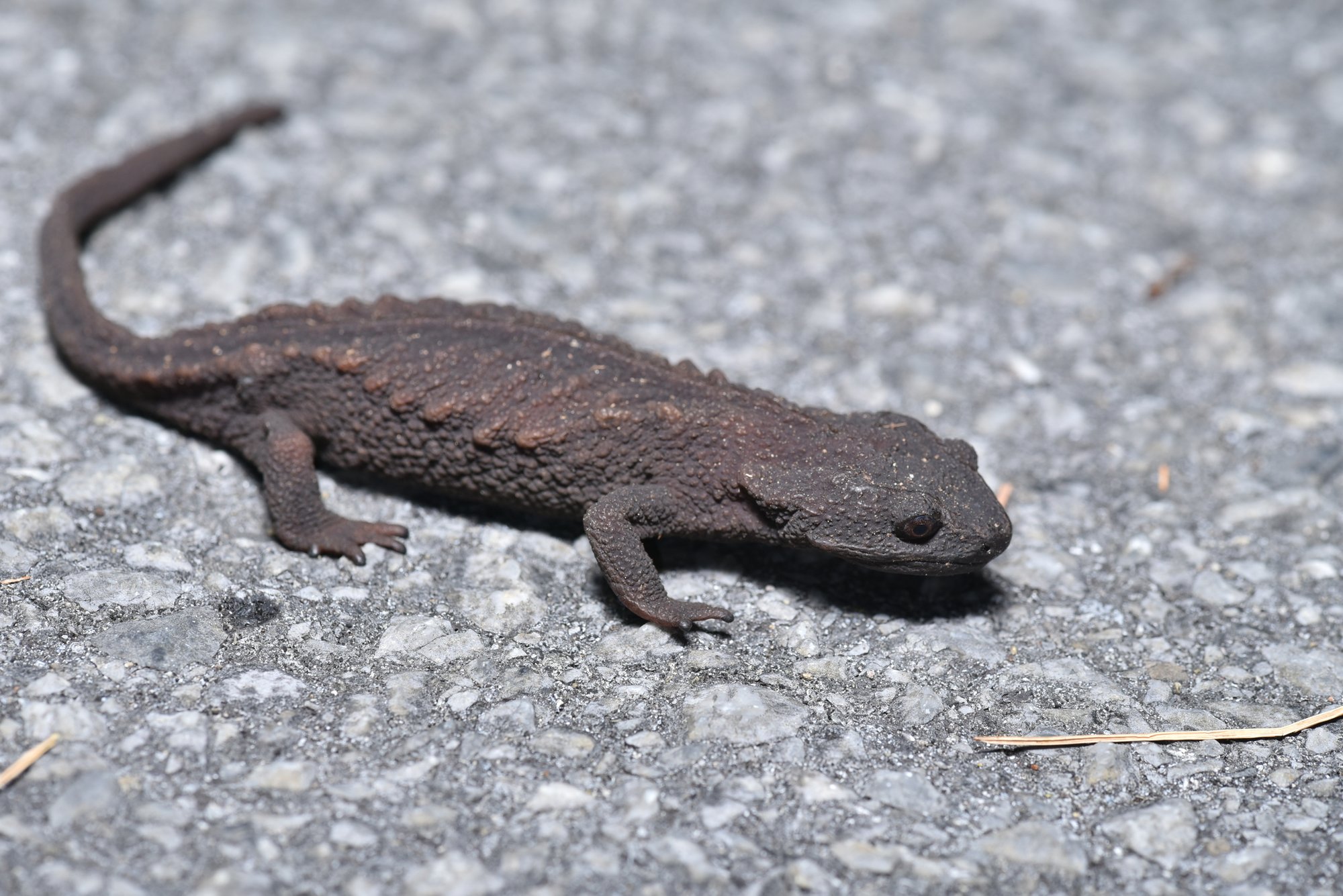
Amphibians · Difficulty: Expert
Key facts and care guidance for Anderson's crocodile newt (Echinotriton andersoni) (origin: Central Ryukyu Islands, Japan: Okinawa, Sesoko, Tokashiki, Amami-Oshima and Tokunoshima; extinct on Taiwan. Lowland and hill country from 3 to about 375 m). Adult size around 12–18 cm. Life expectancy 15–20 years. The values below are carefully researched guidance.
Short answers
Anderson's crocodile newt: How big does the enclosure need to be?
60×40×30 cm.
Anderson's crocodile newt: What temperature does it need?
Daytime 18–24 °C (briefly up to 25 °C, permanently above that dangerous), basking spot No basking spot, at night 11–17 °C.
Anderson's crocodile newt: Does it need UVB lighting?
UVB: Not required.
Anderson's crocodile newt: How long do they live?
Life expectancy: 15–20 years.
Anderson's crocodile newt: Is it suitable for beginners?
No – better suited to experienced keepers (difficulty: Expert).
Climate
- Daytime temperature
- 18–24 °C (briefly up to 25 °C, permanently above that dangerous)
- Night temperature
- 11–17 °C
- Basking spot
- No basking spot
- Humidity
- 60–80 %, with a moist leaf litter layer instead of a wet enclosure
- UVB
- Not required
Enclosure
- Minimum size
- 60×40×30 cm
- Substrate
- Moist forest floor substrate with a thick layer of leaf litter (leaf litter to soil roughly 70:30), moss, cork bark and stones as hides, plus a shallow water area with a gently sloping, soft-edged bank
Feeding
- Food
- Earthworms (main food), woodlice, small slugs, wax moth larvae, small crickets individually with tongs
- Feeding interval
- 2×/week
Key facts
- Adult size
- 12–18 cm
- Life expectancy
- 15–20 years
- Origin
- Central Ryukyu Islands, Japan: Okinawa, Sesoko, Tokashiki, Amami-Oshima and Tokunoshima; extinct on Taiwan. Lowland and hill country from 3 to about 375 m
- Protection status
- Not listed under CITES; strictly protected in Japan and export is prohibited – only European captive-bred animals
- Brumation
- A cooler, damp period of 10–14 weeks in winter; only cool down moderately, as this species comes from subtropical lowlands rather than the mountains. The mating season afterwards runs from February to July, peaking March to May.
- Cohabitation
- Singly or as a pair. Both work: keeping them singly is always safe, and a pair works as long as both animals are roughly the same size and are fed separately. As soon as one animal refuses food, loses condition or shows injuries, separate them — that is not an exception but the normal case you plan for.
Notes
Strictly terrestrial despite being a "newt": it drowns in deep water. It can push its rib tips through the skin in defence – so handle it carefully. Very rare in captivity.
Do you keep this species?
Add your animal to Reptoria – Reptoria reminds you about feeding and shedding. Add your animal for free →
Look for Anderson's crocodile newt (Echinotriton andersoni) in the marketplace →
Related species
- Italian crested newt (Triturus carnifex) – Intermediate
- Alpine salamander (Salamandra atra) – Expert
- Anderson's salamander (Ambystoma andersoni) – Intermediate
- Axolotl (Ambystoma mexicanum) – Beginner to intermediate
- Alpine newt (Ichthyosaura alpestris) – Beginner
- Blue-tailed fire-bellied newt (Cynops cyanurus) – Beginner
- Chinese fire-bellied newt (Cynops orientalis) – Beginner
- Chinese fire-bellied newt (Cynops orphicus) – Intermediate
What you need to start
To keep Anderson's crocodile newt (Echinotriton andersoni) you typically need: a suitable enclosure (60×40×30 cm), substrate (Moist forest floor substrate with a thick layer of leaf litter (leaf litter to soil roughly 70:30), moss, cork bark and stones as hides, plus a shallow water area with a gently sloping, soft-edged bank), a heat source with a thermostat, thermometer and hygrometer, a water dish and hides. You will find equipment in the Reptoria marketplace.
The complete, interactive care database is in the Reptoria app.
Last updated: 9 October 2026 · Editor: Reptoria editorial team · Sources include: caudata.org, pmc.ncbi.nlm.nih.gov (Zuchtstudie, Animals 2013), aqualog.de, Wikipedia EN, EUR-Lex VO (EU) 2026/1383
All values are non-binding guidance and do not replace expert advice. Research thoroughly from several sources before acquiring and keeping an animal, and observe the applicable law (species and animal protection in particular).