Great crested newt (Triturus cristatus)
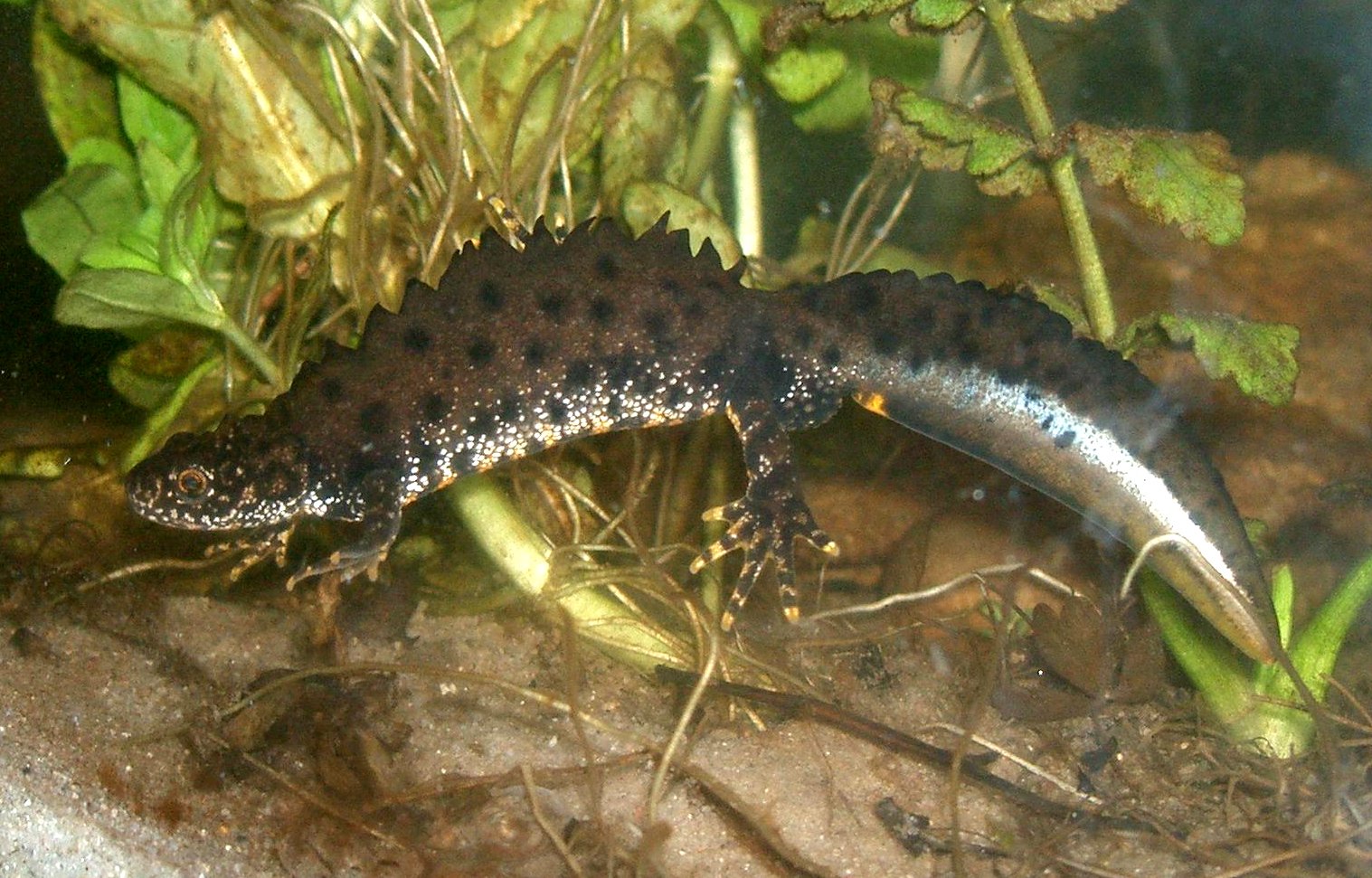
Amphibians · Difficulty: Intermediate
Key facts and care guidance for Great crested newt (Triturus cristatus) (origin: Central and eastern Europe (including Germany), deciduous forest with breeding ponds). Adult size around 14–18 cm (females larger). Life expectancy up to ~15 years. The values below are carefully researched guidance.
Short answers
Great crested newt: How big does the enclosure need to be?
80×40×40 cm aqua-terrarium (~2/3 water, at least 25 cm deep).
Great crested newt: What temperature does it need?
Daytime 15–20 °C (cooler preferred), at night 10–15 °C.
Great crested newt: Does it need UVB lighting?
UVB: Optional.
Great crested newt: How long do they live?
Life expectancy: up to ~15 years.
Great crested newt: Is it suitable for beginners?
Rather not – it is considered an intermediate species (difficulty: Intermediate).
Climate
- Daytime temperature
- 15–20 °C (cooler preferred)
- Night temperature
- 10–15 °C
- Basking spot
- —
- Humidity
- 80–100 % (land section)
- UVB
- Optional
Enclosure
- Minimum size
- 80×40×40 cm aqua-terrarium (~2/3 water, at least 25 cm deep)
- Substrate
- A densely planted water section, a land section of moss and bark hides, exit aids
Feeding
- Food
- Daphnia, mosquito larvae, worms, small slugs, insects
- Feeding interval
- 2–3×/week
Key facts
- Adult size
- 14–18 cm (females larger)
- Life expectancy
- up to ~15 years
- Origin
- Central and eastern Europe (including Germany), deciduous forest with breeding ponds
- Protection status
- Strictly protected (Habitats Directive Annexes II and IV, German Federal Species Protection Ordinance) — taking from the wild is prohibited, registration required, only documented captive breeding
- Brumation
- A winter rest of 3–5 months at 4–6 °C (compulsory for reproduction)
- Cohabitation
- A group of equally sized animals with a surplus of females is the least stressful option: on land the animals share hides. During courtship males harass the females, so keep more females than males. Never house animals of different sizes together – in the water, crested newts also eat smaller amphibians and larvae.
Notes
A strictly protected native species — keep it only with legal proof of origin. Cool conditions are essential; provide safe exit aids in the water section.
Do you keep this species?
Add your animal to Reptoria – Reptoria reminds you about feeding and shedding. Add your animal for free →
Look for Great crested newt (Triturus cristatus) in the marketplace →
Related species
- Italian crested newt (Triturus carnifex) – Intermediate
- Marbled newt (Triturus marmoratus) – Intermediate
- Alpine salamander (Salamandra atra) – Expert
- Anderson's crocodile newt (Echinotriton andersoni) – Expert
- Anderson's salamander (Ambystoma andersoni) – Intermediate
- Axolotl (Ambystoma mexicanum) – Beginner to intermediate
- Alpine newt (Ichthyosaura alpestris) – Beginner
- Blue-tailed fire-bellied newt (Cynops cyanurus) – Beginner
What you need to start
To keep Great crested newt (Triturus cristatus) you typically need: a suitable enclosure (80×40×40 cm aqua-terrarium (~2/3 water, at least 25 cm deep)), substrate (A densely planted water section, a land section of moss and bark hides, exit aids), a heat source with a thermostat, UVB lighting, thermometer and hygrometer, a water dish and hides. You will find equipment in the Reptoria marketplace.
The complete, interactive care database is in the Reptoria app.
Last updated: 9 October 2026 · Editor: Reptoria editorial team · Sources include: http://www.caudata.org/cc/species/Triturus/T_marmoratus.shtml, https://de.wikipedia.org/wiki/Nördlicher_Kammmolch, https://en.wikipedia.org/wiki/Northern_crested_newt
All values are non-binding guidance and do not replace expert advice. Research thoroughly from several sources before acquiring and keeping an animal, and observe the applicable law (species and animal protection in particular).