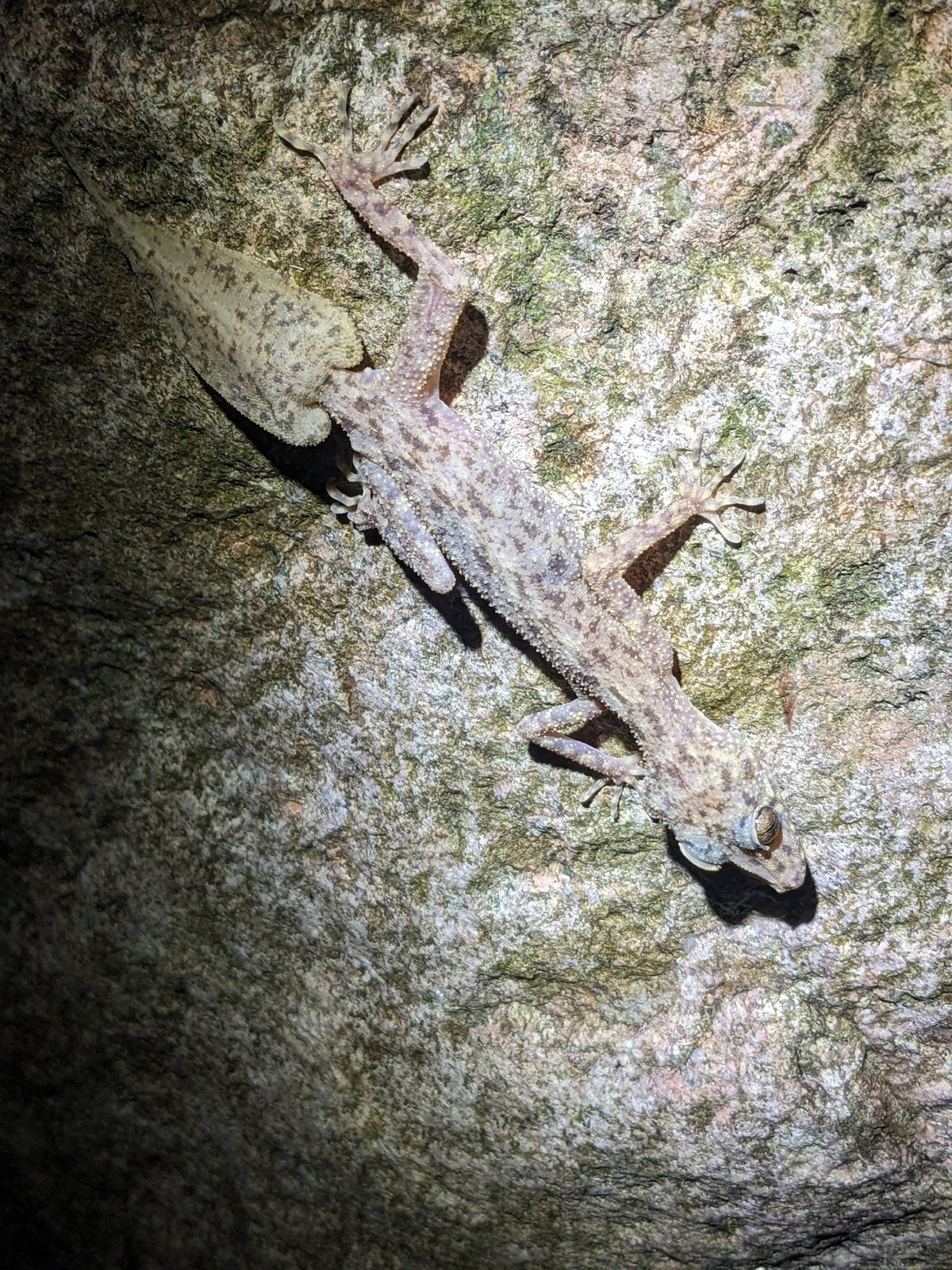
Mount Elliot leaf-tailed gecko (Phyllurus amnicola)
Geckos · Difficulty: Intermediate
Key facts and care guidance for Mount Elliot leaf-tailed gecko (Phyllurus amnicola) (origin: Australia, north-eastern Queensland: only Mount Elliot and Saddle Mountain (Bowling Green Bay National Park near Townsville), 400–1000 m, rocky rainforest along streams). Adult size around 15–20 cm (snout–vent length up to 11 cm). The values below are carefully researched guidance.
Short answers
Mount Elliot leaf-tailed gecko: How big does the enclosure need to be?
From 65×65×90 cm for a pair or trio (1997 expert report, climbing geckos: 6×6×8 × snout–vent length up to 11 cm); tall rather than wide, with vertical climbing surfaces.
Mount Elliot leaf-tailed gecko: What temperature does it need?
Daytime 22–27 °C, basking spot 28 °C, only for gravid females during the breeding season, at night 18–22 °C.
Mount Elliot leaf-tailed gecko: Does it need UVB lighting?
UVB: Not essential.
Mount Elliot leaf-tailed gecko: Is it suitable for beginners?
Rather not – it is considered an intermediate species (difficulty: Intermediate).
Mount Elliot leaf-tailed gecko: Can several be kept together?
In pairs or as a trio (one male, two females) – that is how the species is kept and traded.
Climate
Daytime temperature
22–27 °C
Night temperature
18–22 °C
Basking spot
28 °C, only for gravid females during the breeding season
Humidity
Mist once a day, then let it dry out; ventilate well
UVB
Not essential
Enclosure
Minimum size
from 65×65×90 cm for a pair or trio (1997 expert report, climbing geckos: 6×6×8 × snout–vent length up to 11 cm); tall rather than wide, with vertical climbing surfaces
Substrate
Soil as substrate, upright cork flats and stone slabs as climbing surfaces and hides
Feeding
Food
Live insects (crickets, small roaches), dusted with calcium
Feeding interval
adults 2–3 times a week, juveniles every other day
Key facts
Adult size
15–20 cm (snout–vent length up to 11 cm)
Origin
Australia, north-eastern Queensland: only Mount Elliot and Saddle Mountain (Bowling Green Bay National Park near Townsville), 400–1000 m, rocky rainforest along streams
Protection status
CITES Appendix II / EU Annex B (since 2026); registration requirement and proof of origin. Only buy captive-bred animals with papers.
Brumation
Yes, 2–3 months cooler (in the wild June to August: around 20 °C by day, around 10 °C at night)
Cohabitation
In pairs or as a trio (one male, two females) – that is how the species is kept and traded. Never two males together; each animal needs its own hides.
Notes
Largest Australian leaf-tailed gecko, known from a single mountain. Keep cool, mist daily, cooler in winter. CITES II / EU Annex B since 2026: registration required.
Care questions
Questions and answers from keepers of Mount Elliot leaf-tailed gecko (Phyllurus amnicola) in the Reptoria community.
Ei-Ablage
Wo finden wir die Eier dieser Art? Wo legen sie sie ab?
Kurzer Hinweis vom Reptoria-Team: Die Art, die du ausgewählt hattest, wurde wegen eines Fehlers bei uns nicht angezeigt. Das ist behoben – jetzt sieht jeder, dass es um den Mount-Elliot-Blattschwanzgecko geht. (In der App ggf. einmal neu starten.) Danke für deine Geduld!
To keep Mount Elliot leaf-tailed gecko (Phyllurus amnicola) you typically need: a suitable enclosure (from 65×65×90 cm for a pair or trio (1997 expert report, climbing geckos: 6×6×8 × snout–vent length up to 11 cm); tall rather than wide, with vertical climbing surfaces), substrate (Soil as substrate, upright cork flats and stone slabs as climbing surfaces and hides), a heat source with a thermostat, UVB lighting, thermometer and hygrometer, a water dish and hides. You will find equipment in the Reptoria marketplace.
The complete, interactive care database is in the Reptoria app.
Last updated: 5 November 2026 · Editor: Reptoria editorial team · Sources include: Reptile Database: Phyllurus amnicola Couper, Schneider, Hoskin & Covacevich 2000 – Verbreitung, KRL > 110 mm, eierlegend, IUCN NT – https://reptile-database.reptarium.cz/species?genus=Phyllurus&species=amnicola, Sundown Reptiles (Züchter, North Carolina): Riverine Leaf-Tail Gecko – 6–8 in, nachtaktiver Lauerjäger, Farbwechsel, 65–80 °F, Hotspot 82 °F für trächtige Weibchen, Winterkühlung, täglich sprühen, Erde + senkrechte Korkplatten, Grillen/Schaben bestäubt, adult 2–3×/Woche, juvenil jeden 2. Tag, beobachten statt anfassen, 400–450 $ – https://www.sundownreptiles.com/collections/riverine-leaf-tail-gecko-phyllurus-amnicola, Exmoor Zoo: Mount Elliot Leaf-Tailed Gecko – nachtaktiv, tagsüber in Felsspalten, Insekten – https://www.exmoorzoo.co.uk/animal/mount-elliot-leaf-tailed-gecko/, Bureau of Meteorology, Klimatabelle Townsville Aero 032040 (4 m): Jan 31,5/24,4 °C, Jul 25,2/13,9 °C; für den Fundort (400–1000 m) mit 0,65 °C je 100 m hergeleitet: Sommer tags 25–29, nachts 18–22 °C; Juni–August nachts 7–11 °C – https://www.bom.gov.au/climate/averages/tables/cw_032040_All.shtml, DGHT, CITES Comments CoP20 (07/2025), Prop. 20 – Fundorte inkl. Saddle Mountain, Wilderei 2012/13, in der EU als Nachzucht gehandelt, Jungtier bis 200 €, Zuchttrio ca. 1.000 € – https://www.dght.de/wp-content/uploads/2025/07/CITES_Comments-Cop20-DGHT.pdf
All values are non-binding guidance and do not replace expert advice. Research thoroughly from several sources before acquiring and keeping an animal, and observe the applicable law (species and animal protection in particular).