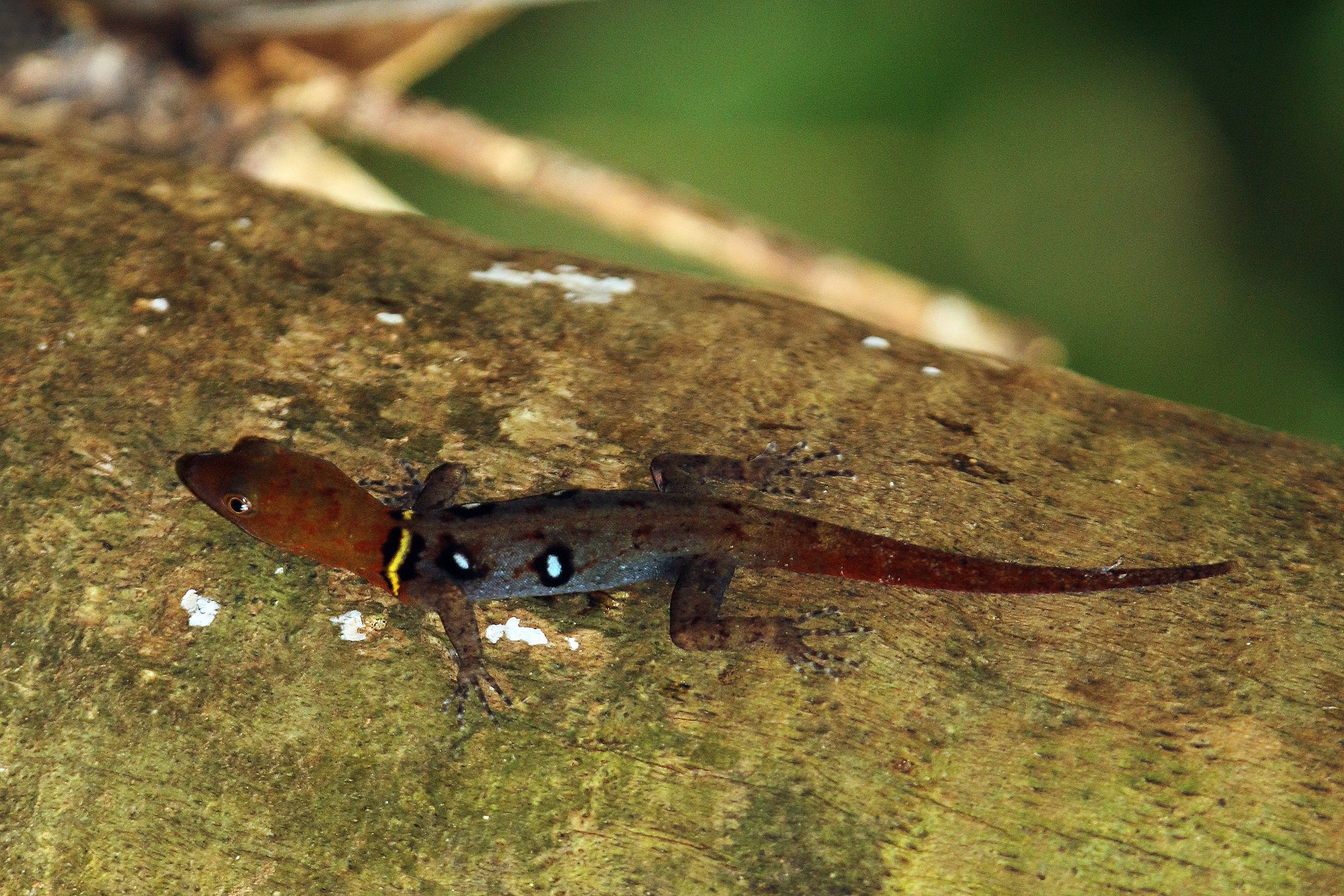
Ocellated gecko (Gonatodes ocellatus)
Geckos · Difficulty: Intermediate
Key facts and care guidance for Ocellated gecko (Gonatodes ocellatus) (origin: Tobago, Little Tobago). Adult size around 8–11 cm total length (males up to 11 cm, females usually under 10 cm). Life expectancy 5–8 years. The values below are carefully researched guidance.
Short answers
Ocellated gecko: How big does the enclosure need to be?
30×30×60 cm for a pair.
Ocellated gecko: What temperature does it need?
Daytime 25–28 °C, basking spot 35–40 °C locally under the lamp, at night 21–24 °C.
Ocellated gecko: Does it need UVB lighting?
UVB: Recommended (UVB 2–5 %).
Ocellated gecko: How long do they live?
Life expectancy: 5–8 years.
Ocellated gecko: Is it suitable for beginners?
Rather not – it is considered an intermediate species (difficulty: Intermediate).
Climate
- Daytime temperature
- 25–28 °C
- Night temperature
- 21–24 °C
- Basking spot
- 35–40 °C locally under the lamp
- Humidity
- 75–90 %
- UVB
- Recommended (UVB 2–5 %)
Enclosure
- Minimum size
- 30×30×60 cm for a pair
- Substrate
- Coco humus, leaf litter, cork bark, dense planting
Feeding
- Food
- Fruit flies, springtails
- Feeding interval
- 3×/week
Key facts
- Adult size
- 8–11 cm total length (males up to 11 cm, females usually under 10 cm)
- Life expectancy
- 5–8 years
- Origin
- Tobago, Little Tobago
- Protection status
- Not listed under CITES; a very small island range
- Brumation
- None
- Cohabitation
- In pairs (1.1), no more animals. Males are incompatible with each other, and females should not be kept together either because of their intraspecific aggression – a harem of several females is explicitly not recommended for this species. Once a year the sexes are separated for one to two months so the female can recover from the laying period. Young that hatch in the enclosure are not pursued by the parents.
Notes
The male has striking eyespots on the shoulders. A small island population – in Europe from only a few breeding lines; document the bloodlines.
Do you keep this species?
Add your animal to Reptoria – Reptoria reminds you about feeding and shedding. Add your animal for free →
Look for Ocellated gecko (Gonatodes ocellatus) in the marketplace →
Related species
- Bridled forest gecko (Gonatodes humeralis) – Beginner
- Yellow-headed gecko (Gonatodes albogularis) – Intermediate
- Ringed gecko (Gonatodes annularis) – Intermediate
- Striped day gecko (Gonatodes vittatus) – Intermediate
- Grenadines clawed gecko (Gonatodes daudini) – Intermediate
- Angolan dwarf gecko (Lygodactylus angularis) – Intermediate
- Ocellated gecko (Sphaerodactylus argus) – Intermediate
- Chobe dwarf gecko (Lygodactylus chobiensis) – Intermediate
What you need to start
To keep Ocellated gecko (Gonatodes ocellatus) you typically need: a suitable enclosure (30×30×60 cm for a pair), substrate (Coco humus, leaf litter, cork bark, dense planting), a heat source with a thermostat, UVB lighting, thermometer and hygrometer, a water dish and hides. You will find equipment in the Reptoria marketplace.
The complete, interactive care database is in the Reptoria app.
Last updated: 2 November 2026 · Editor: Reptoria editorial team · Sources include: Wikipedia EN, dwarfgeckos.com, eu_annex.txt (lokal, VO (EU) 2026/1383), gutachten.txt (lokal, BML 1997), herpetologytt.blogspot.com
All values are non-binding guidance and do not replace expert advice. Research thoroughly from several sources before acquiring and keeping an animal, and observe the applicable law (species and animal protection in particular).