Angolan dwarf gecko (Lygodactylus angularis)
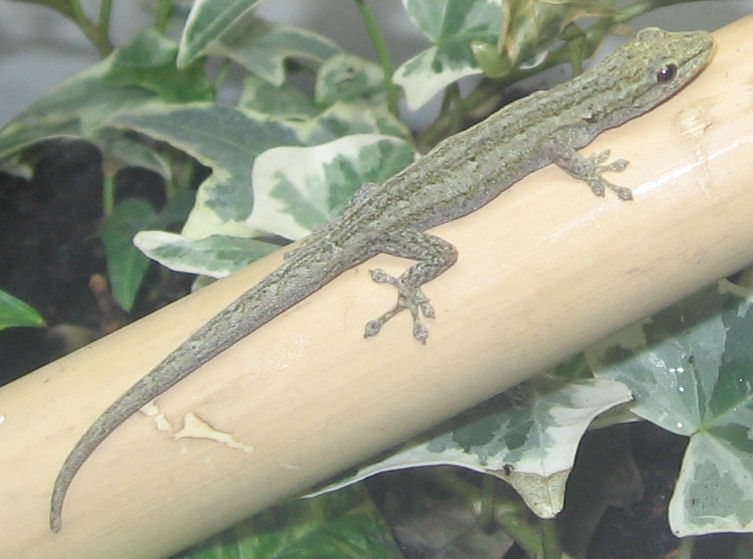
Geckos · Difficulty: Intermediate
Key facts and care guidance for Angolan dwarf gecko (Lygodactylus angularis) (origin: Malawi (type locality Shire Highlands), Zambia, southwest Tanzania, Mozambique, Zimbabwe and southeast DR Congo (Katanga); miombo woodland and open tree savanna. Not found in Angola.). Adult size around 6–8 cm. Life expectancy 5–10 years. The values below are carefully researched guidance.
Short answers
Angolan dwarf gecko: How big does the enclosure need to be?
40×40×60 cm for a pair (height matters more than floor space).
Angolan dwarf gecko: What temperature does it need?
Daytime 25–29 °C, basking spot 35–40 °C only at a small sunny spot in the upper part of the enclosure; the rest of the enclosure stays at 25–29 °C, at night 18–20 °C.
Angolan dwarf gecko: Does it need UVB lighting?
UVB: Essential: this species is diurnal and needs UVB (5.0) as well as bright ambient lighting, around 14 hours in summer and around 10 hours in winter.
Angolan dwarf gecko: How long do they live?
Life expectancy: 5–10 years.
Angolan dwarf gecko: Is it suitable for beginners?
Rather not – it is considered an intermediate species (difficulty: Intermediate).
Climate
- Daytime temperature
- 25–29 °C
- Night temperature
- 18–20 °C
- Basking spot
- 35–40 °C only at a small sunny spot in the upper part of the enclosure; the rest of the enclosure stays at 25–29 °C
- Humidity
- 60–70 % during the day, up to about 90 % at night; mist in the morning
- UVB
- Essential: this species is diurnal and needs UVB (5.0) as well as bright ambient lighting, around 14 hours in summer and around 10 hours in winter.
Enclosure
- Minimum size
- 40×40×60 cm for a pair (height matters more than floor space)
- Substrate
- Forest-floor substrate with live plants, plus thin branches and bamboo
Feeding
- Food
- Small live insects up to about 5 mm: Drosophila, micro-crickets, firebrats, seed beetles, springtails; every other feeding dusted with calcium and vitamins. Plus unsweetened fruit purée or nectar once a week.
- Feeding interval
- adults 3–4×/week
Key facts
- Adult size
- 6–8 cm
- Life expectancy
- 5–10 years
- Origin
- Malawi (type locality Shire Highlands), Zambia, southwest Tanzania, Mozambique, Zimbabwe and southeast DR Congo (Katanga); miombo woodland and open tree savanna. Not found in Angola.
- Protection status
- Not listed under CITES
- Brumation
- No winter rest
- Cohabitation
- In pairs; never keep males together. The reason: several males fight over territory and the warm spot until one is injured or spends its life in a corner. Females usually get on, but each needs its own warm spot and hide; feed them separately once they differ in size.
Notes
A small arboreal species. Rare in the trade.
Do you keep this species?
Add your animal to Reptoria – Reptoria reminds you about feeding and shedding. Add your animal for free →
Look for Angolan dwarf gecko (Lygodactylus angularis) in the marketplace →
Related species
- Chobe dwarf gecko (Lygodactylus chobiensis) – Intermediate
- Conrau's dwarf gecko (Lygodactylus conraui) – Intermediate
- Yellow-headed dwarf gecko (Lygodactylus luteopicturatus) – Beginner
- Electric blue gecko (Lygodactylus williamsi) – Intermediate
- Cape dwarf gecko (Lygodactylus capensis) – Beginner
- Kim Howell's dwarf gecko (Lygodactylus kimhowelli) – Intermediate
- Mombasa dwarf gecko (Lygodactylus mombasicus) – Intermediate
- Yellow-headed dwarf gecko (Lygodactylus picturatus) – Intermediate
What you need to start
To keep Angolan dwarf gecko (Lygodactylus angularis) you typically need: a suitable enclosure (40×40×60 cm for a pair (height matters more than floor space)), substrate (Forest-floor substrate with live plants, plus thin branches and bamboo), a heat source with a thermostat, UVB lighting, thermometer and hygrometer, a water dish and hides. You will find equipment in the Reptoria marketplace.
The complete, interactive care database is in the Reptoria app.
Last updated: 2 November 2026 · Editor: Reptoria editorial team · Sources include: drta-archiv.de, tropic-shop.de, dahmstierleben.de, reptile-database.reptarium.cz, Wikipedia EN
All values are non-binding guidance and do not replace expert advice. Research thoroughly from several sources before acquiring and keeping an animal, and observe the applicable law (species and animal protection in particular).