Ocellated spiny-tailed lizard (Uromastyx ocellata)
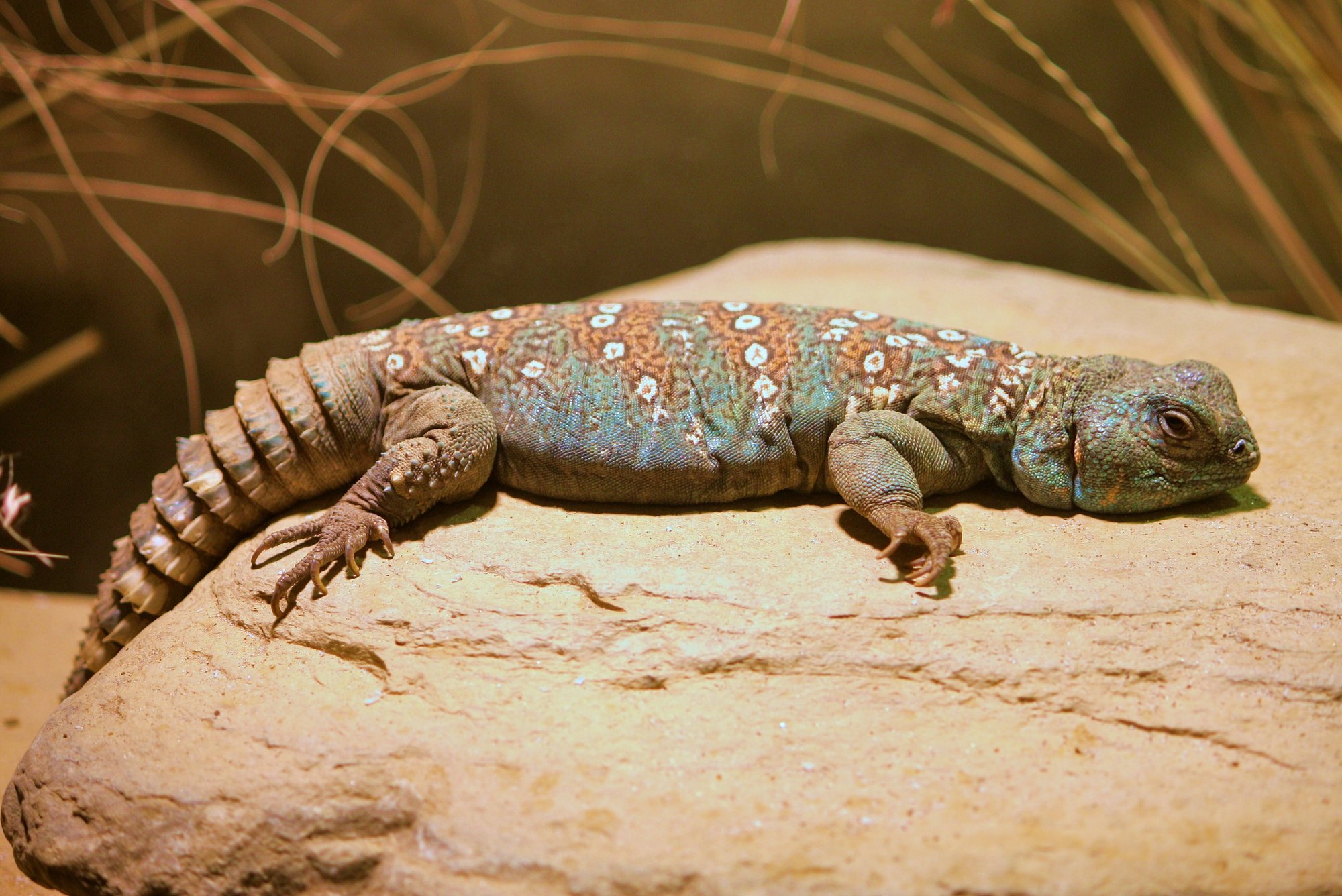
Agamas · Difficulty: Intermediate
Key facts and care guidance for Ocellated spiny-tailed lizard (Uromastyx ocellata) (origin: Egypt, Sudan, Eritrea, Somalia (north-eastern Africa)). Adult size around up to ~32 cm total length (SVL up to 17 cm). Life expectancy 15–25 years. The values below are carefully researched guidance.
Short answers
Ocellated spiny-tailed lizard: How big does the enclosure need to be?
From 120×70×60 cm for one animal; for a pair from 140×70×60 cm (15 % more floor space per additional animal, as in the 1997 expert report).
Ocellated spiny-tailed lizard: What temperature does it need?
Daytime 28–35 °C (cool corner 28–30 °C), basking spot 45–55 °C (surface temperature; air at the basking spot up to ~45 °C), at night 16–21 °C.
Ocellated spiny-tailed lizard: Does it need UVB lighting?
UVB: A very high UVB requirement (Ferguson zone 3–4, UV index 4–6); a strong T5 HO tube (10–14 %).
Ocellated spiny-tailed lizard: How long do they live?
Life expectancy: 15–25 years.
Ocellated spiny-tailed lizard: Is it suitable for beginners?
Rather not – it is considered an intermediate species (difficulty: Intermediate).
Climate
- Daytime temperature
- 28–35 °C (cool corner 28–30 °C)
- Night temperature
- 16–21 °C
- Basking spot
- 45–55 °C (surface temperature; air at the basking spot up to ~45 °C)
- Humidity
- 30–50 %
- UVB
- A very high UVB requirement (Ferguson zone 3–4, UV index 4–6); a strong T5 HO tube (10–14 %)
Enclosure
- Minimum size
- from 120×70×60 cm for one animal; for a pair from 140×70×60 cm (15 % more floor space per additional animal, as in the 1997 expert report)
- Substrate
- A sand-loam mix, diggable, 20–30 cm deep; stones, cork tubes and thick branches as hides and climbing aids
Feeding
- Food
- Purely herbivorous: ribwort plantain, vine leaves, dandelion, daisies, clover, chickweed; grains and seeds (millet, sunflower)
- Feeding interval
- fresh greens offered daily to adults (salad 4–5×/week), juveniles daily
Key facts
- Adult size
- up to ~32 cm total length (SVL up to 17 cm)
- Life expectancy
- 15–25 years
- Origin
- Egypt, Sudan, Eritrea, Somalia (north-eastern Africa)
- Protection status
- CITES Appendix II / EU Regulation Annex B → specially protected; registration with the local nature conservation authority, proof of origin required
- Brumation
- A mild winter rest: reduce the photoperiod to 6–8 h in winter and keep it cooler; it encourages reproduction
- Cohabitation
- Keeping them singly is the standard; strongly territorial. One male with several females (a harem) only in a large enclosure with visual barriers; never keep males together
Notes
Also the "ornate spiny-tailed lizard". Fond of climbing → offer structure and height. German sources sometimes give 50–60 % humidity, US care sheets 30–40 %; the consensus is rather dry with locally damp ground. Well available as captive-bred animals.
Do you keep this species?
Add your animal to Reptoria – Reptoria reminds you about feeding and shedding. Add your animal for free →
Look for Ocellated spiny-tailed lizard (Uromastyx ocellata) in the marketplace →
Related species
- Egyptian spiny-tailed lizard (Uromastyx aegyptia) – Intermediate to expert
- Bent's spiny-tailed lizard (Uromastyx benti) – Intermediate
- Indian spiny-tailed lizard (Uromastyx hardwickii) – Intermediate
- Iraqi spiny-tailed lizard (Uromastyx loricata) – Intermediate
- Yemeni spiny-tailed lizard (Uromastyx shobraki) – Intermediate
- Macfadyen's spiny-tailed lizard (Uromastyx macfadyeni) – Intermediate
- Mali spiny-tailed lizard (Uromastyx dispar maliensis) – Intermediate
- Moroccan spiny-tailed lizard (Uromastyx acanthinura) – Intermediate
What you need to start
To keep Ocellated spiny-tailed lizard (Uromastyx ocellata) you typically need: a suitable enclosure (from 120×70×60 cm for one animal; for a pair from 140×70×60 cm (15 % more floor space per additional animal, as in the 1997 expert report)), substrate (A sand-loam mix, diggable, 20–30 cm deep; stones, cork tubes and thick branches as hides and climbing aids), a heat source with a thermostat, UVB lighting, thermometer and hygrometer, a water dish and hides. You will find equipment in the Reptoria marketplace.
The complete, interactive care database is in the Reptoria app.
Last updated: 9 October 2026 · Editor: Reptoria editorial team · Sources include: https://en.wikipedia.org/wiki/Uromastyx, https://reptifiles.com/uromastyx-care/, https://reptile-database.reptarium.cz/species?genus=Uromastyx&species=ocellata
All values are non-binding guidance and do not replace expert advice. Research thoroughly from several sources before acquiring and keeping an animal, and observe the applicable law (species and animal protection in particular).