Peacock monitor (Varanus auffenbergi)
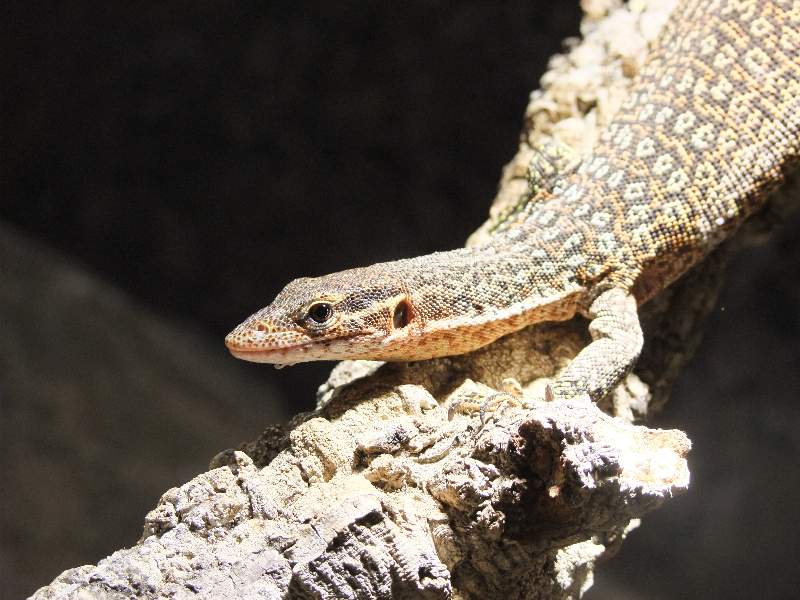
Monitors & tegus · Difficulty: Intermediate
Key facts and care guidance for Peacock monitor (Varanus auffenbergi) (origin: The island of Rote/Roti (south of Timor), Indonesia). Adult size around approx. 60–70 cm including the tail (a pygmy monitor). Life expectancy 12–15+ years. The values below are carefully researched guidance.
Short answers
Peacock monitor: How big does the enclosure need to be?
120×60×120 cm (semi-arboreal, with depth to dig).
Peacock monitor: What temperature does it need?
Daytime 28–32 °C, basking spot 45–55 °C (spot-sized basking place), at night 21–24 °C.
Peacock monitor: Does it need UVB lighting?
UVB: UVB needed (Ferguson zone 3, UV index 4–6; a sun-loving small monitor).
Peacock monitor: How long do they live?
Life expectancy: 12–15+ years.
Peacock monitor: Is it suitable for beginners?
Rather not – it is considered an intermediate species (difficulty: Intermediate).
Climate
- Daytime temperature
- 28–32 °C
- Night temperature
- 21–24 °C
- Basking spot
- 45–55 °C (spot-sized basking place)
- Humidity
- 50–70 %
- UVB
- UVB needed (Ferguson zone 3, UV index 4–6; a sun-loving small monitor)
Enclosure
- Minimum size
- 120×60×120 cm (semi-arboreal, with depth to dig)
- Substrate
- A deep sand and soil mix they can dig in (with leaf litter), cork tubes, climbing branches
Feeding
- Food
- Insects (house crickets, roaches, locusts, beetles), occasionally pinkie mice and eggs
- Feeding interval
- adults 2–3×/week, juveniles daily
Key facts
- Adult size
- approx. 60–70 cm including the tail (a pygmy monitor)
- Life expectancy
- 12–15+ years
- Origin
- The island of Rote/Roti (south of Timor), Indonesia
- Protection status
- CITES Appendix II / EU Annex B – proof of origin required
- Brumation
- None (at most a slightly cooler, drier rest period is possible)
- Cohabitation
- Single housing or a compatible pair (1.1) are both possible; the species is naturally calm but shy. Kept singly the animal has no competition for basking spot and food. A pair needs separate heat and retreat spots plus visual barriers and ongoing monitoring; several males do not tolerate each other.
Notes
A small, very agile Odatria monitor (the timorensis complex). It needs a high, focused basking spot and strong UVB. Common mistakes: basking that is too cold, and substrate that is too shallow.
Do you keep this species?
Add your animal to Reptoria – Reptoria reminds you about feeding and shedding. Add your animal for free →
Look for Peacock monitor (Varanus auffenbergi) in the marketplace →
Related species
- Argus monitor (Varanus panoptes) – Expert
- Bengal monitor (Varanus bengalensis) – Expert
- Blue tree monitor (Varanus macraei) – Expert
- Blue-tailed monitor (Varanus doreanus) – Intermediate to expert
- Finsch's monitor (Varanus doreanus finschi) – Expert
- Boatsi tree monitor (Varanus boatsi) – Expert
- Bogert's tree monitor (Varanus bogerti) – Expert
- Lace monitor (Varanus varius) – Expert
What you need to start
To keep Peacock monitor (Varanus auffenbergi) you typically need: a suitable enclosure (120×60×120 cm (semi-arboreal, with depth to dig)), substrate (A deep sand and soil mix they can dig in (with leaf litter), cork tubes, climbing branches), a heat source with a thermostat, UVB lighting, thermometer and hygrometer, a water dish and hides. You will find equipment in the Reptoria marketplace.
The complete, interactive care database is in the Reptoria app.
Last updated: 2 November 2026 · Editor: Reptoria editorial team · Sources include: http://www.reptile-care.de/species/Anguimorpha/Varanidae/Varanus-auffenbergi.html, https://en.wikipedia.org/wiki/Peacock_monitor, https://reptile-database.reptarium.cz/species?genus=Varanus&species=timorensis
All values are non-binding guidance and do not replace expert advice. Research thoroughly from several sources before acquiring and keeping an animal, and observe the applicable law (species and animal protection in particular).