Poison frogs (Ranitomeya amazonica)
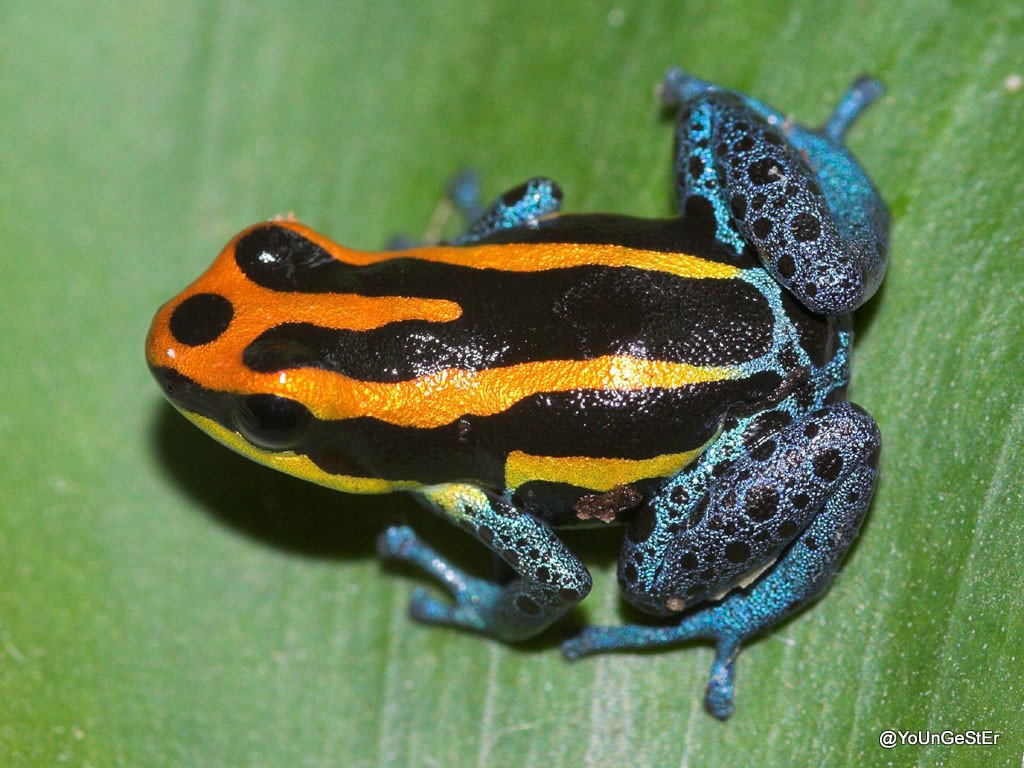
Amphibians · Difficulty: Intermediate
Key facts and care guidance for Poison frogs (Ranitomeya amazonica) (origin: Northeast Peru, lowland rainforest around Iquitos, 0–200 m). Adult size around approx. 1.6–1.9 cm. Life expectancy 8–12 years. The values below are carefully researched guidance.
Short answers
Poison frogs: How big does the enclosure need to be?
45×45×60 cm for a pair, taller than it is wide; markedly larger for a group.
Poison frogs: What temperature does it need?
Daytime 24–26 °C, at night 21–22 °C.
Poison frogs: Does it need UVB lighting?
UVB: Optional.
Poison frogs: How long do they live?
Life expectancy: 8–12 years.
Poison frogs: Is it suitable for beginners?
Rather not – it is considered an intermediate species (difficulty: Intermediate).
Climate
- Daytime temperature
- 24–26 °C
- Night temperature
- 21–22 °C
- Basking spot
- —
- Humidity
- 70–80 % by day, ~100 % at night
- UVB
- Optional
Enclosure
- Minimum size
- 45×45×60 cm for a pair, taller than it is wide; markedly larger for a group
- Substrate
- Rainforest with bromeliads, leaf litter, moss
Feeding
- Food
- Fruit flies, springtails, micro crickets
- Feeding interval
- Daily to several times a week, dusted
Key facts
- Adult size
- approx. 1.6–1.9 cm
- Life expectancy
- 8–12 years
- Origin
- Northeast Peru, lowland rainforest around Iquitos, 0–200 m
- Protection status
- CITES Appendix II / EU Annex B, registration required
- Brumation
- None
- Cohabitation
- A pair (1.1) is the least stressful; males are territorial. A small group is possible in a large, densely planted tank, but rival animals, females included, can suppress one another, and a subordinate frog then stops eating. Raise juveniles separately from adults — not because they would be eaten, these frogs are far too small for that, but because the larger ones reach the food first and the small ones fall behind. Provide enough hiding places so every animal can retreat, and feed separately when sizes differ.
Notes
A tiny frog with a high humidity requirement. Captive-bred animals are non-toxic; bromeliads matter for breeding.
Do you keep this species?
Add your animal to Reptoria – Reptoria reminds you about feeding and shedding. Add your animal for free →
Look for Poison frogs (Ranitomeya amazonica) in the marketplace →
Related species
- Poison frogs (Ranitomeya imitator) – Beginner to intermediate
- Poison frogs (Ranitomeya variabilis) – Intermediate
- Red-headed poison frog (Ranitomeya fantastica) – Intermediate
- Yellow-striped poison frog (Ranitomeya flavovittata) – Intermediate
- Reticulated poison frog (Ranitomeya reticulata) – Intermediate
- Blessed poison frog (Ranitomeya benedicta) – Intermediate
- Sira poison frog (Ranitomeya sirensis) – Intermediate
- Summers' poison frog (Ranitomeya summersi) – Intermediate
What you need to start
To keep Poison frogs (Ranitomeya amazonica) you typically need: a suitable enclosure (45×45×60 cm for a pair, taller than it is wide; markedly larger for a group), substrate (Rainforest with bromeliads, leaf litter, moss), a heat source with a thermostat, UVB lighting, thermometer and hygrometer, a water dish and hides. You will find equipment in the Reptoria marketplace.
The complete, interactive care database is in the Reptoria app.
Last updated: 9 October 2026 · Editor: Reptoria editorial team · Sources include: Wikipedia EN, einrichtungsbeispiele.de, amphibiansoftheworld.amnh.org, dendroboard.com, eu_annex.txt (lokal, VO (EU) 2026/1383)
All values are non-binding guidance and do not replace expert advice. Research thoroughly from several sources before acquiring and keeping an animal, and observe the applicable law (species and animal protection in particular).