Poison frogs (Ranitomeya variabilis)
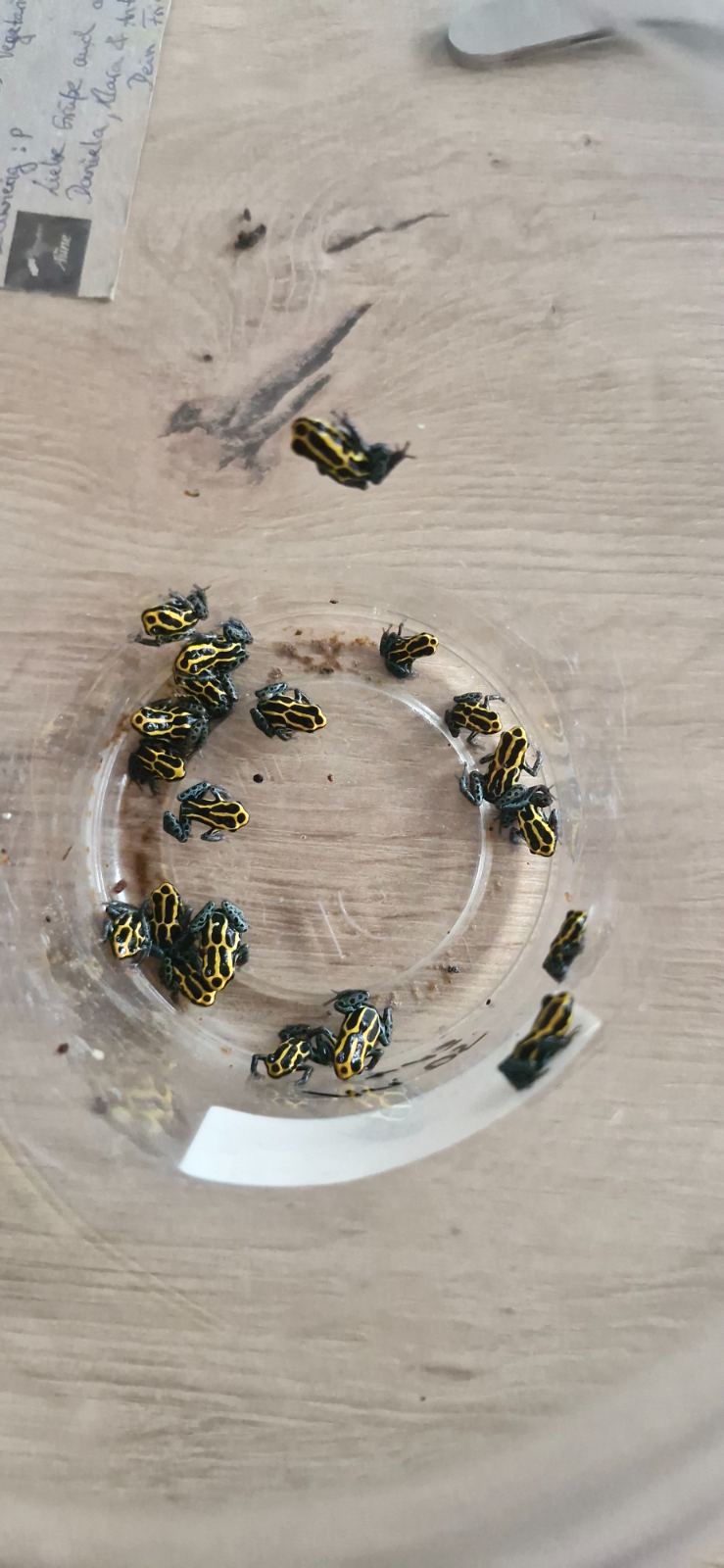
Amphibians · Difficulty: Intermediate
Key facts and care guidance for Poison frogs (Ranitomeya variabilis) (origin: Peru and Ecuador, lowland to montane rainforest). Adult size around ~1,7–2 cm. Life expectancy 8–12 years. The values below are carefully researched guidance.
Short answers
Poison frogs: How big does the enclosure need to be?
40 × 40 × 50–60 cm (vertical) for a pair.
Poison frogs: What temperature does it need?
Daytime 22–25 °C (highland forms cooler), at night below 20 °C possible (drop).
Poison frogs: Does it need UVB lighting?
UVB: Optional.
Poison frogs: How long do they live?
Life expectancy: 8–12 years.
Poison frogs: Is it suitable for beginners?
Rather not – it is considered an intermediate species (difficulty: Intermediate).
Climate
- Daytime temperature
- 22–25 °C (highland forms cooler)
- Night temperature
- below 20 °C possible (drop)
- Basking spot
- —
- Humidity
- ~80 % by day, ~100 % at night
- UVB
- Optional
Enclosure
- Minimum size
- 40 × 40 × 50–60 cm (vertical) for a pair
- Substrate
- Rainforest with bromeliads, leaf litter, moss
Feeding
- Food
- Fruit flies, springtails, isopods, micro crickets
- Feeding interval
- Daily to several times a week, dusted
Key facts
- Adult size
- ~1,7–2 cm
- Life expectancy
- 8–12 years
- Origin
- Peru and Ecuador, lowland to montane rainforest
- Protection status
- CITES Appendix II / EU Annex B, registration required
- Brumation
- None
- Cohabitation
- Pair or group. Ranitomeya variabilis is notably peaceful among poison frogs: the animals hardly ever attack each other, which is why group housing works well in a large, densely planted enclosure. What matters is enough bromeliads and film canisters as territorial focal points.
Notes
Temperatures above 27–28 °C are critical to lethal; a night drop matters. Captive-bred animals are non-toxic, and bromeliads serve as spawning sites.
Do you keep this species?
Add your animal to Reptoria – Reptoria reminds you about feeding and shedding. Add your animal for free →
Poison frogs (Ranitomeya variabilis) currently offered
- Ranitomeya variabilis french guiana – french guiana · Dresden · 55 €
Related species
- Poison frogs (Ranitomeya amazonica) – Intermediate
- Poison frogs (Ranitomeya imitator) – Beginner to intermediate
- Red-headed poison frog (Ranitomeya fantastica) – Intermediate
- Yellow-striped poison frog (Ranitomeya flavovittata) – Intermediate
- Reticulated poison frog (Ranitomeya reticulata) – Intermediate
- Blessed poison frog (Ranitomeya benedicta) – Intermediate
- Sira poison frog (Ranitomeya sirensis) – Intermediate
- Summers' poison frog (Ranitomeya summersi) – Intermediate
What you need to start
To keep Poison frogs (Ranitomeya variabilis) you typically need: a suitable enclosure (40 × 40 × 50–60 cm (vertical) for a pair), substrate (Rainforest with bromeliads, leaf litter, moss), a heat source with a thermostat, UVB lighting, thermometer and hygrometer, a water dish and hides. You will find equipment in the Reptoria marketplace.
The complete, interactive care database is in the Reptoria app.
Last updated: 24 September 2026 · Editor: Reptoria editorial team · Sources include: pfeilgiftfrosch.info, pfeilgiftfrosch-forum.de, einrichtungsbeispiele.de, CITES Anhang II, EU-VO 338/97 Anhang B
All values are non-binding guidance and do not replace expert advice. Research thoroughly from several sources before acquiring and keeping an animal, and observe the applicable law (species and animal protection in particular).