Red-tailed pipe snake (Cylindrophis ruffus)
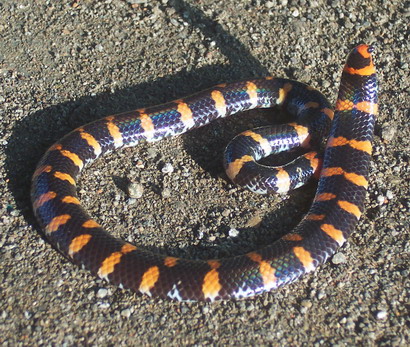
Snakes · Difficulty: Intermediate
Key facts and care guidance for Red-tailed pipe snake (Cylindrophis ruffus) (origin: South-East Asia). Adult size around 50–90 cm. Life expectancy 10–15 years. The values below are carefully researched guidance.
Short answers
Red-tailed pipe snake: How big does the enclosure need to be?
From 90×45×45 cm (minimum size according to the 1997 expert report, cylinder snakes).
Red-tailed pipe snake: What temperature does it need?
Daytime 25–30 °C, basking spot No basking spot, at night 21–24 °C.
Red-tailed pipe snake: Does it need UVB lighting?
UVB: Not required.
Red-tailed pipe snake: How long do they live?
Life expectancy: 10–15 years.
Red-tailed pipe snake: Is it suitable for beginners?
Rather not – it is considered an intermediate species (difficulty: Intermediate).
Climate
- Daytime temperature
- 25–30 °C
- Night temperature
- 21–24 °C
- Basking spot
- No basking spot
- Humidity
- 75–90 %
- UVB
- Not required
Enclosure
- Minimum size
- from 90×45×45 cm (minimum size according to the 1997 expert report, cylinder snakes)
- Substrate
- Damp coco humus 15–20 cm, leaf litter, a shallow water dish
Feeding
- Food
- A SPECIALIST: eels, worm snakes, narrow fish; frozen-thawed mice are often refused
- Feeding interval
- 1×/week
Key facts
- Adult size
- 50–90 cm
- Life expectancy
- 10–15 years
- Origin
- South-East Asia
- Protection status
- Not listed under CITES
- Brumation
- None
- Cohabitation
- Keep them singly. Snakes are solitary and do not seek company — a shared hide is competition for the best spot, not social behaviour. The concrete reason is the feeding accident: if two animals grab the same food item, one can swallow the other along with it. On top of that, once they are kept together you can no longer tell which animal has eaten and which is losing weight. For breeding, put them together under supervision and separate them again afterwards.
Notes
When threatened it shows the brilliant red-and-black underside of its tail and raises it like a false head. Burrowing; its specialisation on elongated prey is the crux of keeping it.
Do you keep this species?
Add your animal to Reptoria – Reptoria reminds you about feeding and shedding. Add your animal for free →
Look for Red-tailed pipe snake (Cylindrophis ruffus) in the marketplace →
Related species
- Sunbeam snake (Xenopeltis unicolor) – Intermediate
- Rubber boa (Charina bottae) – Intermediate
- Calabar burrowing python (Calabaria reinhardtii) – Intermediate
- Mexican burrowing python (Loxocemus bicolor) – Intermediate
- Red pipe snake (Anilius scytale) – Expert
- Common egg-eating snake (Dasypeltis scabra) – Intermediate
- Northern water snake (Nerodia sipedon) – Intermediate
- Andean milk snake (Lampropeltis micropholis) – Intermediate
What you need to start
To keep Red-tailed pipe snake (Cylindrophis ruffus) you typically need: a suitable enclosure (from 90×45×45 cm (minimum size according to the 1997 expert report, cylinder snakes)), substrate (Damp coco humus 15–20 cm, leaf litter, a shallow water dish), a heat source with a thermostat, thermometer and hygrometer, a water dish and hides. You will find equipment in the Reptoria marketplace.
The complete, interactive care database is in the Reptoria app.
Last updated: 9 October 2026 · Editor: Reptoria editorial team · Sources include: https://en.wikipedia.org/wiki/Cylindrophis_ruffus, https://reptile-database.reptarium.cz/species?genus=Cylindrophis&species=ruffus
All values are non-binding guidance and do not replace expert advice. Research thoroughly from several sources before acquiring and keeping an animal, and observe the applicable law (species and animal protection in particular).