Common egg-eating snake (Dasypeltis scabra)
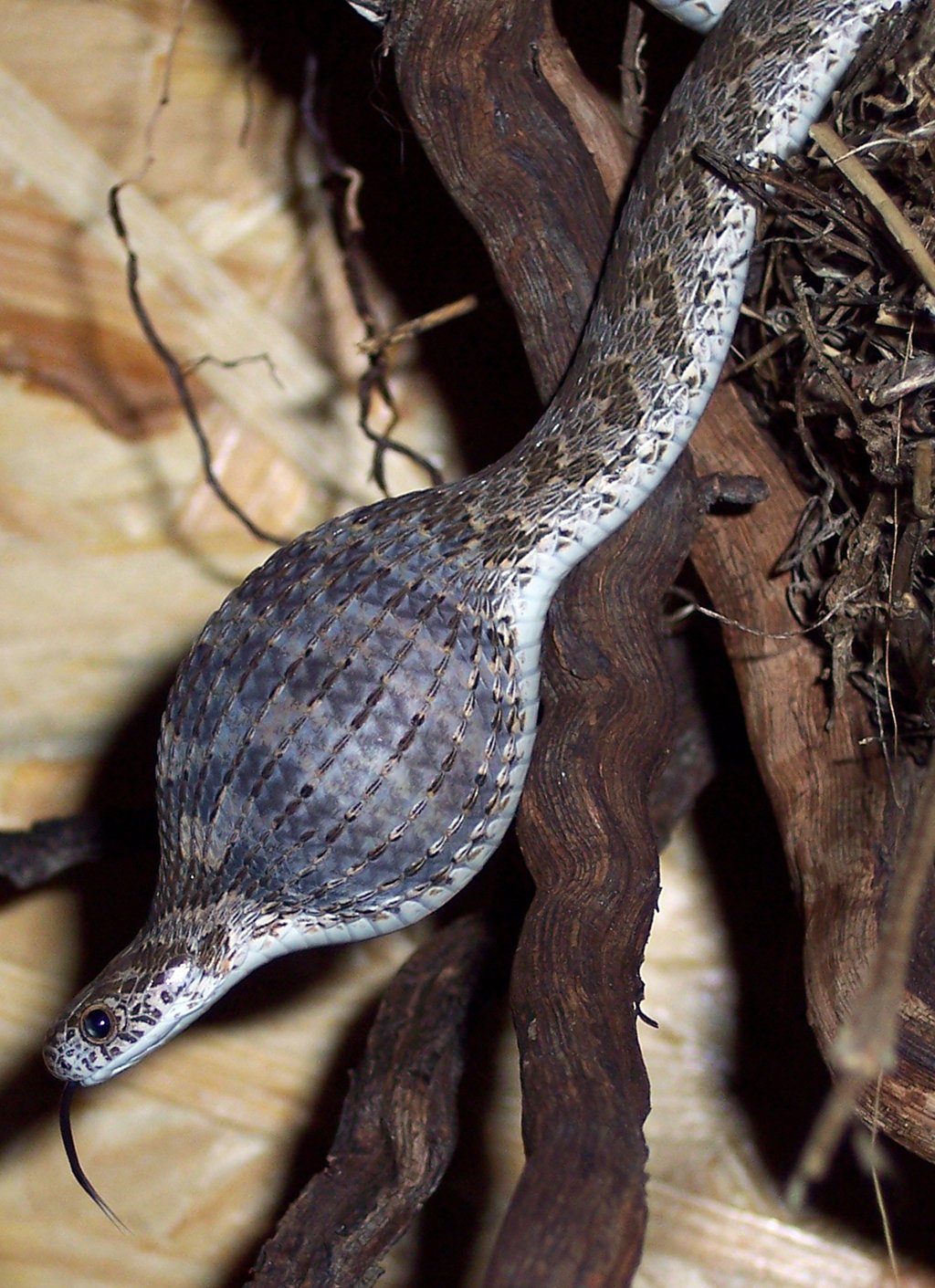
Snakes · Difficulty: Intermediate
Key facts and care guidance for Common egg-eating snake (Dasypeltis scabra) (origin: Sub-Saharan Africa). Adult size around usually 60–90 cm, females up to 110 cm (exceptionally 120 cm). Life expectancy 10–15 years; maximum recorded age in captivity about 22 years. The values below are carefully researched guidance.
Short answers
Common egg-eating snake: How big does the enclosure need to be?
From 110×55×110 cm (minimum size per the 1997 expert report, egg-eating snakes); for one or two animals; each additional animal adds around 20% more floor space.
Common egg-eating snake: What temperature does it need?
Daytime 22–28 °C, basking spot 30–35 °C at a local basking spot, at night 18–22 °C.
Common egg-eating snake: Does it need UVB lighting?
UVB: Not essential.
Common egg-eating snake: How long do they live?
Life expectancy: 10–15 years; maximum recorded age in captivity about 22 years.
Common egg-eating snake: Is it suitable for beginners?
Rather not – it is considered an intermediate species (difficulty: Intermediate).
Climate
- Daytime temperature
- 22–28 °C
- Night temperature
- 18–22 °C
- Basking spot
- 30–35 °C at a local basking spot
- Humidity
- 50–65 %
- UVB
- Not essential
Enclosure
- Minimum size
- from 110×55×110 cm (minimum size per the 1997 expert report, egg-eating snakes); for one or two animals; each additional animal adds around 20% more floor space
- Substrate
- A sand-loam mix, climbing branches, hides
Feeding
- Food
- Exclusively bird eggs, nothing else. Zebra finch, budgerigar or small quail eggs for juveniles, quail to chicken eggs for adult animals; offered as fresh and unfertilised as possible, at room temperature. The empty shell is regurgitated again after eating.
- Feeding interval
- every 10–14 days during the season
Key facts
- Adult size
- usually 60–90 cm, females up to 110 cm (exceptionally 120 cm)
- Life expectancy
- 10–15 years; maximum recorded age in captivity about 22 years
- Origin
- Sub-Saharan Africa
- Protection status
- Not listed under CITES
- Brumation
- Yes — about 2 to 4 months: lower the temperature by 4 to 5 °C, shorten lighting to 6 hours, and don't feed during this period
- Cohabitation
- Single, in pairs or in small groups — African egg-eating snakes are compatible with each other. With multiple animals, add about 20% more floor space per additional animal, provide enough hides at different levels, and keep an eye on each animal individually at feeding time so you know who has taken food.
Notes
It eats only eggs – obtaining suitably small, fresh eggs is the real challenge and has to be sorted out BEFORE purchase. Toothless and entirely harmless; when disturbed it imitates a venomous snake by rasping its scales.
Do you keep this species?
Add your animal to Reptoria – Reptoria reminds you about feeding and shedding. Add your animal for free →
Look for Common egg-eating snake (Dasypeltis scabra) in the marketplace →
Related species
- East African egg-eating snake (Dasypeltis medici) – Intermediate
- African house snake (Boaedon fuliginosus) – Beginner
- False water cobra (Hydrodynastes gigas) – Experts
- Spotted house snake (Boaedon maculatus) – Beginner
- Western whip snake (Hierophis viridiflavus) – Intermediate
- Striped house snake (Boaedon lineatus) – Beginner
- Smooth green snake (Opheodrys vernalis) – Expert
- Rough green snake (Opheodrys aestivus) – Intermediate
What you need to start
To keep Common egg-eating snake (Dasypeltis scabra) you typically need: a suitable enclosure (from 110×55×110 cm (minimum size per the 1997 expert report, egg-eating snakes); for one or two animals; each additional animal adds around 20% more floor space), substrate (A sand-loam mix, climbing branches, hides), a heat source with a thermostat, UVB lighting, thermometer and hygrometer, a water dish and hides. You will find equipment in the Reptoria marketplace.
The complete, interactive care database is in the Reptoria app.
Last updated: 5 November 2026 · Editor: Reptoria editorial team · Sources include: einrichtungsbeispiele.de, tropic-shop.de, zwerggeckos.info, Wikipedia EN, eu_annex.txt (VO (EU) 2026/1383, lokal)
All values are non-binding guidance and do not replace expert advice. Research thoroughly from several sources before acquiring and keeping an animal, and observe the applicable law (species and animal protection in particular).