Striped house snake (Boaedon lineatus)
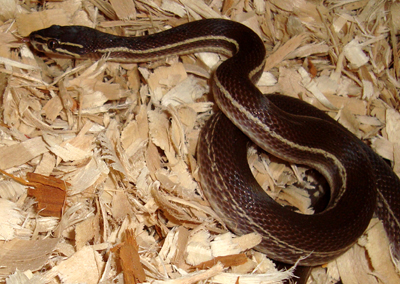
Snakes · Difficulty: Beginner
Key facts and care guidance for Striped house snake (Boaedon lineatus) (origin: West and central Africa (Senegal and the Gambia through Ghana, Nigeria and Cameroon to Chad, the Central African Republic and Sudan)). Adult size around males 50–70 cm, females up to approx. 100 cm. Life expectancy 15–20 years. The values below are carefully researched guidance.
Short answers
Striped house snake: How big does the enclosure need to be?
100×50×50 cm.
Striped house snake: What temperature does it need?
Daytime 25–30 °C, basking spot 32–35 °C, at night 20–23 °C.
Striped house snake: Does it need UVB lighting?
UVB: Not essential.
Striped house snake: How long do they live?
Life expectancy: 15–20 years.
Striped house snake: Is it suitable for beginners?
Yes – it is considered suitable for beginners (difficulty: Beginner).
Climate
- Daytime temperature
- 25–30 °C
- Night temperature
- 20–23 °C
- Basking spot
- 32–35 °C
- Humidity
- 55–70 %
- UVB
- Not essential
Enclosure
- Minimum size
- 100×50×50 cm
- Substrate
- Coco fibre/beech-wood granulate, slightly damper than for the brown house snake, hides on both the warm and cool sides
Feeding
- Food
- Frozen-thawed mice (small sizes — this species stays slender)
- Feeding interval
- Adults every 10–14 days, juveniles weekly.
Key facts
- Adult size
- males 50–70 cm, females up to approx. 100 cm
- Life expectancy
- 15–20 years
- Origin
- West and central Africa (Senegal and the Gambia through Ghana, Nigeria and Cameroon to Chad, the Central African Republic and Sudan)
- Protection status
- Not listed under CITES
- Brumation
- None
- Cohabitation
- Keep them singly. Snakes are solitary and do not seek company — a shared hide is competition for the best spot, not social behaviour. The concrete reason is the feeding accident: if two animals grab the same food item, one can swallow the other along with it. On top of that, once they are kept together you can no longer tell which animal has eaten and which is losing weight. For breeding, put them together under supervision and separate them again afterwards.
Notes
The smallest of the common house snakes — adult females take hopper to weaned mice, males stay on fuzzies. Nocturnal, and often found near human settlements in its native range. Very fecund: several clutches per season are normal, which can exhaust females badly — don't breed every season.
Do you keep this species?
Add your animal to Reptoria – Reptoria reminds you about feeding and shedding. Add your animal for free →
Striped house snake (Boaedon lineatus) currently offered
- Afrikanische Hausschlange (Boaedon lineatus) – Belau · 120 €
Related species
- African house snake (Boaedon fuliginosus) – Beginner
- Spotted house snake (Boaedon maculatus) – Beginner
- Cape house snake (Boaedon capensis) – Beginner
- Common egg-eating snake (Dasypeltis scabra) – Intermediate
- False water cobra (Hydrodynastes gigas) – Experts
- Western whip snake (Hierophis viridiflavus) – Intermediate
- Smooth green snake (Opheodrys vernalis) – Expert
- Rough green snake (Opheodrys aestivus) – Intermediate
What you need to start
To keep Striped house snake (Boaedon lineatus) you typically need: a suitable enclosure (100×50×50 cm), substrate (Coco fibre/beech-wood granulate, slightly damper than for the brown house snake, hides on both the warm and cool sides), a heat source with a thermostat, UVB lighting, thermometer and hygrometer, a water dish and hides. You will find equipment in the Reptoria marketplace.
The complete, interactive care database is in the Reptoria app.
Last updated: 9 October 2026 · Editor: Reptoria editorial team · Sources include: reptile-database.reptarium.cz, reptile-care.de, herz-fuer-tiere.de, dubiaroaches.com, einrichtungsbeispiele.de
All values are non-binding guidance and do not replace expert advice. Research thoroughly from several sources before acquiring and keeping an animal, and observe the applicable law (species and animal protection in particular).