Rough green snake (Opheodrys aestivus)
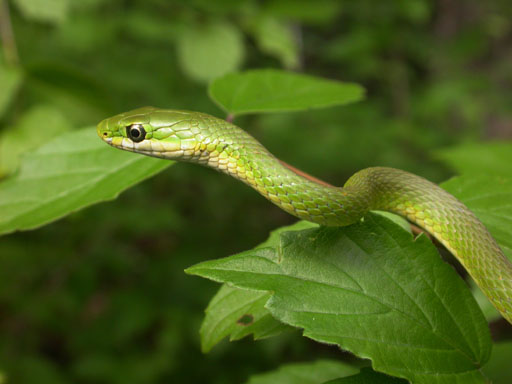
Snakes · Difficulty: Intermediate
Key facts and care guidance for Rough green snake (Opheodrys aestivus) (origin: The south-eastern and south-central USA, north-western Mexico). Adult size around 55–90 cm, individual animals over 110 cm (very slender; females larger). Life expectancy captive-bred 5–15 years; wild-caught often only 1–3 years. The values below are carefully researched guidance.
Short answers
Rough green snake: How big does the enclosure need to be?
Single animal from 90×45×90 cm according to the official formula (1.0 × 0.5 × 1.0 of total length); proven in practice are 100×50×80 cm or 60×45×120 cm, pair from 100×50×90 cm. For each additional animal about 20 % more volume.
Rough green snake: What temperature does it need?
Daytime 24–29 °C, basking spot 30–33 °C, at night 20–22 °C.
Rough green snake: Does it need UVB lighting?
UVB: UVB needed (diurnal, Ferguson zone 2–3, UV index 2–4).
Rough green snake: How long do they live?
Life expectancy: captive-bred 5–15 years; wild-caught often only 1–3 years.
Rough green snake: Is it suitable for beginners?
Rather not – it is considered an intermediate species (difficulty: Intermediate).
Climate
- Daytime temperature
- 24–29 °C
- Night temperature
- 20–22 °C
- Basking spot
- 30–33 °C
- Humidity
- 60–80 %, plus a permanently humid hide box with sphagnum
- UVB
- UVB needed (diurnal, Ferguson zone 2–3, UV index 2–4)
Enclosure
- Minimum size
- Single animal from 90×45×90 cm according to the official formula (1.0 × 0.5 × 1.0 of total length); proven in practice are 100×50×80 cm or 60×45×120 cm, pair from 100×50×90 cm. For each additional animal about 20 % more volume.
- Substrate
- Coco humus, orchid bark or sphagnum, 5 cm or more, very densely planted
Feeding
- Food
- Soft-bodied insects: crickets, locusts, caterpillars, wax moths – NO rodents; dust with calcium and vitamins
- Feeding interval
- adults 2–3×/week (5–8 insects), juveniles daily
Key facts
- Adult size
- 55–90 cm, individual animals over 110 cm (very slender; females larger)
- Life expectancy
- captive-bred 5–15 years; wild-caught often only 1–3 years
- Origin
- The south-eastern and south-central USA, north-western Mexico
- Protection status
- Not listed under CITES; prefer captive-bred animals to wild-caught ones
- Brumation
- No strict winter rest is needed; a slight drop in temperature and light in winter encourages breeding
- Cohabitation
- Keeping them singly is safe and trouble-free. A pair or small group (2–3 animals) is possible — one of the few colubrids that tolerate this, as it defends no territory — but only in a large, densely planted enclosure, and it is harder to see whether every animal is eating enough.
Notes
Dense planting at several heights is the most important factor – without enough cover there is chronic stress. UVB is essential (untypical for colubrids). A strict insect eater (no rodents), prone to stress, and barely to be handled. Wild-caught animals often die early; prefer captive-bred ones.
Do you keep this species?
Add your animal to Reptoria – Reptoria reminds you about feeding and shedding. Add your animal for free →
Look for Rough green snake (Opheodrys aestivus) in the marketplace →
Related species
- Smooth green snake (Opheodrys vernalis) – Expert
- Common egg-eating snake (Dasypeltis scabra) – Intermediate
- African house snake (Boaedon fuliginosus) – Beginner
- False water cobra (Hydrodynastes gigas) – Experts
- Spotted house snake (Boaedon maculatus) – Beginner
- Western whip snake (Hierophis viridiflavus) – Intermediate
- Striped house snake (Boaedon lineatus) – Beginner
- Oriental vine snake (Ahaetulla prasina) – Experts
What you need to start
To keep Rough green snake (Opheodrys aestivus) you typically need: a suitable enclosure (Single animal from 90×45×90 cm according to the official formula (1.0 × 0.5 × 1.0 of total length); proven in practice are 100×50×80 cm or 60×45×120 cm, pair from 100×50×90 cm. For each additional animal about 20 % more volume.), substrate (Coco humus, orchid bark or sphagnum, 5 cm or more, very densely planted), a heat source with a thermostat, UVB lighting, thermometer and hygrometer, a water dish and hides. You will find equipment in the Reptoria marketplace.
The complete, interactive care database is in the Reptoria app.
Last updated: 9 October 2026 · Editor: Reptoria editorial team · Sources include: BMEL-Gutachten Reptilien 1997, Wikipedia EN, dubiaroaches.com, einrichtungsbeispiele.de, reptilesmagazine.com
All values are non-binding guidance and do not replace expert advice. Research thoroughly from several sources before acquiring and keeping an animal, and observe the applicable law (species and animal protection in particular).