Saharan horned viper (Cerastes cerastes)
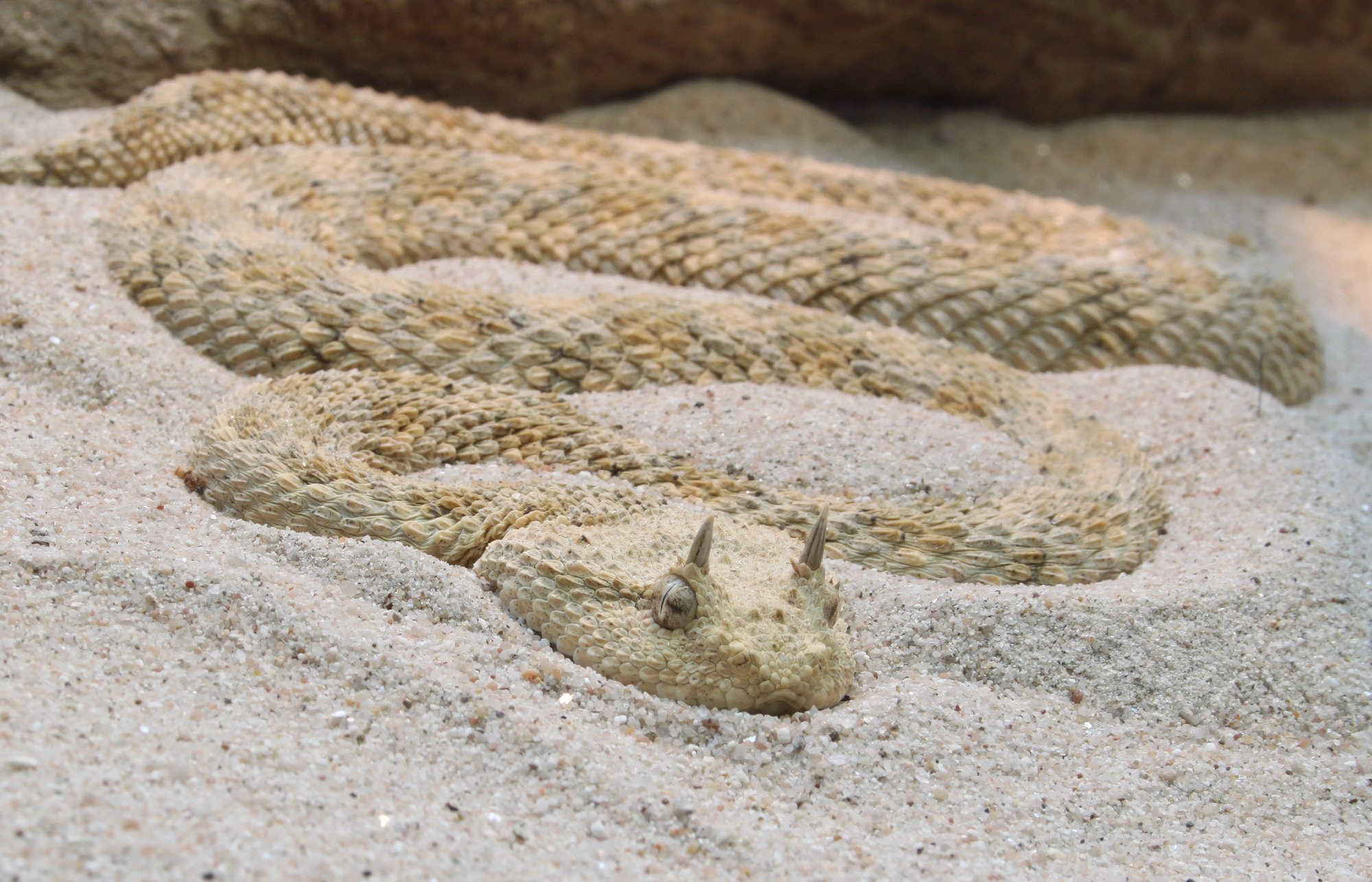
Snakes · Difficulty: Expert
Key facts and care guidance for Saharan horned viper (Cerastes cerastes) (origin: North Africa / the Sahara, the Arabian Peninsula, south-western Israel (arid regions)). Adult size around 30–60 cm, max. ~85 cm (females larger). Life expectancy 14–18 years. The values below are carefully researched guidance.
Short answers
Saharan horned viper: How big does the enclosure need to be?
From 110×65×45 cm (minimum size per the 1997 expert report, African horned vipers).
Saharan horned viper: What temperature does it need?
Daytime 25–30 °C, basking spot 33–35 °C, at night 18–22 °C.
Saharan horned viper: Does it need UVB lighting?
UVB: Weak UVB recommended (a desert species, Ferguson zone 2–3), but not essential.
Saharan horned viper: How long do they live?
Life expectancy: 14–18 years.
Saharan horned viper: Is it suitable for beginners?
No – better suited to experienced keepers (difficulty: Expert).
Climate
- Daytime temperature
- 25–30 °C
- Night temperature
- 18–22 °C
- Basking spot
- 33–35 °C
- Humidity
- 30–50 % (dry; one locally damp digging spot)
- UVB
- Weak UVB recommended (a desert species, Ferguson zone 2–3), but not essential
Enclosure
- Minimum size
- from 110×65×45 cm (minimum size per the 1997 expert report, African horned vipers)
- Substrate
- Sand about 7–10 cm deep for burying; a small area (~10 %) slightly damp; rock structures and hides
Feeding
- Food
- Frozen mice of a suitable size (rodents, occasionally chicks)
- Feeding interval
- adults every 10–14 days, juveniles weekly
Key facts
- Adult size
- 30–60 cm, max. ~85 cm (females larger)
- Life expectancy
- 14–18 years
- Origin
- North Africa / the Sahara, the Arabian Peninsula, south-western Israel (arid regions)
- Protection status
- A VENOMOUS SNAKE – keeping it requires a permit, notification and proof of expertise in several German states (e.g. Bavaria, Berlin, Hesse); North Rhine-Westphalia has banned new acquisitions since 2021; not listed under CITES, but observe the states' dangerous-animal law
- Brumation
- Yes – a winter rest or brumation of about 2–3 months at 12–15 °C (the annual mean is rather cool at ~20 °C, for health and breeding)
- Cohabitation
- Keep them singly – solitary; put them together only briefly and under supervision for breeding, and never keep males together
Notes
The venom is medically significant and a bite is potentially life-threatening – only for experienced keepers with a safety concept. A sidewinding desert viper that buries itself by day. Common mistakes: conditions that are too damp (respiratory and skin problems) and no winter rest. Not all animals carry the typical "horns".
Do you keep this species?
Add your animal to Reptoria – Reptoria reminds you about feeding and shedding. Add your animal for free →
Look for Saharan horned viper (Cerastes cerastes) in the marketplace →
Related species
- Sahara sand viper (Cerastes vipera) – Expert
- Savanna vine snake (Thelotornis capensis) – Expert
- Egyptian cobra (Naja haje) – Expert
- Egyptian saw-scaled viper (Echis pyramidum) – Expert
- Barnett's lancehead (Bothrops barnetti) – Expert
- Usambara bush viper (Atheris ceratophora) – Expert
- Ottoman viper (Montivipera xanthina) – Expert
- Malayan krait (Bungarus candidus) – Expert
What you need to start
To keep Saharan horned viper (Cerastes cerastes) you typically need: a suitable enclosure (from 110×65×45 cm (minimum size per the 1997 expert report, African horned vipers)), substrate (Sand about 7–10 cm deep for burying; a small area (~10 %) slightly damp; rock structures and hides), a heat source with a thermostat, UVB lighting, thermometer and hygrometer, a water dish and hides. You will find equipment in the Reptoria marketplace.
The complete, interactive care database is in the Reptoria app.
Last updated: 9 October 2026 · Editor: Reptoria editorial team · Sources include: https://de.wikipedia.org/wiki/W%C3%BCsten-Hornviper, https://reptile-database.reptarium.cz/species?genus=Cerastes&species=cerastes
All values are non-binding guidance and do not replace expert advice. Research thoroughly from several sources before acquiring and keeping an animal, and observe the applicable law (species and animal protection in particular).