Sinai agama (Pseudotrapelus sinaitus)
Agamas · Difficulty: Intermediate
Key facts and care guidance for Sinai agama (Pseudotrapelus sinaitus) (origin: North-eastern Africa and the Arabian Peninsula (Sinai / Egypt, Israel, Jordan, Syria, Saudi Arabia, Oman among others); arid rock and desert habitats). Adult size around up to ~18 cm total length (the tail approx. two thirds). Life expectancy 5–10 years. The values below are carefully researched guidance.
Short answers
Sinai agama: How big does the enclosure need to be?
100×50×60 cm (one animal; a pair from ~130×50×60 cm).
Sinai agama: What temperature does it need?
Daytime 28–32 °C (cooler areas / floor ~25 °C), basking spot 45–55 °C, at night 22–25 °C.
Sinai agama: Does it need UVB lighting?
UVB: UVB essential, high (desert-grade UV, Ferguson zone 3–4, UV index 4–6; e.g. Bright Sun Desert or Vitalux).
Sinai agama: How long do they live?
Life expectancy: 5–10 years.
Sinai agama: Is it suitable for beginners?
Rather not – it is considered an intermediate species (difficulty: Intermediate).
Climate
- Daytime temperature
- 28–32 °C (cooler areas / floor ~25 °C)
- Night temperature
- 22–25 °C
- Basking spot
- 45–55 °C
- Humidity
- 30–50 % (dry, rising slightly at night)
- UVB
- UVB essential, high (desert-grade UV, Ferguson zone 3–4, UV index 4–6; e.g. Bright Sun Desert or Vitalux)
Enclosure
- Minimum size
- 100×50×60 cm (one animal; a pair from ~130×50×60 cm)
- Substrate
- A sand-loam mix with securely built, stable rock structures and room to dig
Feeding
- Food
- Insects (crickets, house crickets, beetles, locusts, termites); occasionally a little plant food or flowers
- Feeding interval
- adults 3–4×/week, juveniles daily
Key facts
- Adult size
- up to ~18 cm total length (the tail approx. two thirds)
- Life expectancy
- 5–10 years
- Origin
- North-eastern Africa and the Arabian Peninsula (Sinai / Egypt, Israel, Jordan, Syria, Saudi Arabia, Oman among others); arid rock and desert habitats
- Protection status
- Not listed under CITES; IUCN "Least Concern"; no special registration duty in Germany. Often wild-caught in the trade – prefer captive-bred animals.
- Brumation
- No real winter rest; an optional short, milder dry or cool spell (a few weeks with reduced temperature and lighting) to stimulate breeding
- Cohabitation
- Single housing. Males are strongly territorial and can injure each other seriously, and during the breeding season females also defend territories and egg-laying sites; one animal per enclosure avoids this. A pair or a male with females is mentioned in husbandry reports only for large, structured set-ups; the drawback is that females still compete for egg-laying sites in the breeding season.
Notes
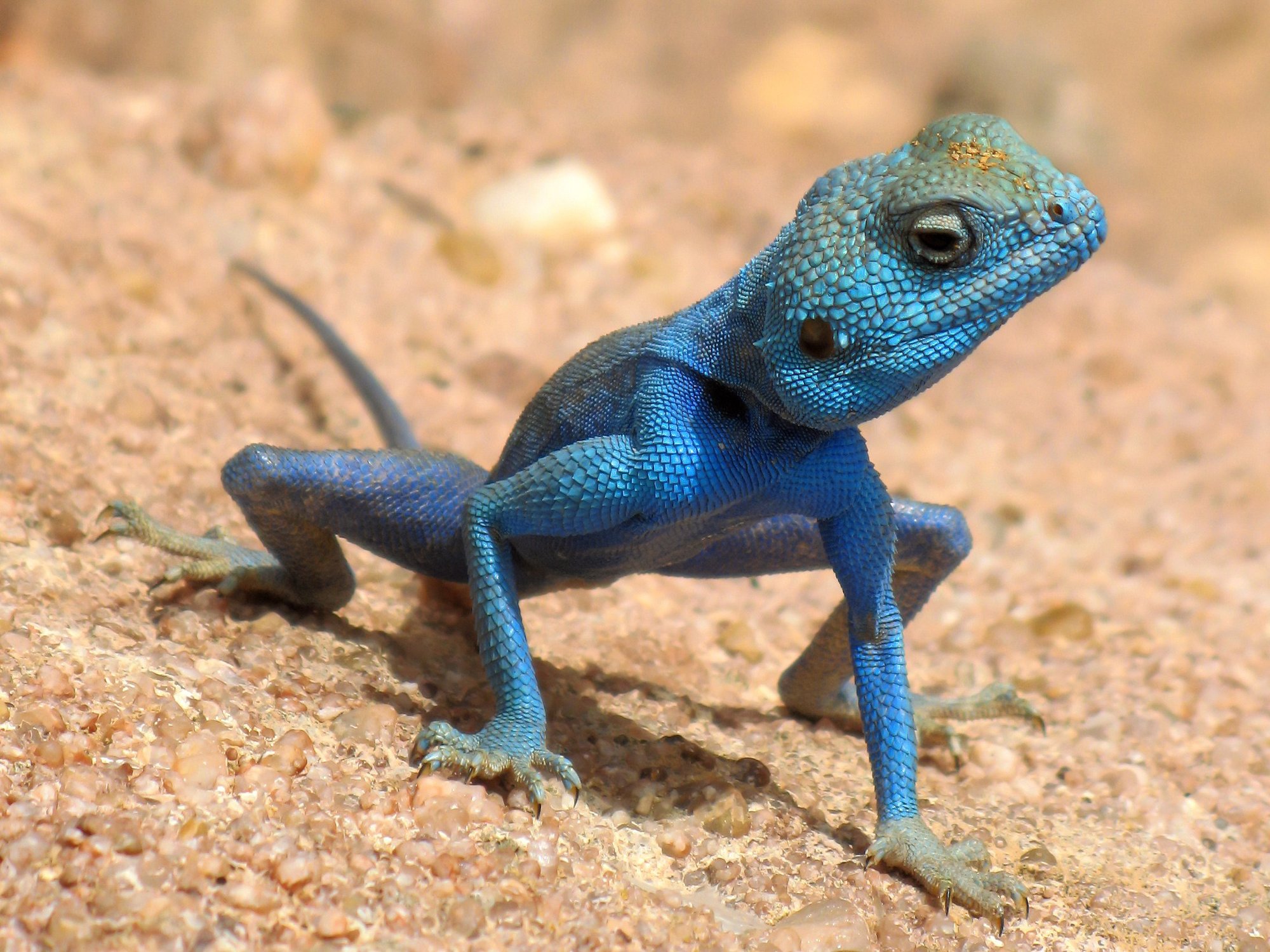
A desert species with a high warmth and UV requirement and a strong temperature gradient; conditions that are too damp or too cool are the commonest mistake. The males turn brilliant blue in the mating season. It drinks dew droplets (light morning misting). Many wild-caught animals – check for parasites and quarantine. The husbandry figures come from keeper reports (the DGHT forum, schoepfung.eu), and the field data are well documented.
Do you keep this species?
Add your animal to Reptoria – Reptoria reminds you about feeding and shedding. Add your animal for free →
Look for Sinai agama (Pseudotrapelus sinaitus) in the marketplace →
Related species
- Sinai agama (Pseudotrapelus aqabensis) – Intermediate
- Oriental garden lizard (Calotes versicolor) – Intermediate
- Spotted butterfly lizard (Leiolepis guttata) – Intermediate
- Painted dragon (Ctenophorus pictus) – Intermediate
- Common flying dragon (Draco volans) – Expert
- Green crested lizard (Bronchocela cristatella) – Intermediate
- Himalayan agama (Paralaudakia himalayana) – Intermediate
- Horsfield's salea (Salea horsfieldii) – Expert
What you need to start
To keep Sinai agama (Pseudotrapelus sinaitus) you typically need: a suitable enclosure (100×50×60 cm (one animal; a pair from ~130×50×60 cm)), substrate (A sand-loam mix with securely built, stable rock structures and room to dig), a heat source with a thermostat, UVB lighting, thermometer and hygrometer, a water dish and hides. You will find equipment in the Reptoria marketplace.
The complete, interactive care database is in the Reptoria app.
Last updated: 7 November 2026 · Editor: Reptoria editorial team · Sources include: Reptile Database - Pseudotrapelus sinaitus: oviparous (Goldberg 2013, Herpetological Review, Reproduktionsstudie) – https://reptile-database.reptarium.cz/species?genus=Pseudotrapelus&species=sinaitus, Pseudotrapelus - Wikipedia Gattungsuebersicht (Wuesten-/Felsagamen) – https://en.wikipedia.org/wiki/Pseudotrapelus, https://en.wikipedia.org/wiki/Sinai_agama, https://reptile-database.reptarium.cz/species?genus=Pseudotrapelus&species=sinaitus, https://www.caudata.org/threads/middle-eastern-agamid-care-pseudotrapelus-trapelus-ect.70049
All values are non-binding guidance and do not replace expert advice. Research thoroughly from several sources before acquiring and keeping an animal, and observe the applicable law (species and animal protection in particular).