Spiny softshell turtle (Apalone spinifera)
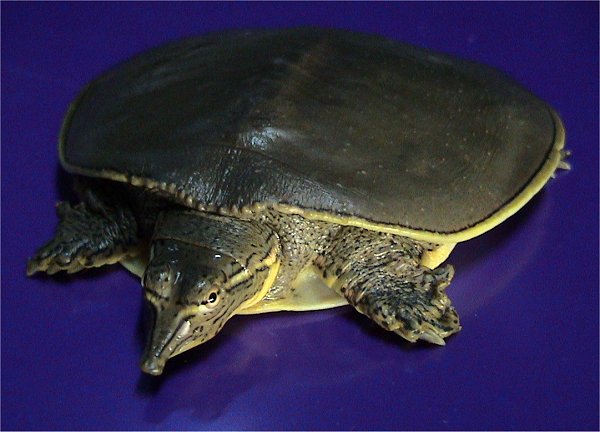
Turtles & tortoises · Difficulty: Expert
Key facts and care guidance for Spiny softshell turtle (Apalone spinifera) (origin: North America (Canada, much of the USA, north-eastern Mexico); oxygen-rich rivers and lakes). Adult size around females ~21–44 cm, males ~13–24 cm. Life expectancy 25–50 years. The values below are carefully researched guidance.
Short answers
Spiny softshell turtle: How big does the enclosure need to be?
A very large tank (at least 8× the shell length; 100+ gal for subadults, considerably larger for adult females); fine sand.
Spiny softshell turtle: What temperature does it need?
Daytime 22–26 °C water (85–88 °F / above 30 °C can be fatal), basking spot 30–35 °C (land section), at night approx. 22 °C.
Spiny softshell turtle: Does it need UVB lighting?
UVB: UVB recommended (above the land section).
Spiny softshell turtle: How long do they live?
Life expectancy: 25–50 years.
Spiny softshell turtle: Is it suitable for beginners?
No – better suited to experienced keepers (difficulty: Expert).
Climate
- Daytime temperature
- 22–26 °C water (85–88 °F / above 30 °C can be fatal)
- Night temperature
- approx. 22 °C
- Basking spot
- 30–35 °C (land section)
- Humidity
- — (aquatic)
- UVB
- UVB recommended (above the land section)
Enclosure
- Minimum size
- A very large tank (at least 8× the shell length; 100+ gal for subadults, considerably larger for adult females); fine sand
- Substrate
- Fine, non-abrasive sand (for burying)
Feeding
- Food
- Carnivorous – insects, fish, crayfish, amphibians, worms; pellets
- Feeding interval
- juveniles daily, adults 2–3×/week
Key facts
- Adult size
- females ~21–44 cm, males ~13–24 cm
- Life expectancy
- 25–50 years
- Origin
- North America (Canada, much of the USA, north-eastern Mexico); oxygen-rich rivers and lakes
- Protection status
- CITES Appendix II (Apalone, since 2023; previously Appendix III since 2016), EU Regulation Annex B; proof of origin required
- Brumation
- A temperate species – northern animals take a winter rest outdoors; in captivity a slight rest period is optional
- Cohabitation
- Single housing – aggressive, sensitive. The reason is territory: males ram and bite one another, and females are harassed so persistently during prolonged courtship that they visibly lose weight. Worn shell edges and bites on the hind legs are what you end up showing the vet.
Notes
The young are very delicate; warm water (permanently above 30 °C) can be fatal. It needs clean, oxygen-rich, rather cooler water, fine sand and top-quality filtration; no sharp-edged objects. A large species with a powerful bite.
Do you keep this species?
Add your animal to Reptoria – Reptoria reminds you about feeding and shedding. Add your animal for free →
Look for Spiny softshell turtle (Apalone spinifera) in the marketplace →
Related species
- Florida softshell turtle (Apalone ferox) – Expert
- Smooth softshell turtle (Apalone mutica) – Expert
- Chinese softshell turtle (Pelodiscus sinensis) – Intermediate
- Indian flapshell turtle (Lissemys punctata) – Intermediate
- Indian softshell turtle (Nilssonia gangetica) – Expert
- African softshell turtle (Trionyx triunguis) – Expert
- Asiatic softshell turtle (Amyda cartilaginea) – Expert
- Wattle-necked softshell turtle (Palea steindachneri) – Intermediate
What you need to start
To keep Spiny softshell turtle (Apalone spinifera) you typically need: a suitable enclosure (A very large tank (at least 8× the shell length; 100+ gal for subadults, considerably larger for adult females); fine sand), substrate (Fine, non-abrasive sand (for burying)), a heat source with a thermostat, UVB lighting, thermometer and hygrometer, a water dish and hides. You will find equipment in the Reptoria marketplace.
The complete, interactive care database is in the Reptoria app.
Last updated: 30 October 2026 · Editor: Reptoria editorial team · Sources include: https://en.wikipedia.org/wiki/Spiny_softshell_turtle, https://reptile-database.reptarium.cz/species?genus=Apalone&species=spinifera, https://www.zierschildkroete.de/weichschildkroeten-apalone-sp/
All values are non-binding guidance and do not replace expert advice. Research thoroughly from several sources before acquiring and keeping an animal, and observe the applicable law (species and animal protection in particular).