Storr's monitor (Varanus storri)
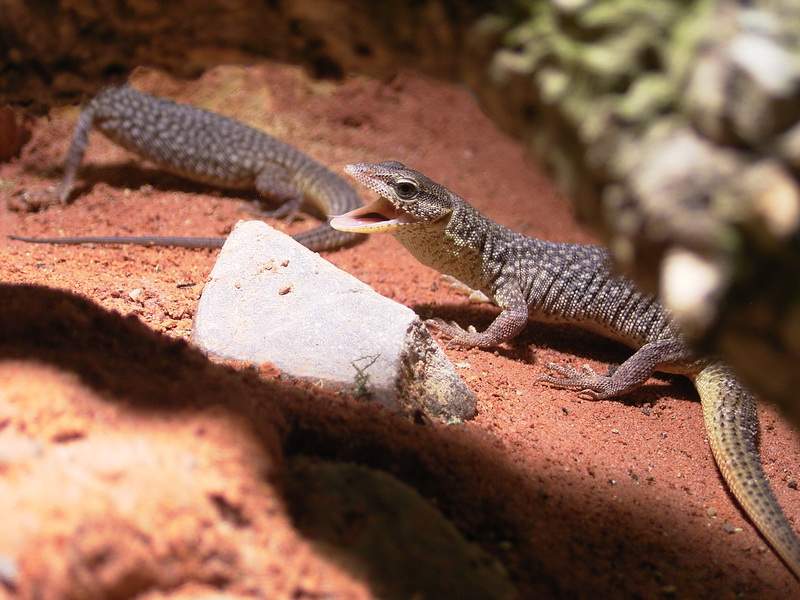
Monitors & tegus · Difficulty: Beginner to intermediate
Key facts and care guidance for Storr's monitor (Varanus storri) (origin: Northern and eastern Australia (Queensland)). Adult size around 30–40 cm total length. Life expectancy 10–15 years. The values below are carefully researched guidance.
Short answers
Storr's monitor: How big does the enclosure need to be?
120 x 60 x 60 cm (a single animal), larger for a pair.
Storr's monitor: What temperature does it need?
Daytime 28–33 °C, basking spot 45–50 °C, at night 20–24 °C.
Storr's monitor: Does it need UVB lighting?
UVB: Essential (desert and steppe-grade UVB, 10–12 %).
Storr's monitor: How long do they live?
Life expectancy: 10–15 years.
Storr's monitor: Is it suitable for beginners?
Partly – manageable with some prior knowledge (difficulty: Beginner to intermediate).
Climate
- Daytime temperature
- 28–33 °C
- Night temperature
- 20–24 °C
- Basking spot
- 45–50 °C
- Humidity
- 40–60 %
- UVB
- Essential (desert and steppe-grade UVB, 10–12 %)
Enclosure
- Minimum size
- 120 x 60 x 60 cm (a single animal), larger for a pair
- Substrate
- A sand-loam mix they can dig in, ~10–15 cm, with stacked stones and bark
Feeding
- Food
- Insects (crickets, roaches, locusts), rarely pinkies
- Feeding interval
- Adults 2–3×/week, juveniles daily
Key facts
- Adult size
- 30–40 cm total length
- Life expectancy
- 10–15 years
- Origin
- Northern and eastern Australia (Queensland)
- Protection status
- CITES Appendix II, EU Annex B, registration required
- Brumation
- None (a cooler dry spell is possible)
- Cohabitation
- Single housing is the least stressful choice. Keeping a pair (1.1) also works in a sufficiently large enclosure with several basking and hiding spots, but only as long as the pair gets along. The species is known for intolerance among conspecifics, especially in confined spaces: groups and several males only succeed in very large setups, ranking fights cannot be ruled out, and a subordinate animal can be permanently displaced or injured — a way to separate them should therefore always be at hand. Several animals each need their own basking and hiding spots; feed separately if sizes differ.
Notes
It needs a very hot, focused basking spot and heavily structured, diggable ground. A small, robust monitor and a good way into keeping monitors.
Do you keep this species?
Add your animal to Reptoria – Reptoria reminds you about feeding and shedding. Add your animal for free →
Look for Storr's monitor (Varanus storri) in the marketplace →
Related species
- Argus monitor (Varanus panoptes) – Expert
- Bengal monitor (Varanus bengalensis) – Expert
- Blue tree monitor (Varanus macraei) – Expert
- Blue-tailed monitor (Varanus doreanus) – Intermediate to expert
- Finsch's monitor (Varanus doreanus finschi) – Expert
- Boatsi tree monitor (Varanus boatsi) – Expert
- Bogert's tree monitor (Varanus bogerti) – Expert
- Lace monitor (Varanus varius) – Expert
What you need to start
To keep Storr's monitor (Varanus storri) you typically need: a suitable enclosure (120 x 60 x 60 cm (a single animal), larger for a pair), substrate (A sand-loam mix they can dig in, ~10–15 cm, with stacked stones and bark), a heat source with a thermostat, UVB lighting, thermometer and hygrometer, a water dish and hides. You will find equipment in the Reptoria marketplace.
The complete, interactive care database is in the Reptoria app.
Last updated: 9 October 2026 · Editor: Reptoria editorial team · Sources include: Wikipedia DE, echsen.net, monster-reptiles.com, reptile-database.reptarium.cz, Black-headed monitor / V. tristis (Wikipedia): Inkubation bei 27-29C, Schlupf Feb/Maerz nach Dez-Ablage – https://en.wikipedia.org/wiki/Black-headed_monitor
All values are non-binding guidance and do not replace expert advice. Research thoroughly from several sources before acquiring and keeping an animal, and observe the applicable law (species and animal protection in particular).