Strange-nosed chameleon (Kinyongia xenorhina)
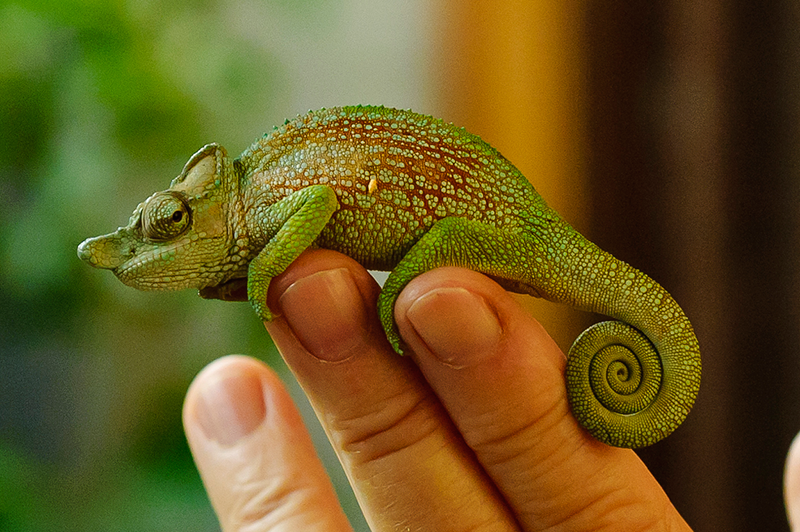
Chameleons · Difficulty: Expert
Key facts and care guidance for Strange-nosed chameleon (Kinyongia xenorhina) (origin: The Ruwenzori Mountains, western Uganda / eastern DR Congo, montane rainforest ~1,200–2,600 m). Adult size around approx. 20–30 cm total length (males with a striking plate-like nasal horn) – figure uncertain. Life expectancy not firmly documented (probably ~4–6 years) – uncertain. The values below are carefully researched guidance.
Short answers
Strange-nosed chameleon: How big does the enclosure need to be?
80×60×120 cm for one adult animal, very densely planted, with opaque sides (a visual screen).
Strange-nosed chameleon: What temperature does it need?
Daytime 18–22 °C (cool mountain climate, ~19 °C), basking spot 24–26 °C (moderate; overheating above 30 °C is dangerous), at night 12–16 °C.
Strange-nosed chameleon: Does it need UVB lighting?
UVB: UVB needed (Ferguson zone 2–3, UV index 3; natural sun in summer, otherwise a T5/T8 5.0).
Strange-nosed chameleon: How long do they live?
Life expectancy: not firmly documented (probably ~4–6 years) – uncertain.
Strange-nosed chameleon: Is it suitable for beginners?
No – better suited to experienced keepers (difficulty: Expert).
Climate
- Daytime temperature
- 18–22 °C (cool mountain climate, ~19 °C)
- Night temperature
- 12–16 °C
- Basking spot
- 24–26 °C (moderate; overheating above 30 °C is dangerous)
- Humidity
- 80–100 % (fogging before lights on in the morning)
- UVB
- UVB needed (Ferguson zone 2–3, UV index 3; natural sun in summer, otherwise a T5/T8 5.0)
Enclosure
- Minimum size
- 80×60×120 cm for one adult animal, very densely planted, with opaque sides (a visual screen)
- Substrate
- Damp forest floor or humus, moss, leaf litter; dense planting plus fine branches; good ventilation, no waterlogging
Feeding
- Food
- Insects: crickets, locusts, roaches, flying insects; calcium weekly (calcium plus D3 in winter)
- Feeding interval
- adults 2–3×/week, juveniles daily
Key facts
- Adult size
- approx. 20–30 cm total length (males with a striking plate-like nasal horn) – figure uncertain
- Life expectancy
- not firmly documented (probably ~4–6 years) – uncertain
- Origin
- The Ruwenzori Mountains, western Uganda / eastern DR Congo, montane rainforest ~1,200–2,600 m
- Protection status
- CITES Appendix II / EU Regulation Annex B – specially protected: proof of origin plus registration required; very rarely kept
- Brumation
- No brumation; a cool indoor winter spell with calcium and D3 supplementation; in summer they must be protected from heat above 35 °C (a cool room or cellar if needed)
- Cohabitation
- Keep them singly. Strictly territorial and solitary (the males are territorial and the females very shy). Only briefly together for breeding. NEVER keep males together
Notes
Expressly for experts only (not merely the "experienced"). Very shy; it needs visual screening and opaque sides, and misting in the morning. Keep it cool – it is sensitive to heat. The final size and lifespan are not cleanly documented in the sources.
Do you keep this species?
Add your animal to Reptoria – Reptoria reminds you about feeding and shedding. Add your animal for free →
Look for Strange-nosed chameleon (Kinyongia xenorhina) in the marketplace →
Related species
- Adolf Friedrich's chameleon (Kinyongia adolfifriderici) – Expert
- Böhme's two-horned chameleon (Kinyongia boehmei) – Expert
- Carpenter's chameleon (Kinyongia carpenteri) – Expert
- Fischer's two-horned chameleon (Kinyongia fischeri) – Intermediate
- Taveta two-horned chameleon (Kinyongia tavetana) – Intermediate
- Magombera chameleon (Kinyongia magomberae) – Expert
- Matschie's two-horned chameleon (Kinyongia matschiei) – Intermediate
- Sharp-nosed chameleon (Kinyongia oxyrhina) – Intermediate
What you need to start
To keep Strange-nosed chameleon (Kinyongia xenorhina) you typically need: a suitable enclosure (80×60×120 cm for one adult animal, very densely planted, with opaque sides (a visual screen)), substrate (Damp forest floor or humus, moss, leaf litter; dense planting plus fine branches; good ventilation, no waterlogging), a heat source with a thermostat, UVB lighting, thermometer and hygrometer, a water dish and hides. You will find equipment in the Reptoria marketplace.
The complete, interactive care database is in the Reptoria app.
Last updated: 9 October 2026 · Editor: Reptoria editorial team · Sources include: https://en.wikipedia.org/wiki/Kinyongia_xenorhina, https://reptile-database.reptarium.cz/species?genus=Kinyongia&species=xenorhina
All values are non-binding guidance and do not replace expert advice. Research thoroughly from several sources before acquiring and keeping an animal, and observe the applicable law (species and animal protection in particular).