Stripe-tailed monitor (Varanus caudolineatus)
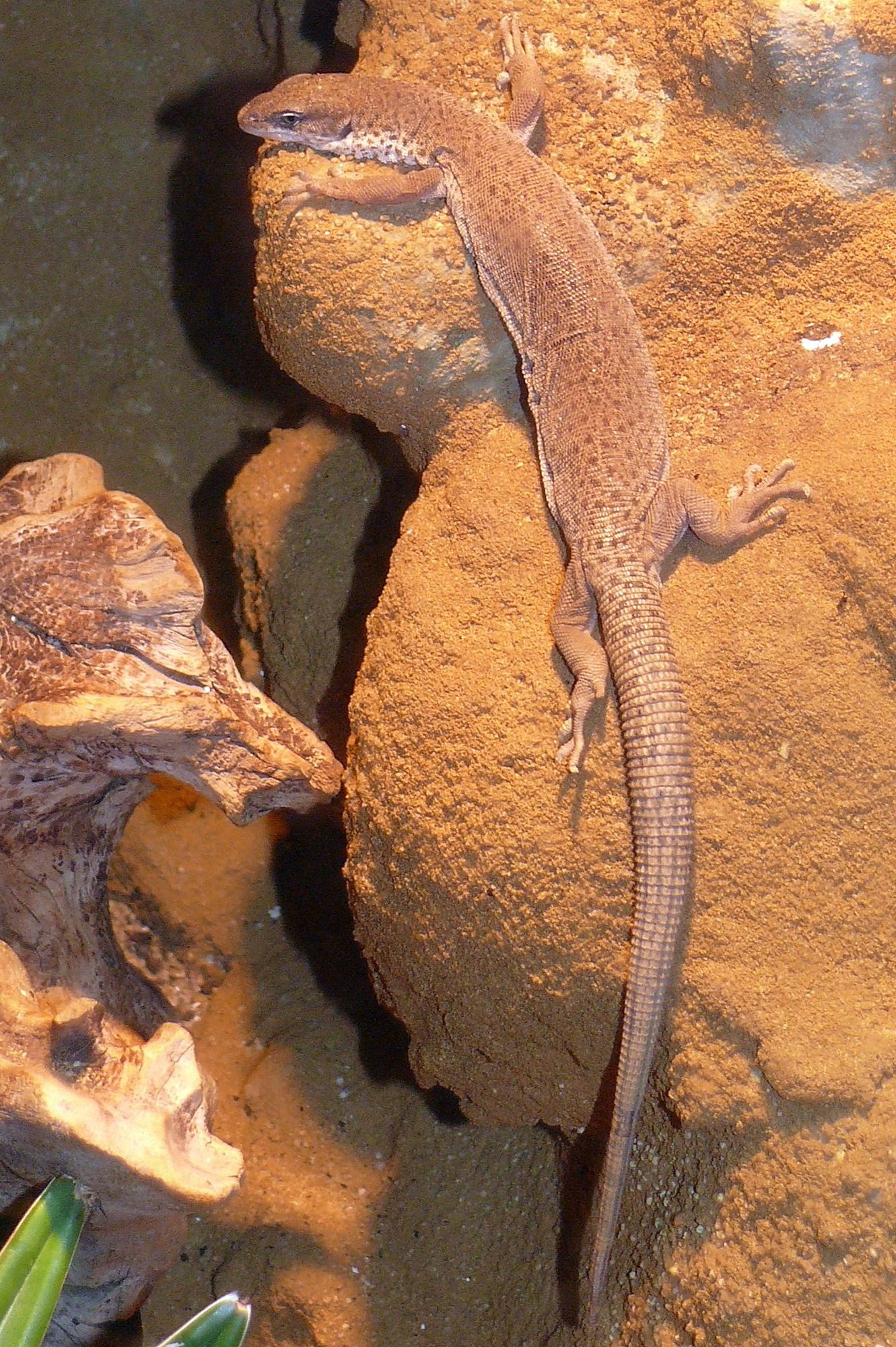
Monitors & tegus · Difficulty: Intermediate
Key facts and care guidance for Stripe-tailed monitor (Varanus caudolineatus) (origin: Western Australia (mulga and dry scrubland; semi-arboreal)). Adult size around approx. 25–32 cm total length (the tail longer than head and body). Life expectancy approx. 8–15 years in captivity. The values below are carefully researched guidance.
Short answers
Stripe-tailed monitor: How big does the enclosure need to be?
At least 80×45×45 cm for one animal (it climbs, plenty of hides); more floor area is better.
Stripe-tailed monitor: What temperature does it need?
Daytime 28–33 °C, basking spot 45–55 °C (spot-sized basking place), at night 20–24 °C.
Stripe-tailed monitor: Does it need UVB lighting?
UVB: UVB needed (Ferguson zone 3, UV index 3–5).
Stripe-tailed monitor: How long do they live?
Life expectancy: approx. 8–15 years in captivity.
Stripe-tailed monitor: Is it suitable for beginners?
Rather not – it is considered an intermediate species (difficulty: Intermediate).
Climate
- Daytime temperature
- 28–33 °C
- Night temperature
- 20–24 °C
- Basking spot
- 45–55 °C (spot-sized basking place)
- Humidity
- 40–60 % (arid species, a humid floor or hide microclimate)
- UVB
- UVB needed (Ferguson zone 3, UV index 3–5)
Enclosure
- Minimum size
- at least 80×45×45 cm for one animal (it climbs, plenty of hides); more floor area is better
- Substrate
- A sand-loam mix (diggable), cork and branches to climb, stacked bark
Feeding
- Food
- Insects (crickets, roaches, house crickets), occasionally small vertebrates or eggs; calcium and vitamins
- Feeding interval
- adults 2–3×/week, juveniles daily
Key facts
- Adult size
- approx. 25–32 cm total length (the tail longer than head and body)
- Life expectancy
- approx. 8–15 years in captivity
- Origin
- Western Australia (mulga and dry scrubland; semi-arboreal)
- Protection status
- CITES Appendix II / EU Annex B → registration required, proof of origin (an Australian export ban → captive-bred animals only)
- Brumation
- a slight winter drop (cooler, with a shorter day length) encourages breeding; no true brumation
- Cohabitation
- Paired or in a small group (1.1 or 1.2) is possible with plenty of space and hides - dwarf monitors are considered comparatively social. Use only one male and monitor for aggression/cannibalism; when in doubt, keep singly.
Notes
Identical to the species "Cowan water monitor" (V. caudolineatus) – listed twice in the source. A semi-arboreal dryland species (the line-tailed or stripe-tailed pygmy monitor), NOT a water monitor. Barely in the trade; the care is largely analogous to V. gilleni.
Do you keep this species?
Add your animal to Reptoria – Reptoria reminds you about feeding and shedding. Add your animal for free →
Look for Stripe-tailed monitor (Varanus caudolineatus) in the marketplace →
Related species
- Argus monitor (Varanus panoptes) – Expert
- Bengal monitor (Varanus bengalensis) – Expert
- Blue tree monitor (Varanus macraei) – Expert
- Blue-tailed monitor (Varanus doreanus) – Intermediate to expert
- Finsch's monitor (Varanus doreanus finschi) – Expert
- Boatsi tree monitor (Varanus boatsi) – Expert
- Bogert's tree monitor (Varanus bogerti) – Expert
- Lace monitor (Varanus varius) – Expert
What you need to start
To keep Stripe-tailed monitor (Varanus caudolineatus) you typically need: a suitable enclosure (at least 80×45×45 cm for one animal (it climbs, plenty of hides); more floor area is better), substrate (A sand-loam mix (diggable), cork and branches to climb, stacked bark), a heat source with a thermostat, UVB lighting, thermometer and hygrometer, a water dish and hides. You will find equipment in the Reptoria marketplace.
The complete, interactive care database is in the Reptoria app.
Last updated: 9 October 2026 · Editor: Reptoria editorial team · Sources include: https://de.wikipedia.org/wiki/Streifenschwanzwaran, https://reptile-database.reptarium.cz/species?genus=Varanus&species=caudolineatus
All values are non-binding guidance and do not replace expert advice. Research thoroughly from several sources before acquiring and keeping an animal, and observe the applicable law (species and animal protection in particular).