Twin-spotted ratsnake (Elaphe bimaculata)
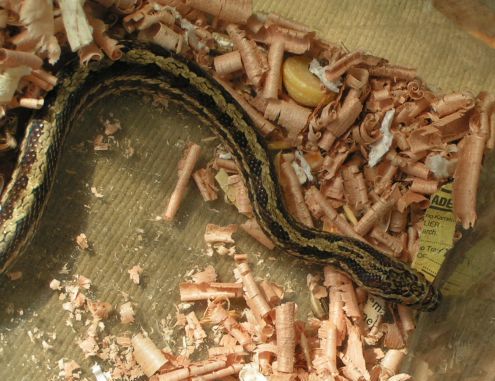
Snakes · Difficulty: Beginner
Key facts and care guidance for Twin-spotted ratsnake (Elaphe bimaculata) (origin: Central and eastern China: from eastern Sichuan via Hubei, Anhui, Jiangxi, Zhejiang and Jiangsu, north to Hebei – hills and mountains, forest edges, scrubland, farmland). Adult size around 60–100 cm, individual females up to 120 cm. Life expectancy 15–20 years. The values below are carefully researched guidance.
Short answers
Twin-spotted ratsnake: How big does the enclosure need to be?
From 100×50×100 cm for one animal up to 1 m total length (minimum size according to the 1997 expert report, ratsnakes: 1.0 × 0.5 × 1.0 of total length); large females and pairs from 120×60×120 cm.
Twin-spotted ratsnake: What temperature does it need?
Daytime 22–28 °C, basking spot 30 °C, at night 18–20 °C.
Twin-spotted ratsnake: Does it need UVB lighting?
UVB: Not essential.
Twin-spotted ratsnake: How long do they live?
Life expectancy: 15–20 years.
Twin-spotted ratsnake: Is it suitable for beginners?
Yes – it is considered suitable for beginners (difficulty: Beginner).
Climate
- Daytime temperature
- 22–28 °C
- Night temperature
- 18–20 °C
- Basking spot
- 30 °C
- Humidity
- 60–70 %
- UVB
- Not essential
Enclosure
- Minimum size
- from 100×50×100 cm for one animal up to 1 m total length (minimum size according to the 1997 expert report, ratsnakes: 1.0 × 0.5 × 1.0 of total length); large females and pairs from 120×60×120 cm
- Substrate
- Absorbent substrate (clay-sand mix, soil or bark mulch), climbing branches, several hides, a humid hide with moss, small water dish
Feeding
- Food
- Frozen-thawed mice (young animals pinkies, adults half-grown mice)
- Feeding interval
- adults every 7–14 days, juveniles weekly
Key facts
- Adult size
- 60–100 cm, individual females up to 120 cm
- Life expectancy
- 15–20 years
- Origin
- Central and eastern China: from eastern Sichuan via Hubei, Anhui, Jiangxi, Zhejiang and Jiangsu, north to Hebei – hills and mountains, forest edges, scrubland, farmland
- Protection status
- Not listed under CITES
- Brumation
- Winter rest of 2–3 months at about 10–15 °C (roughly December to February)
- Cohabitation
- Keeping it singly is the least stressful. Keeping a pair or a small group is possible with this species and is practised by keepers; females of similar size can be kept together well. The drawback is the risk of a feeding accident — if two animals grab the same prey, one can swallow the other along with it. So always feed separately, offer several hides and basking spots, and separate them if there is food refusal, bite injuries or weight loss.
Notes
A small Chinese ratsnake with two rows of blotches on its back, not to be confused with the European leopard snake (Zamenis situla). Needs a cool winter rest every year and small prey.
Do you keep this species?
Add your animal to Reptoria – Reptoria reminds you about feeding and shedding. Add your animal for free →
Look for Twin-spotted ratsnake (Elaphe bimaculata) in the marketplace →
Related species
- Russian rat snake (Elaphe schrenckii) – Beginner
- Dione rat snake (Elaphe dione) – Beginner
- King rat snake (Elaphe carinata) – Intermediate
- Four-lined snake (Elaphe quatuorlineata) – Intermediate
- Aesculapian snake (Zamenis longissimus) – Intermediate
- Baird's rat snake (Pantherophis bairdi) – Beginner
- Red bamboo rat snake (Oreocryptophis porphyraceus) – Intermediate
- Western fox snake (Pantherophis vulpinus) – Beginner
What you need to start
To keep Twin-spotted ratsnake (Elaphe bimaculata) you typically need: a suitable enclosure (from 100×50×100 cm for one animal up to 1 m total length (minimum size according to the 1997 expert report, ratsnakes: 1.0 × 0.5 × 1.0 of total length); large females and pairs from 120×60×120 cm), substrate (Absorbent substrate (clay-sand mix, soil or bark mulch), climbing branches, several hides, a humid hide with moss, small water dish), a heat source with a thermostat, UVB lighting, thermometer and hygrometer, a water dish and hides. You will find equipment in the Reptoria marketplace.
The complete, interactive care database is in the Reptoria app.
Last updated: 5 November 2026 · Editor: Reptoria editorial team · Sources include: Bartz 1989, Keeping and breeding Elaphe bimaculata, Litteratura Serpentium 9(6): 277–280 – Weibchen 90–100 cm, tag- und nachtaktiv, 25–30 °C, Winter 12–15 °C Dez.–Feb., kleine bis mittlere Mäuse, nervös, beißt kaum, 8 Eier, 28 °C, 25 Tage, Schlüpflinge 26–28 cm – https://www.snakesociety.nl/jaargangen/1989e/Litteratura%20Serpentium%209-6%20277-280%20Bartz,%20Keeping%20and%20breeding%20Elaphe%20bimaculata.pdf, Reptile Care Database (Obelgönner): Elaphe bimaculata – 70 cm, max. 120 cm, bis 20 Jahre, 80×50×60 cm, 22–28/18–20 °C, Spot 30 °C, 60–70 %, feuchtes Versteck, tagaktiv, Gruppen möglich, Winterruhe 3 Monate bei 11–13 °C, 3–10 Eier, ~40 Tage bei 26–27 °C, Schlüpflinge 30 cm – http://www.reptile-care.de/species/Serpentes/Colubridae/Elaphe-bimaculata.html, Wikipedia EN: Elaphe bimaculata – 60–80 cm, kleine Mäuse, versteckt, 3–10 Eier im späten Frühjahr, 35–48 Tage, Winterruhe 2–3 Monate – https://en.wikipedia.org/wiki/Elaphe_bimaculata, Diekmann, Asiatische Kletternattern: Zweiflecknatter – 0–1000 m, Kulturfolger, Verwechslung mit E. dione, Weibchen kräftiger, Weibchen zusammen gehalten, wählerisch bei Frostfutter, Geruch der Jungtiere, in der Winterruhe inaktiv; Überwinterung und Temperaturen der Kletternattern – http://bimaculata.de/, Reptile Database: Elaphe bimaculata Schmidt 1925 – Namen, Verbreitung, Verwechslung mit E. dione, IUCN LC – https://reptile-database.reptarium.cz/species?genus=Elaphe&species=bimaculata
All values are non-binding guidance and do not replace expert advice. Research thoroughly from several sources before acquiring and keeping an animal, and observe the applicable law (species and animal protection in particular).