Aesculapian snake (Zamenis longissimus)
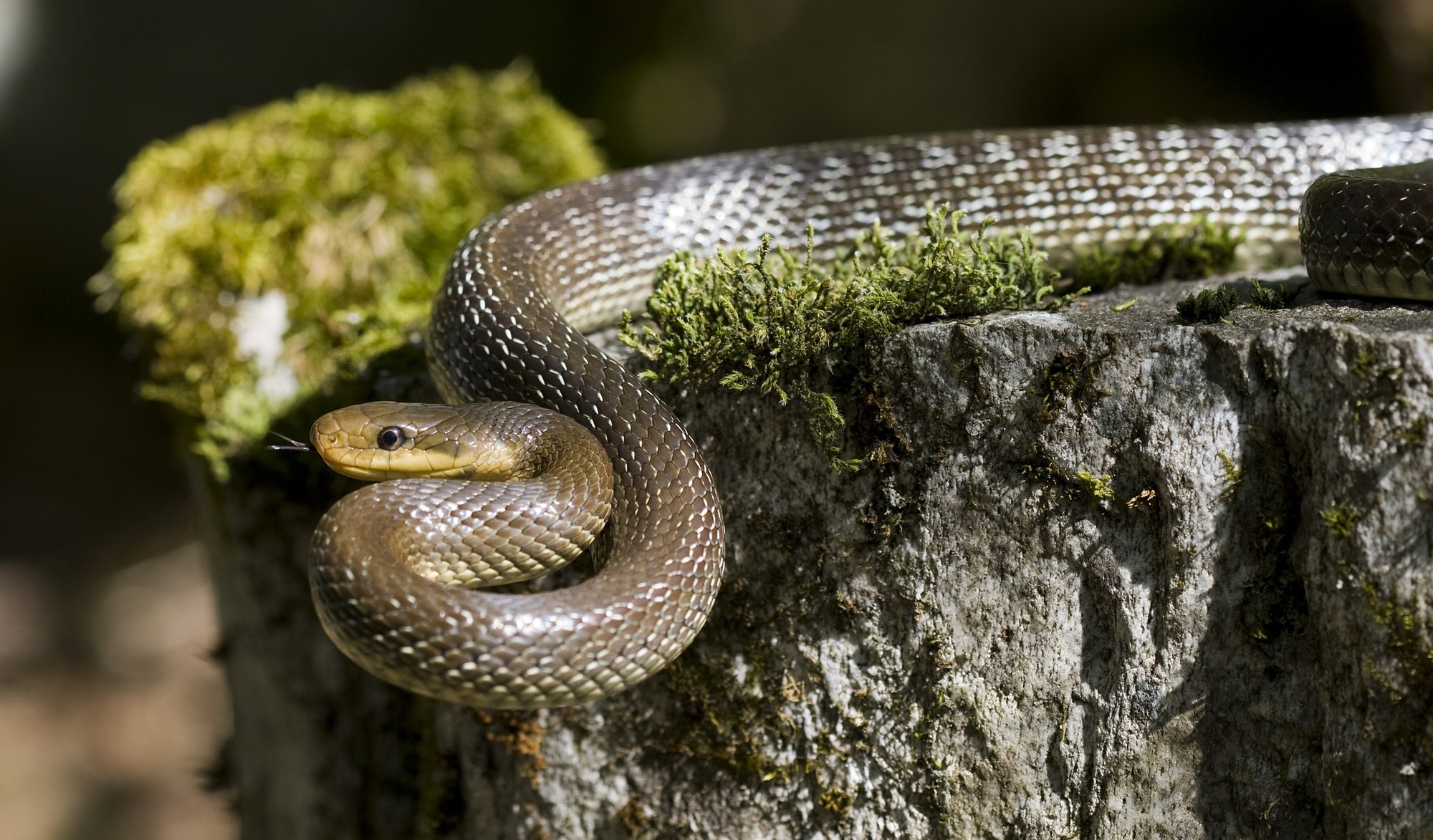
Snakes · Difficulty: Intermediate
Key facts and care guidance for Aesculapian snake (Zamenis longissimus) (origin: Southern and central Europe to Asia Minor). Adult size around 140–160 cm, individual animals up to 220 cm. Life expectancy 15–25 years, up to 30. The values below are carefully researched guidance.
Short answers
Aesculapian snake: How big does the enclosure need to be?
From 220×110×200 cm (minimum size per the 1997 expert report, formerly Elaphe).
Aesculapian snake: What temperature does it need?
Daytime 24–28 °C, basking spot ~30–32 °C (local basking spot), at night 18–20 °C.
Aesculapian snake: Does it need UVB lighting?
UVB: Recommended.
Aesculapian snake: How long do they live?
Life expectancy: 15–25 years, up to 30.
Aesculapian snake: Is it suitable for beginners?
Rather not – it is considered an intermediate species (difficulty: Intermediate).
Climate
- Daytime temperature
- 24–28 °C
- Night temperature
- 18–20 °C
- Basking spot
- ~30–32 °C (local basking spot)
- Humidity
- 60–70 %
- UVB
- Recommended
Enclosure
- Minimum size
- from 220×110×200 cm (minimum size per the 1997 expert report, formerly Elaphe)
- Substrate
- Dry substrate (bark mulch or beech leaves), with the water section separate
Feeding
- Food
- Mice (frozen-thawed); juveniles may also take lizards or nestlings
- Feeding interval
- Adults every 7–14 days
Key facts
- Adult size
- 140–160 cm, individual animals up to 220 cm
- Life expectancy
- 15–25 years, up to 30
- Origin
- Southern and central Europe to Asia Minor
- Protection status
- Strictly protected in Germany (Federal Nature Conservation Act, Habitats Directive Ann. IV) – proof of origin and registration are mandatory
- Brumation
- A winter rest of ~3–4 months at 8–12 °C (compulsory for health and breeding)
- Cohabitation
- In pairs or singly; feed separately. Even when kept together, a feeding accident remains the risk: always feed individually, ideally in separate boxes, and only house animals of roughly equal size together.
Notes
Non-venomous; a native, strictly protected species – legal proof of origin is essential. Fond of climbing, a tall terrarium and dry substrate (skin diseases if kept permanently wet).
Do you keep this species?
Add your animal to Reptoria – Reptoria reminds you about feeding and shedding. Add your animal for free →
Look for Aesculapian snake (Zamenis longissimus) in the marketplace →
Related species
- Leopard snake (Zamenis situla) – Intermediate
- Persian rat snake (Zamenis persicus) – Intermediate
- Russian rat snake (Elaphe schrenckii) – Beginner
- Baird's rat snake (Pantherophis bairdi) – Beginner
- Red bamboo rat snake (Oreocryptophis porphyraceus) – Intermediate
- Twin-spotted ratsnake (Elaphe bimaculata) – Beginner
- Western fox snake (Pantherophis vulpinus) – Beginner
- Rhinoceros rat snake (Gonyosoma boulengeri) – Intermediate
What you need to start
To keep Aesculapian snake (Zamenis longissimus) you typically need: a suitable enclosure (from 220×110×200 cm (minimum size per the 1997 expert report, formerly Elaphe)), substrate (Dry substrate (bark mulch or beech leaves), with the water section separate), a heat source with a thermostat, UVB lighting, thermometer and hygrometer, a water dish and hides. You will find equipment in the Reptoria marketplace.
The complete, interactive care database is in the Reptoria app.
Last updated: 5 November 2026 · Editor: Reptoria editorial team · Sources include: Wikipedia DE, Wikipedia EN, bfn.de (FFH-Anhang IV), einrichtungsbeispiele.de, eu_annex.txt (lokal)
All values are non-binding guidance and do not replace expert advice. Research thoroughly from several sources before acquiring and keeping an animal, and observe the applicable law (species and animal protection in particular).