Leopard snake (Zamenis situla)
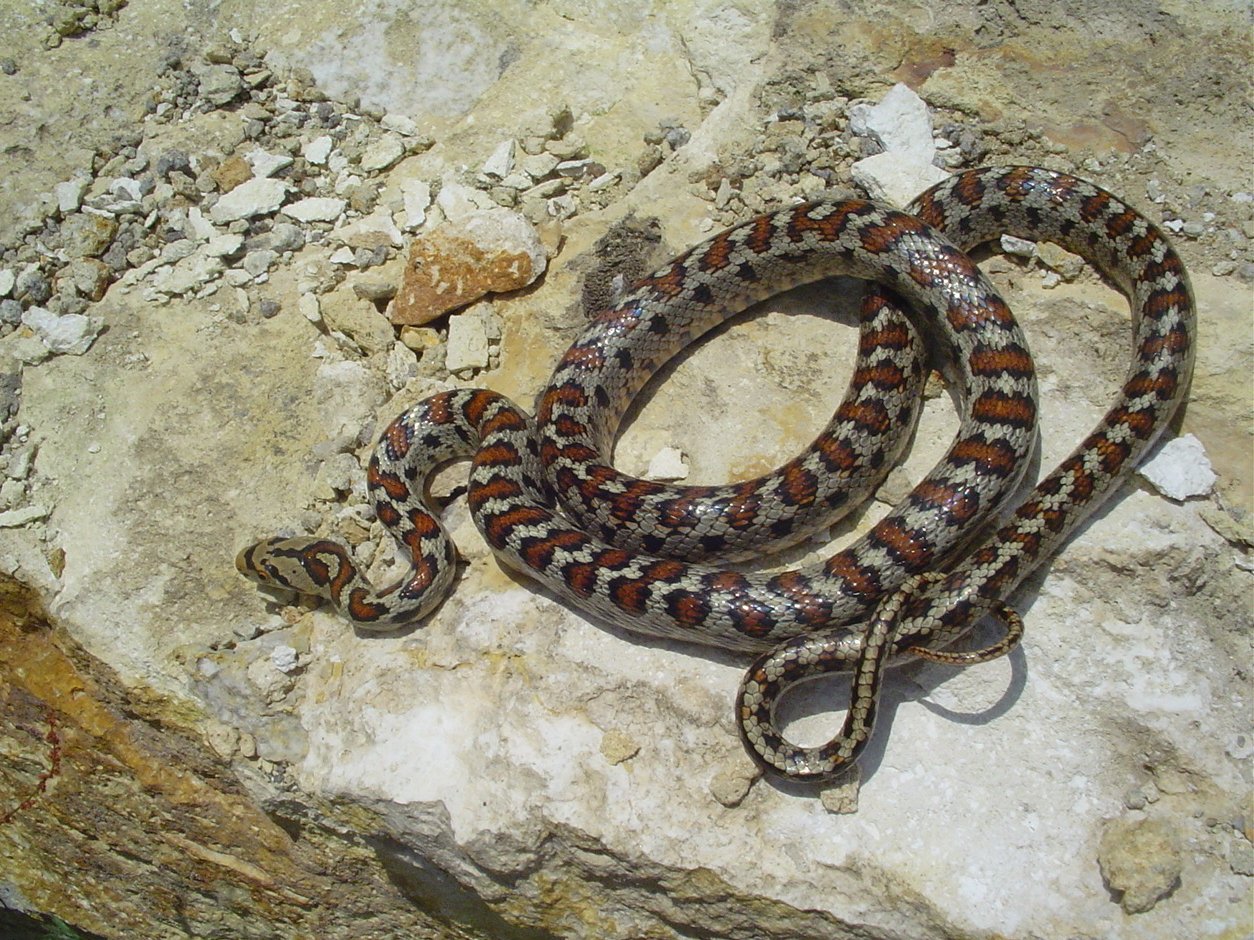
Snakes · Difficulty: Intermediate
Key facts and care guidance for Leopard snake (Zamenis situla) (origin: South-eastern Europe (Italy, the Balkans, Greece, Crimea, Asia Minor)). Adult size around 70–100 cm (rarely up to 120 cm). Life expectancy 15–20+ years in captivity. The values below are carefully researched guidance.
Short answers
Leopard snake: How big does the enclosure need to be?
From 120×60×120 cm (minimum size according to the 1997 expert report, formerly Elaphe, adult; richly structured with plenty of hides).
Leopard snake: What temperature does it need?
Daytime 24–28 °C, basking spot 30–32 °C (local hot spot), at night 18–20 °C.
Leopard snake: Does it need UVB lighting?
UVB: UVB not essential, weak UVB (Ferguson zone 1–2) recommended.
Leopard snake: How long do they live?
Life expectancy: 15–20+ years in captivity.
Leopard snake: Is it suitable for beginners?
Rather not – it is considered an intermediate species (difficulty: Intermediate).
Climate
- Daytime temperature
- 24–28 °C
- Night temperature
- 18–20 °C
- Basking spot
- 30–32 °C (local hot spot)
- Humidity
- 50–60 %
- UVB
- UVB not essential, weak UVB (Ferguson zone 1–2) recommended
Enclosure
- Minimum size
- from 120×60×120 cm (minimum size according to the 1997 expert report, formerly Elaphe, adult; richly structured with plenty of hides)
- Substrate
- A sand-loam mix or forest humus, cork tubes, rock structures; dry, with one damp hide
Feeding
- Food
- Frozen-thawed mice (small); juveniles are sometimes reluctant feeders (scenting with lizard may help)
- Feeding interval
- adults every 7–14 days, juveniles every 5–7 days
Key facts
- Adult size
- 70–100 cm (rarely up to 120 cm)
- Life expectancy
- 15–20+ years in captivity
- Origin
- South-eastern Europe (Italy, the Balkans, Greece, Crimea, Asia Minor)
- Protection status
- Strictly protected – Habitats Directive Annexes II and IV, "strictly protected" under German nature conservation law; registration with the nature conservation authority plus an unbroken chain of proof of origin or an EU commercial-use certificate are required
- Brumation
- A winter rest of about 10–12 weeks at 10–13 °C; lower the temperature slowly from late summer
- Cohabitation
- Keep them singly – do not keep them permanently in pairs; put them together only temporarily for supervised breeding
Notes
Considered "Europe's most beautiful snake", but trickier than the corn snake: it needs plenty of hides in different temperature and humidity zones, is not very active, and is partly a reluctant feeder. Acquire only legal captive-bred animals with papers.
Do you keep this species?
Add your animal to Reptoria – Reptoria reminds you about feeding and shedding. Add your animal for free →
Look for Leopard snake (Zamenis situla) in the marketplace →
Related species
- Aesculapian snake (Zamenis longissimus) – Intermediate
- Persian rat snake (Zamenis persicus) – Intermediate
- Russian rat snake (Elaphe schrenckii) – Beginner
- Baird's rat snake (Pantherophis bairdi) – Beginner
- Red bamboo rat snake (Oreocryptophis porphyraceus) – Intermediate
- Twin-spotted ratsnake (Elaphe bimaculata) – Beginner
- Western fox snake (Pantherophis vulpinus) – Beginner
- Rhinoceros rat snake (Gonyosoma boulengeri) – Intermediate
What you need to start
To keep Leopard snake (Zamenis situla) you typically need: a suitable enclosure (from 120×60×120 cm (minimum size according to the 1997 expert report, formerly Elaphe, adult; richly structured with plenty of hides)), substrate (A sand-loam mix or forest humus, cork tubes, rock structures; dry, with one damp hide), a heat source with a thermostat, UVB lighting, thermometer and hygrometer, a water dish and hides. You will find equipment in the Reptoria marketplace.
The complete, interactive care database is in the Reptoria app.
Last updated: 5 November 2026 · Editor: Reptoria editorial team · Sources include: http://www.kingsnake.com/blog/archives/4236-Leopard-Rat-Snake,-Zamenis-situla.html, https://en.wikipedia.org/wiki/Leopard_snake, https://reptile-database.reptarium.cz/species?genus=Zamenis&species=situla, Store norske leksikon: leopardsnok („normalt dagaktiv med størst aktivitet om ettermiddagen“) – https://snl.no/leopardsnok, Wikipedia DE: Leopardnatter („tag- und dämmerungsaktiv“, Literatur Klesius 2015, Kwet 2005) – https://de.wikipedia.org/wiki/Leopardnatter
All values are non-binding guidance and do not replace expert advice. Research thoroughly from several sources before acquiring and keeping an animal, and observe the applicable law (species and animal protection in particular).