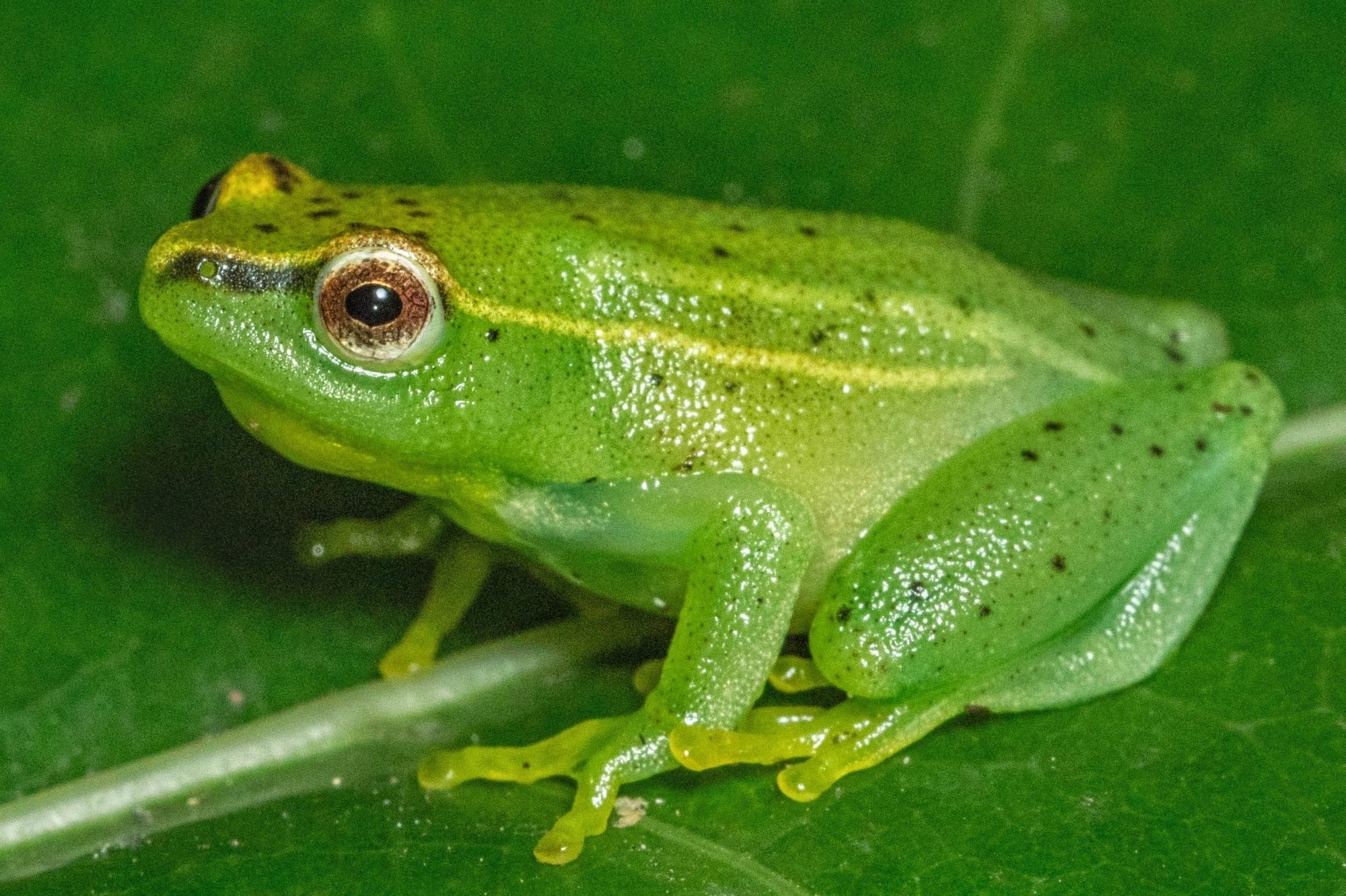
Water lily reed frog (Hyperolius pusillus)
Amphibians · Difficulty: Intermediate
Key facts and care guidance for Water lily reed frog (Hyperolius pusillus) (origin: South-eastern Africa). Adult size around 1,5–2,2 cm. Life expectancy 5–10 years. The values below are carefully researched guidance.
Short answers
Water lily reed frog: How big does the enclosure need to be?
50×40×50 cm for a group, planted.
Water lily reed frog: What temperature does it need?
Daytime 23–28 °C, basking spot No basking spot — direct heat is harmful, at night 19–22 °C.
Water lily reed frog: Does it need UVB lighting?
UVB: Weak UVB recommended (UVB 2.0).
Water lily reed frog: How long do they live?
Life expectancy: 5–10 years.
Water lily reed frog: Is it suitable for beginners?
Rather not – it is considered an intermediate species (difficulty: Intermediate).
Climate
- Daytime temperature
- 23–28 °C
- Night temperature
- 19–22 °C
- Basking spot
- No basking spot — direct heat is harmful
- Humidity
- 80–95 %
- UVB
- Weak UVB recommended (UVB 2.0)
Enclosure
- Minimum size
- 50×40×50 cm for a group, planted
- Substrate
- Forest-floor substrate with a drainage layer, moss, leaf litter and a shallow water section
Feeding
- Food
- Crickets, house crickets, fruit flies and firebrats, dusted regularly with calcium and vitamins
- Feeding interval
- adults 3–4×/week
Key facts
- Adult size
- 1,5–2,2 cm
- Life expectancy
- 5–10 years
- Origin
- South-eastern Africa
- Protection status
- Not listed under CITES
- Brumation
- No winter rest
- Cohabitation
- A group. Raise juveniles separately from adults. Not because they would be eaten - these animals are far too small for that - but because the larger ones reach food first and the small ones fall behind. Offer enough hiding spots so each animal can retreat, and feed separately if sizes differ.
Notes
Tiny and almost transparent. It spawns between floating leaves — floating plants are essential.
Do you keep this species?
Add your animal to Reptoria – Reptoria reminds you about feeding and shedding. Add your animal for free →
Look for Water lily reed frog (Hyperolius pusillus) in the marketplace →
Related species
- Argus reed frog (Hyperolius argus) – Intermediate
- Common reed frog (Hyperolius viridiflavus) – Intermediate
- Spotted reed frog (Hyperolius puncticulatus) – Intermediate
- Marbled reed frog (Hyperolius marmoratus) – Intermediate
- Tinker reed frog (Hyperolius tuberilinguis) – Intermediate
- Yellow-spotted tree frog (Leptopelis flavomaculatus) – Intermediate
- Greater leaf-folding frog (Afrixalus fornasini) – Intermediate
- Red-legged running frog (Kassina maculata) – Intermediate
What you need to start
To keep Water lily reed frog (Hyperolius pusillus) you typically need: a suitable enclosure (50×40×50 cm for a group, planted), substrate (Forest-floor substrate with a drainage layer, moss, leaf litter and a shallow water section), a heat source with a thermostat, UVB lighting, thermometer and hygrometer, a water dish and hides. You will find equipment in the Reptoria marketplace.
The complete, interactive care database is in the Reptoria app.
Last updated: 30 October 2026 · Editor: Reptoria editorial team · Sources include: https://en.wikipedia.org/wiki/Hyperolius, https://en.wikipedia.org/wiki/Hyperolius_pusillus
All values are non-binding guidance and do not replace expert advice. Research thoroughly from several sources before acquiring and keeping an animal, and observe the applicable law (species and animal protection in particular).