Yellow-bellied poison frog (Ameerega hahneli)
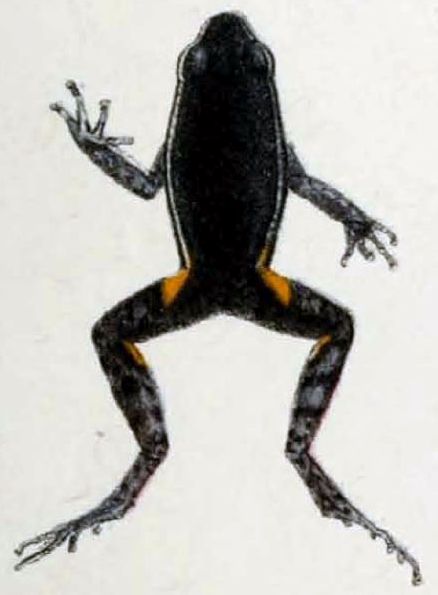
Amphibians · Difficulty: Intermediate
Key facts and care guidance for Yellow-bellied poison frog (Ameerega hahneli) (origin: Amazon basin — Brazil, Bolivia, Peru, Ecuador, Colombia, Venezuela, Guyana, French Guiana and Suriname; forest floor in tropical rainforest). Adult size around 1.7–2.2 cm (males 1.7–1.9 cm, females 1.9–2.2 cm). Life expectancy 5–10 years. The values below are carefully researched guidance.
Short answers
Yellow-bellied poison frog: How big does the enclosure need to be?
50×50×50 cm for a pair or a small group — a forest-floor dweller: floor space with a thick leaf-litter layer matters more than height; breeding additionally requires a spot with moving water.
Yellow-bellied poison frog: What temperature does it need?
Daytime 22–26 °C, basking spot No basking spot — direct heat is harmful, at night 18–21 °C.
Yellow-bellied poison frog: Does it need UVB lighting?
UVB: Weak UVB recommended (UVB 2.0), no strong lamp.
Yellow-bellied poison frog: How long do they live?
Life expectancy: 5–10 years.
Yellow-bellied poison frog: Is it suitable for beginners?
Rather not – it is considered an intermediate species (difficulty: Intermediate).
Climate
- Daytime temperature
- 22–26 °C
- Night temperature
- 18–21 °C
- Basking spot
- No basking spot — direct heat is harmful
- Humidity
- 80–95 %, mist daily
- UVB
- Weak UVB recommended (UVB 2.0), no strong lamp
Enclosure
- Minimum size
- 50×50×50 cm for a pair or a small group — a forest-floor dweller: floor space with a thick leaf-litter layer matters more than height; breeding additionally requires a spot with moving water
- Substrate
- Forest-floor substrate with a drainage layer, moss, leaf litter, bromeliads and film canisters as spawning sites
Feeding
- Food
- Springtails, fruit flies and aphids, dusted regularly with calcium and vitamins
- Feeding interval
- adults daily to every other day
Key facts
- Adult size
- 1.7–2.2 cm (males 1.7–1.9 cm, females 1.9–2.2 cm)
- Life expectancy
- 5–10 years
- Origin
- Amazon basin — Brazil, Bolivia, Peru, Ecuador, Colombia, Venezuela, Guyana, French Guiana and Suriname; forest floor in tropical rainforest
- Protection status
- CITES II — proof of origin required
- Brumation
- No winter rest, at most a short dry spell to trigger breeding
- Cohabitation
- Pair or small group. Unlike most poison frogs, this species also tolerates being kept in larger numbers: keepers report three males with one female without aggression. The males call to each other and thereby stake out their territories without fighting. What's needed is a floor area on which each male can find its own calling perch, plus dense leaf litter and several hiding spots. Freshly morphed juveniles are raised separately, because otherwise they lose out in the competition for tiny feeder insects.
Notes
A leaf-litter ground dweller, less fond of climbing than Ranitomeya.
Do you keep this species?
Add your animal to Reptoria – Reptoria reminds you about feeding and shedding. Add your animal for free →
Look for Yellow-bellied poison frog (Ameerega hahneli) in the marketplace →
Related species
- Bassler's poison frog (Ameerega bassleri) – Intermediate
- Painted poison frog (Ameerega picta) – Intermediate
- Ruby poison frog (Ameerega parvula) – Intermediate
- Yellow-striped poison frog (Ameerega flavopicta) – Intermediate
- Three-striped poison frog (Ameerega trivittata) – Intermediate
- Pepper's poison frog (Ameerega pepperi) – Intermediate
- Silverstone's poison frog (Ameerega silverstonei) – Intermediate
- Anthony's poison frog (Hyloxalus nexipus) – Intermediate
What you need to start
To keep Yellow-bellied poison frog (Ameerega hahneli) you typically need: a suitable enclosure (50×50×50 cm for a pair or a small group — a forest-floor dweller: floor space with a thick leaf-litter layer matters more than height; breeding additionally requires a spot with moving water), substrate (Forest-floor substrate with a drainage layer, moss, leaf litter, bromeliads and film canisters as spawning sites), a heat source with a thermostat, UVB lighting, thermometer and hygrometer, a water dish and hides. You will find equipment in the Reptoria marketplace.
The complete, interactive care database is in the Reptoria app.
Last updated: 2 November 2026 · Editor: Reptoria editorial team · Sources include: Wikipedia EN, herpetoculturenetwork.com, dartfrogconnection.com, drta-archiv.de, eu_annex.txt (lokal, VO (EU) 2026/1383)
All values are non-binding guidance and do not replace expert advice. Research thoroughly from several sources before acquiring and keeping an animal, and observe the applicable law (species and animal protection in particular).