Algerian jumping spider (Cyrba algerina)
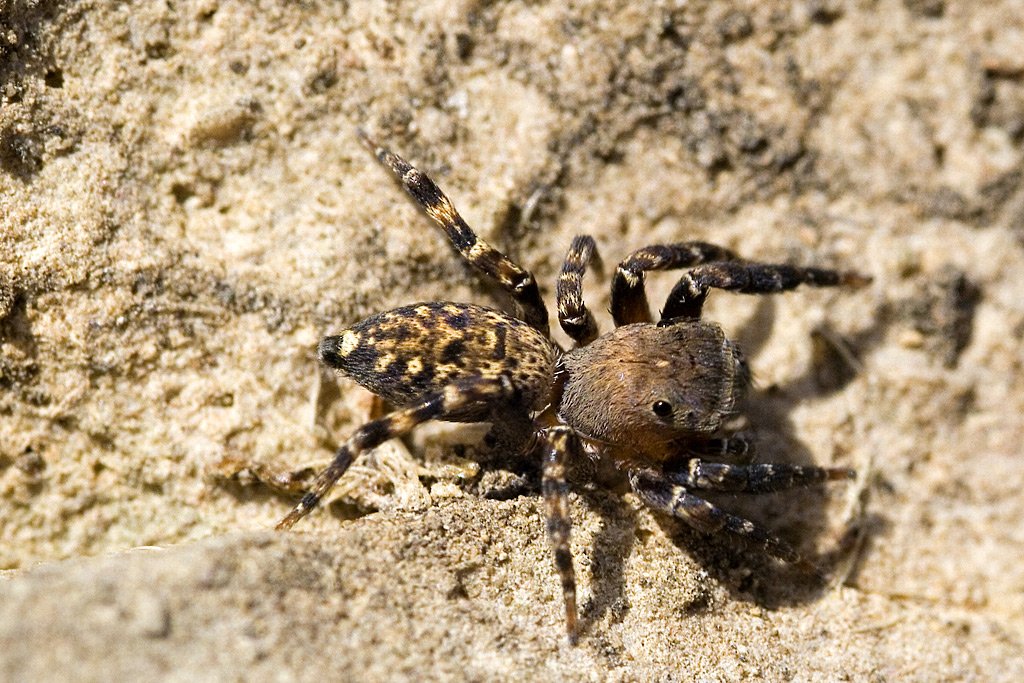
Invertebrates · Difficulty: Intermediate
Key facts and care guidance for Algerian jumping spider (Cyrba algerina) (origin: The Mediterranean (southern Europe, North Africa) to the Caucasus and Near East; the only European Cyrba species). Adult size around females 4.2–6.7 mm, males 3.5–4.9 mm (body length). Life expectancy approx. 1 year (short-lived). The values below are carefully researched guidance.
Short answers
Algerian jumping spider: How big does the enclosure need to be?
15×15×20 cm (tall format, plenty of climbing and hiding structures, cork and stones).
Algerian jumping spider: What temperature does it need?
Daytime 22–28 °C, at night 16–20 °C.
Algerian jumping spider: How long do they live?
Life expectancy: approx. 1 year (short-lived).
Algerian jumping spider: Is it suitable for beginners?
Rather not – it is considered an intermediate species (difficulty: Intermediate).
Algerian jumping spider: Can several be kept together?
Keeping them singly is essential – like all jumping spiders strictly solitary and cannibalistic, and additionally araneophagic (it deliberately eats other spiders).
Climate
- Daytime temperature
- 22–28 °C
- Night temperature
- 16–20 °C
- Basking spot
- —
- Humidity
- 50–65 %
Enclosure
- Minimum size
- 15×15×20 cm (tall format, plenty of climbing and hiding structures, cork and stones)
- Substrate
- Coco humus or terrarium soil with rock structures, a dry area plus one damp corner
Feeding
- Food
- Prefers spiders, especially web-building species (around 56% of prey in the wild, half of that orb-weavers). Besides that it also regularly eats insects it hunts away from webs — in captivity, flightless fruit flies, micro-crickets and small flies.
- Feeding interval
- adults ~1–2×/week, juveniles more often (every 1–2 days)
Key facts
- Adult size
- females 4.2–6.7 mm, males 3.5–4.9 mm (body length)
- Life expectancy
- approx. 1 year (short-lived)
- Origin
- The Mediterranean (southern Europe, North Africa) to the Caucasus and Near East; the only European Cyrba species
- Protection status
- Not listed under CITES; wild-caught native or European species fall under general species protection – prefer captive-bred animals
- Brumation
- A cool period mainly for sub-adult animals: in the wild the spiderlings hatch at the end of July, overwinter as sub-adults and only mature in spring. A few weeks at 10–15 °C replicates this and is useful for breeding; a cool period isn't necessary for already-adult animals.
- Cohabitation
- Keeping them singly is essential – like all jumping spiders strictly solitary and cannibalistic, and additionally araneophagic (it deliberately eats other spiders). NEVER keep males together; mate them only briefly and under supervision.
Notes
A specialist: rare in herpetoculture, with barely any solid keeper data → the husbandry figures are derived from general salticid care plus its biology (uncertain). Being araneophagous (about 56 % of its prey is spiders) makes feeding demanding. Distribution and size are well documented; concrete climate figures for keeping it are uncertain.
Do you keep this species?
Add your animal to Reptoria – Reptoria reminds you about feeding and shedding. Add your animal for free →
Look for Algerian jumping spider (Cyrba algerina) in the marketplace →
Related species
- Arched jumping spider (Evarcha arcuata) – Intermediate
- Bronze jumping spider (Hyllus semicupreus) – Beginner
- Peacock jumping spider (Saitis barbipes) – Intermediate
- Diard's jumping spider (Hyllus diardi) – Beginner
- Three-spotted jumping spider (Pellenes tripunctatus) – Intermediate
- Canopy jumping spider (Phidippus otiosus) – Beginner
- Fringed jumping spider (Portia fimbriata) – Expert
- Golden-eyed jumping spider (Heliophanus flavipes) – Intermediate
What you need to start
To keep Algerian jumping spider (Cyrba algerina) you typically need: a suitable enclosure (15×15×20 cm (tall format, plenty of climbing and hiding structures, cork and stones)), substrate (Coco humus or terrarium soil with rock structures, a dry area plus one damp corner), a heat source with a thermostat, thermometer and hygrometer, a water dish and hides. You will find equipment in the Reptoria marketplace.
The complete, interactive care database is in the Reptoria app.
Last updated: 9 October 2026 · Editor: Reptoria editorial team · Sources include: tandfonline.com (New Zealand Journal of Zoology, Jackson et al. 2004), Wikipedia EN, araneae.nmbe.ch (Spinnen Europas), EUR-Lex VO (EU) 2026/1383, arachnophoto.com
All values are non-binding guidance and do not replace expert advice. Research thoroughly from several sources before acquiring and keeping an animal, and observe the applicable law (species and animal protection in particular).