Fringed jumping spider (Portia fimbriata)
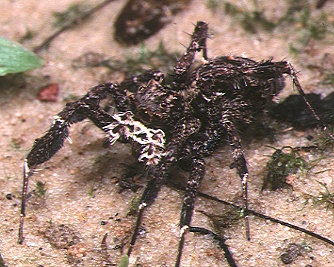
Invertebrates · Difficulty: Expert
Key facts and care guidance for Fringed jumping spider (Portia fimbriata) (origin: Northern Australia (WA, NT, Queensland) and South-East Asia; savannah woodland to rainforest, rock and cave margins). Adult size around females 6.8–10.5 mm, males 5.2–6.5 mm (body length). Life expectancy approx. 1–2 years (average ~1.5 years). The values below are carefully researched guidance.
Short answers
Fringed jumping spider: How big does the enclosure need to be?
20×20×30 cm (tall format, dense structure of bark and branches, a humid microclimate).
Fringed jumping spider: What temperature does it need?
Daytime 24–28 °C, at night 20–22 °C.
Fringed jumping spider: How long do they live?
Life expectancy: approx. 1–2 years (average ~1.5 years).
Fringed jumping spider: Is it suitable for beginners?
No – better suited to experienced keepers (difficulty: Expert).
Fringed jumping spider: Can several be kept together?
Keeping them singly is essential – solitary and cannibalistic, and additionally araneophagic (it deliberately eats other spiders).
Climate
- Daytime temperature
- 24–28 °C
- Night temperature
- 20–22 °C
- Basking spot
- —
- Humidity
- 70–80 %
Enclosure
- Minimum size
- 20×20×30 cm (tall format, dense structure of bark and branches, a humid microclimate)
- Substrate
- Coco humus, leaf litter, moss, cork; damp (a rainforest or savannah microclimate)
Feeding
- Food
- Araneophagic – it prefers other spiders (including web-builders); it sometimes takes insects or flies; a demanding feeder
- Feeding interval
- adults ~1–2×/week, juveniles more often (every 1–2 days)
Key facts
- Adult size
- females 6.8–10.5 mm, males 5.2–6.5 mm (body length)
- Life expectancy
- approx. 1–2 years (average ~1.5 years)
- Origin
- Northern Australia (WA, NT, Queensland) and South-East Asia; savannah woodland to rainforest, rock and cave margins
- Protection status
- Not CITES-listed; no special protection. Of Australian origin - export strictly regulated, usually captive-bred animals.
- Brumation
- None (a tropical species)
- Cohabitation
- Keeping them singly is essential – solitary and cannibalistic, and additionally araneophagic (it deliberately eats other spiders). NEVER keep males together; mate them only very briefly and under supervision.
Notes
A highly specialised, intelligent spider hunter (it uses prey vibrations and aggressive mimicry). Not a beginner's species: its prey is preferentially other spiders, so the food supply is a lot of work. Its biology, size and distribution are well documented; some concrete husbandry figures are derived.
Do you keep this species?
Add your animal to Reptoria – Reptoria reminds you about feeding and shedding. Add your animal for free →
Look for Fringed jumping spider (Portia fimbriata) in the marketplace →
Related species
- Algerian jumping spider (Cyrba algerina) – Intermediate
- Arched jumping spider (Evarcha arcuata) – Intermediate
- Bronze jumping spider (Hyllus semicupreus) – Beginner
- Peacock jumping spider (Saitis barbipes) – Intermediate
- Diard's jumping spider (Hyllus diardi) – Beginner
- Three-spotted jumping spider (Pellenes tripunctatus) – Intermediate
- Canopy jumping spider (Phidippus otiosus) – Beginner
- Golden-eyed jumping spider (Heliophanus flavipes) – Intermediate
What you need to start
To keep Fringed jumping spider (Portia fimbriata) you typically need: a suitable enclosure (20×20×30 cm (tall format, dense structure of bark and branches, a humid microclimate)), substrate (Coco humus, leaf litter, moss, cork; damp (a rainforest or savannah microclimate)), a heat source with a thermostat, thermometer and hygrometer, a water dish and hides. You will find equipment in the Reptoria marketplace.
The complete, interactive care database is in the Reptoria app.
Last updated: 2 November 2026 · Editor: Reptoria editorial team · Sources include: https://animaldiversity.org/accounts/Portia_fimbriata/, https://en.wikipedia.org/wiki/Portia_fimbriata
All values are non-binding guidance and do not replace expert advice. Research thoroughly from several sources before acquiring and keeping an animal, and observe the applicable law (species and animal protection in particular).