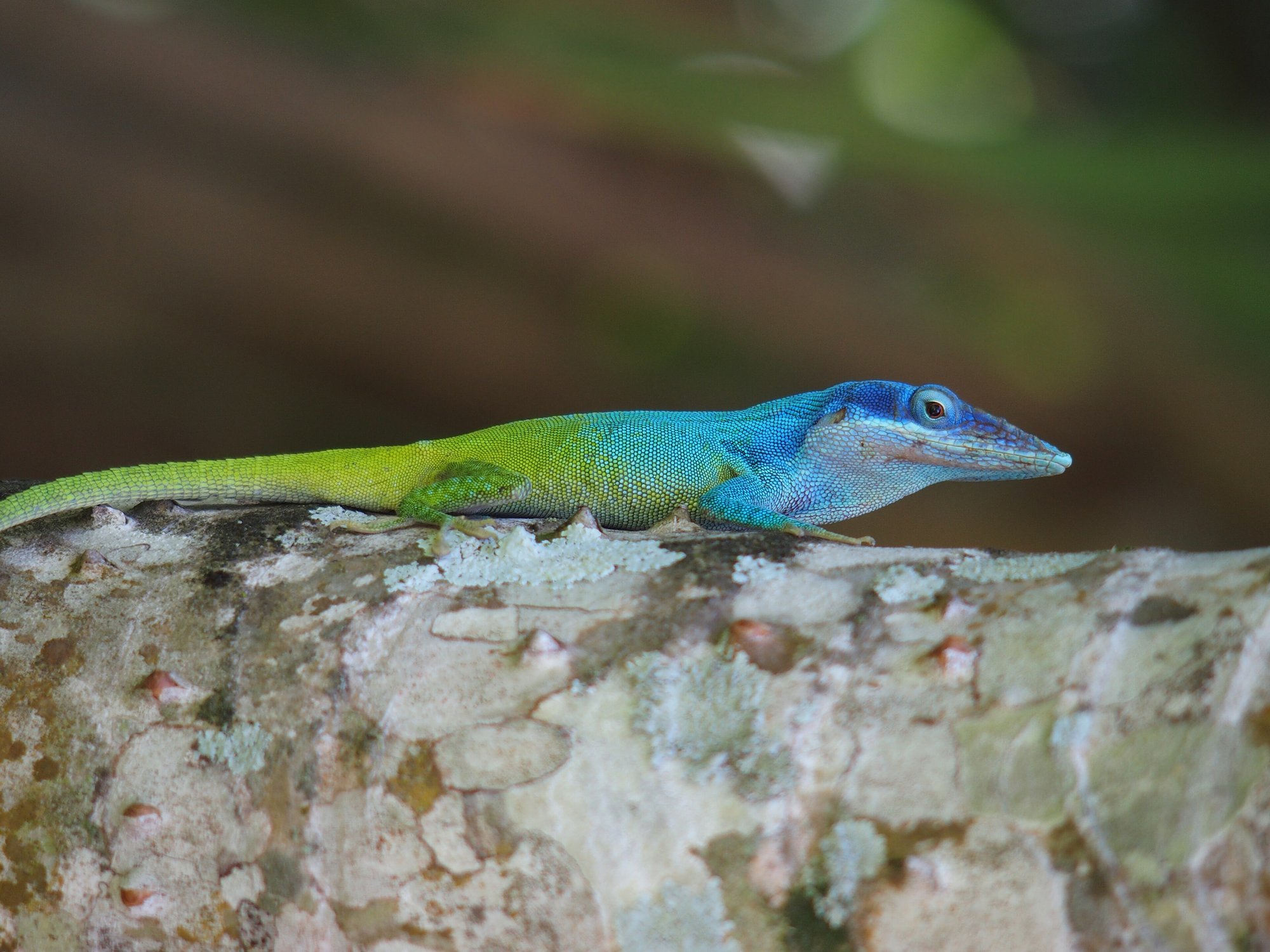
Allison's anole (Anolis allisoni)
Iguanas · Difficulty: Beginner with some knowledge
Key facts and care guidance for Allison's anole (Anolis allisoni) (origin: Cuba (except the west and the extreme southeast), the Islas de la Bahia including Roatan and Guanaja as well as Cayos Cochinos (Honduras), Half Moon Caye (Belize) and Mexico (Quintana Roo, Campeche); introduced to south Florida. A trunk-crown dweller, often on palm trunks). Adult size around males SVL ~10 cm, total length ~18–20 cm; females ~7–8 cm SVL. Life expectancy approx. 8–10 years in captivity. The values below are carefully researched guidance.
Short answers
Allison's anole: How big does the enclosure need to be?
Single animal at least 60×45×80 cm, for a pair 60×60×80 cm, group from 80×60×100 cm; sturdy vertical trunks and cork tubes, densely planted.
Allison's anole: What temperature does it need?
Daytime 26–30 °C, basking spot 32–35 °C locally under the lamp, at night 20–24 °C, not below 18 °C.
Allison's anole: Does it need UVB lighting?
UVB: UVB needed (Ferguson zone 2–3, UV index 2–4).
Allison's anole: How long do they live?
Life expectancy: approx. 8–10 years in captivity.
Allison's anole: Is it suitable for beginners?
Partly – manageable with some prior knowledge (difficulty: Beginner with some knowledge).
Climate
- Daytime temperature
- 26–30 °C
- Night temperature
- 20–24 °C, not below 18 °C
- Basking spot
- 32–35 °C locally under the lamp
- Humidity
- 60–70 %
- UVB
- UVB needed (Ferguson zone 2–3, UV index 2–4)
Enclosure
- Minimum size
- Single animal at least 60×45×80 cm, for a pair 60×60×80 cm, group from 80×60×100 cm; sturdy vertical trunks and cork tubes, densely planted
- Substrate
- Damp tropical substrate, leaf litter, live plants, climbing branches
Feeding
- Food
- Insects (crickets, flies, small roaches); fruit flies or small house crickets for juveniles
- Feeding interval
- adults 2–3×/week, juveniles daily
Key facts
- Adult size
- males SVL ~10 cm, total length ~18–20 cm; females ~7–8 cm SVL
- Life expectancy
- approx. 8–10 years in captivity
- Origin
- Cuba (except the west and the extreme southeast), the Islas de la Bahia including Roatan and Guanaja as well as Cayos Cochinos (Honduras), Half Moon Caye (Belize) and Mexico (Quintana Roo, Campeche); introduced to south Florida. A trunk-crown dweller, often on palm trunks
- Protection status
- Not listed under CITES; no German registration duty as a non-native species; prefer captive-bred animals
- Brumation
- None (tropical)
- Cohabitation
- Keeping a pair (1.1) is the least stressful option; never keep males together. One male with several females is possible in a large, well-structured terrarium, but: females defend territories too, and a subordinate animal often loses weight unnoticed — separate it if that happens.
Notes
A striking blue head colour in the males (the blue-throated or Allison's anole). Sun-loving and diurnal. It lays a single egg about every 2 weeks. A common mistake: permanently too humid and poorly ventilated.
Do you keep this species?
Add your animal to Reptoria – Reptoria reminds you about feeding and shedding. Add your animal for free →
Look for Allison's anole (Anolis allisoni) in the marketplace →
Related species
- Ghost anole (Anolis lemurinus) – Intermediate
- Ahl's anole (Anolis ahli) – Intermediate
- Aliniger anole (Anolis aliniger) – Beginner with some knowledge
- Allogus anole (Anolis allogus) – Beginner with some knowledge
- Bahaman green anole (Anolis smaragdinus) – Beginner
- Bahoruco anole (Anolis bahorucoensis) – Beginner with some knowledge
- Baleatus giant anole (Anolis baleatus) – Intermediate
- Baracoa giant anole (Anolis baracoae) – Intermediate
What you need to start
To keep Allison's anole (Anolis allisoni) you typically need: a suitable enclosure (Single animal at least 60×45×80 cm, for a pair 60×60×80 cm, group from 80×60×100 cm; sturdy vertical trunks and cork tubes, densely planted), substrate (Damp tropical substrate, leaf litter, live plants, climbing branches), a heat source with a thermostat, UVB lighting, thermometer and hygrometer, a water dish and hides. You will find equipment in the Reptoria marketplace.
The complete, interactive care database is in the Reptoria app.
Last updated: 9 October 2026 · Editor: Reptoria editorial team · Sources include: Wikipedia EN, joshsfrogs.com, reptile-database.reptarium.cz, einrichtungsbeispiele.de, eu_annex.txt (lokal, VO (EU) 2026/1383)
All values are non-binding guidance and do not replace expert advice. Research thoroughly from several sources before acquiring and keeping an animal, and observe the applicable law (species and animal protection in particular).