Armoured pricklenape (Acanthosaura armata)
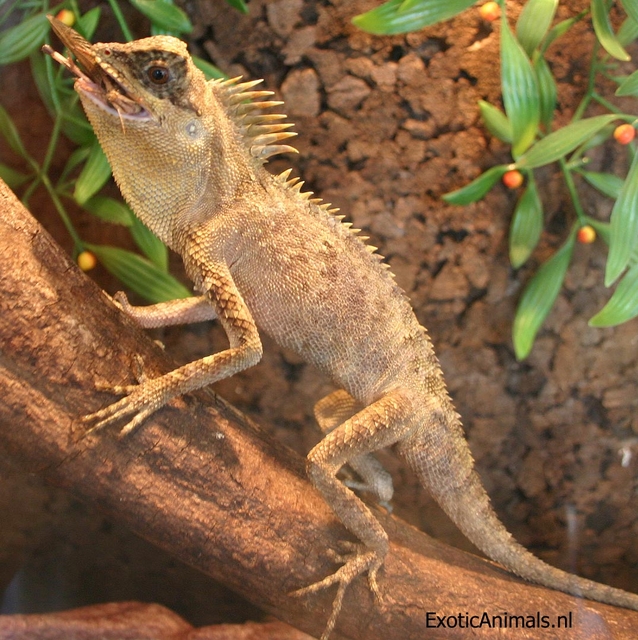
Agamas · Difficulty: Intermediate
Key facts and care guidance for Armoured pricklenape (Acanthosaura armata) (origin: Peninsular Malaysia, Singapore, southern Thailand, Sumatra, Borneo; lowland and montane rainforest). Adult size around one of the largest species: approx. 28–30 cm total length (with the tail), males larger. Life expectancy approx. 8–12 years. The values below are carefully researched guidance.
Short answers
Armoured pricklenape: How big does the enclosure need to be?
100×60×120 cm for one adult animal, larger animals or an aqua-terrarium are better; height matters.
Armoured pricklenape: What temperature does it need?
Daytime 24–28 °C, basking spot local warm spot up to 30–32 °C (do not overheat the enclosure), at night 20–22 °C.
Armoured pricklenape: Does it need UVB lighting?
UVB: UVB needed (a forest dweller, Ferguson zone 1–2, UV index 1–3; for D3 synthesis).
Armoured pricklenape: How long do they live?
Life expectancy: approx. 8–12 years.
Armoured pricklenape: Is it suitable for beginners?
Rather not – it is considered an intermediate species (difficulty: Intermediate).
Climate
- Daytime temperature
- 24–28 °C
- Night temperature
- 20–22 °C
- Basking spot
- local warm spot up to 30–32 °C (do not overheat the enclosure)
- Humidity
- 70–90 % by day, up to ~100 % at night (good ventilation against mould)
- UVB
- UVB needed (a forest dweller, Ferguson zone 1–2, UV index 1–3; for D3 synthesis)
Enclosure
- Minimum size
- 100×60×120 cm for one adult animal, larger animals or an aqua-terrarium are better; height matters
- Substrate
- Coco humus or forest floor with leaf litter and moss, a drainage layer; a large water section
Feeding
- Food
- Insectivorous: crickets, roaches, earthworms, larvae; large animals rarely take a nestling mouse or smelt; calcium and D3
- Feeding interval
- adults 2–3×/week, juveniles daily
Key facts
- Adult size
- one of the largest species: approx. 28–30 cm total length (with the tail), males larger
- Life expectancy
- approx. 8–12 years
- Origin
- Peninsular Malaysia, Singapore, southern Thailand, Sumatra, Borneo; lowland and montane rainforest
- Protection status
- Not listed under CITES (as far as research shows); mostly wild-caught – look for captive breeding and proof of origin
- Brumation
- No pronounced winter rest (a tropical lowland distribution); only a mild seasonal drop
- Cohabitation
- Single housing. The lower-stress option is one animal per enclosure, as there is no evidence that pricklenapes need company. Pairs or small groups work according to care sheets as long as several males are never kept together; the drawback is that the enclosure must then be proportionally larger and stress between the animals is hard to spot.
Notes
The "Malayan / black-naped forest dragon". A large species → a large, tall humid terrarium with a water section. High humidity with good ventilation (a risk of mould and respiratory problems). The main mistakes: too small, too warm or too dry.
Do you keep this species?
Add your animal to Reptoria – Reptoria reminds you about feeding and shedding. Add your animal for free →
Look for Armoured pricklenape (Acanthosaura armata) in the marketplace →
Related species
- Bintang mountain horned lizard (Acanthosaura bintangensis) – Intermediate
- Short-legged horned lizard (Acanthosaura brachypoda) – Intermediate
- Brown pricklenape (Acanthosaura lepidogaster) – Intermediate
- Cardamom mountain horned lizard (Acanthosaura cardamomensis) – Intermediate
- Crowned pricklenape (Acanthosaura coronata) – Intermediate
- Golden pricklenape (Acanthosaura capra) – Intermediate
- Masked spiny lizard (Acanthosaura crucigera) – Intermediate
- Natalia's pricklenape (Acanthosaura nataliae) – Intermediate
What you need to start
To keep Armoured pricklenape (Acanthosaura armata) you typically need: a suitable enclosure (100×60×120 cm for one adult animal, larger animals or an aqua-terrarium are better; height matters), substrate (Coco humus or forest floor with leaf litter and moss, a drainage layer; a large water section), a heat source with a thermostat, UVB lighting, thermometer and hygrometer, a water dish and hides. You will find equipment in the Reptoria marketplace.
The complete, interactive care database is in the Reptoria app.
Last updated: 7 November 2026 · Editor: Reptoria editorial team · Sources include: Mountain Horned Dragons (Acanthosaura) - 140-190 Tage, 19-24°C, 70-80% Feuchte – http://www.kingsnake.com/mhd/MHDkingsnake.html, Acanthosaura crucigera - Vergleichswert derselben Gattung – https://grokipedia.com/page/acanthosaura_crucigera, https://dubiaroaches.com/blogs/lizard-care/mountain-horned-dragon-care-sheet, https://en.wikipedia.org/wiki/Acanthosaura, https://en.wikipedia.org/wiki/Acanthosaura_armata
All values are non-binding guidance and do not replace expert advice. Research thoroughly from several sources before acquiring and keeping an animal, and observe the applicable law (species and animal protection in particular).