Barbados anole (Anolis extremus)
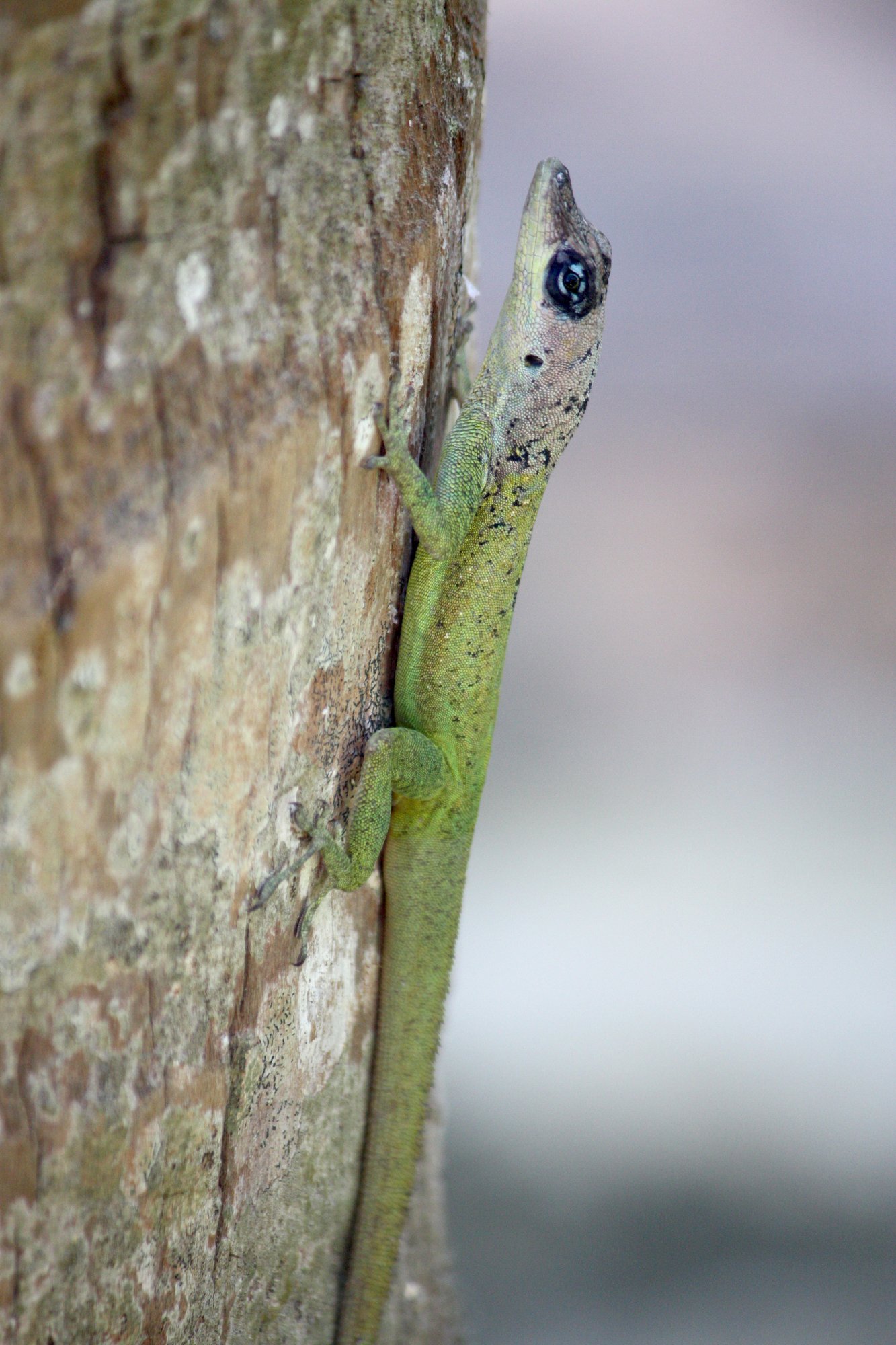
Iguanas · Difficulty: Beginner to intermediate
Key facts and care guidance for Barbados anole (Anolis extremus) (origin: Barbados (endemic); naturalised on Bermuda, St. Lucia and in Venezuela, with unstable occurrences in Florida and on Trinidad and Tobago. Habitat: dry forest to moderately humid forest, all habitats except open grassland). Adult size around approx. 15–20 cm total length (males about 20 cm, females about 17 cm). Life expectancy ~4–6 years. The values below are carefully researched guidance.
Short answers
Barbados anole: How big does the enclosure need to be?
From 50×50×80 cm for one animal; for a pair from 55×50×80 cm (15 % more floor space per additional animal, as in the 1997 expert report).
Barbados anole: What temperature does it need?
Daytime 26–30 °C, basking spot Local basking spot 32–40 °C, at night 20–23 °C.
Barbados anole: Does it need UVB lighting?
UVB: Essential (UVB 5.0–10.0, plus strong lighting).
Barbados anole: How long do they live?
Life expectancy: ~4–6 years.
Barbados anole: Is it suitable for beginners?
Partly – manageable with some prior knowledge (difficulty: Beginner to intermediate).
Climate
- Daytime temperature
- 26–30 °C
- Night temperature
- 20–23 °C
- Basking spot
- Local basking spot 32–40 °C
- Humidity
- 60–80 %
- UVB
- Essential (UVB 5.0–10.0, plus strong lighting)
Enclosure
- Minimum size
- from 50×50×80 cm for one animal; for a pair from 55×50×80 cm (15 % more floor space per additional animal, as in the 1997 expert report)
- Substrate
- Forest floor or soil, planted, climbing branches
Feeding
- Food
- Invertebrates: crickets, small grasshoppers, roaches, flies, occasionally waxworms; plus occasional fruit; dusted regularly with calcium and vitamins
- Feeding interval
- Several times a week
Key facts
- Adult size
- approx. 15–20 cm total length (males about 20 cm, females about 17 cm)
- Life expectancy
- ~4–6 years
- Origin
- Barbados (endemic); naturalised on Bermuda, St. Lucia and in Venezuela, with unstable occurrences in Florida and on Trinidad and Tobago. Habitat: dry forest to moderately humid forest, all habitats except open grassland
- Protection status
- —
- Brumation
- None (a slight drop is possible)
- Cohabitation
- 1.1 to 1.4. Never males together — they fight over territory and basking spot until one is injured or permanently confined to a corner. One male can be kept with up to four females if the enclosure is large enough and offers several basking spots and visual screens; if the females are too crowded the lower-ranking animal loses condition, often without a visible bite wound.
Notes
A robust, semi-arboreal species. The figures are largely derived from general anole husbandry plus its origin.
Do you keep this species?
Add your animal to Reptoria – Reptoria reminds you about feeding and shedding. Add your animal for free →
Look for Barbados anole (Anolis extremus) in the marketplace →
Related species
- Ghost anole (Anolis lemurinus) – Intermediate
- Ahl's anole (Anolis ahli) – Intermediate
- Aliniger anole (Anolis aliniger) – Beginner with some knowledge
- Allogus anole (Anolis allogus) – Beginner with some knowledge
- Bahaman green anole (Anolis smaragdinus) – Beginner
- Bahoruco anole (Anolis bahorucoensis) – Beginner with some knowledge
- Baleatus giant anole (Anolis baleatus) – Intermediate
- Baracoa giant anole (Anolis baracoae) – Intermediate
What you need to start
To keep Barbados anole (Anolis extremus) you typically need: a suitable enclosure (from 50×50×80 cm for one animal; for a pair from 55×50×80 cm (15 % more floor space per additional animal, as in the 1997 expert report)), substrate (Forest floor or soil, planted, climbing branches), a heat source with a thermostat, UVB lighting, thermometer and hygrometer, a water dish and hides. You will find equipment in the Reptoria marketplace.
The complete, interactive care database is in the Reptoria app.
Last updated: 9 October 2026 · Editor: Reptoria editorial team · Sources include: einrichtungsbeispiele.de, karibische-anolis.de, interaquaristik.de, en.wikipedia.org (Barbados anole), EUR-Lex VO (EU) 2026/1383
All values are non-binding guidance and do not replace expert advice. Research thoroughly from several sources before acquiring and keeping an animal, and observe the applicable law (species and animal protection in particular).