Barbour's anole (Anolis barbouri)
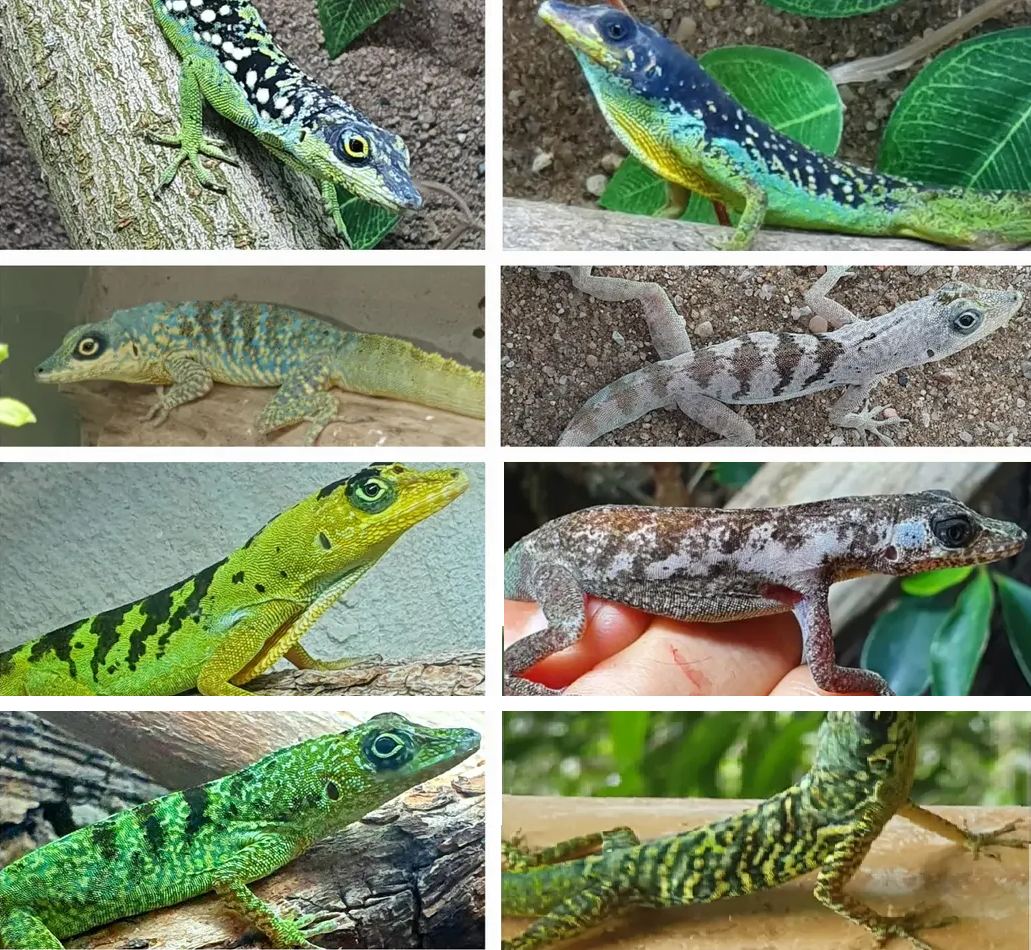
Iguanas · Difficulty: Expert
Key facts and care guidance for Barbour's anole (Anolis barbouri) (origin: Hispaniola: southern Haiti (Massif de la Hotte, Tiburon Peninsula) and western Dominican Republic (Sierra de Bahoruco); montane cloud forest, documented at around 1050–1150 m). Adult size around 10–13 cm. Life expectancy 4–8 years. The values below are carefully researched guidance.
Short answers
Barbour's anole: How big does the enclosure need to be?
Wide format, at least 80×50×50 cm for a pair — floor space and a deep leaf-litter layer matter more than height; flat hides, pieces of bark and low branches instead of a climbing wall.
Barbour's anole: What temperature does it need?
Daytime 22–27 °C ambient temperature, local basking spot up to about 32 °C; a montane forest species, no permanent heat, basking spot Basking spot 32–35 °C, at night 19–22 °C.
Barbour's anole: Does it need UVB lighting?
UVB: Essential (UVB 5.0).
Barbour's anole: How long do they live?
Life expectancy: 4–8 years.
Barbour's anole: Is it suitable for beginners?
No – better suited to experienced keepers (difficulty: Expert).
Climate
- Daytime temperature
- 22–27 °C ambient temperature, local basking spot up to about 32 °C; a montane forest species, no permanent heat
- Night temperature
- 19–22 °C
- Basking spot
- Basking spot 32–35 °C
- Humidity
- 65–85 %, mist in the morning
- UVB
- Essential (UVB 5.0)
Enclosure
- Minimum size
- wide format, at least 80×50×50 cm for a pair — floor space and a deep leaf-litter layer matter more than height; flat hides, pieces of bark and low branches instead of a climbing wall
- Substrate
- Forest-floor substrate with live plants, plus thin branches and bamboo at all heights
Feeding
- Food
- Crickets, house crickets, flies, firebrats and wax moths, dusted regularly with calcium and vitamins
- Feeding interval
- adults 3–4×/week
Key facts
- Adult size
- 10–13 cm
- Life expectancy
- 4–8 years
- Origin
- Hispaniola: southern Haiti (Massif de la Hotte, Tiburon Peninsula) and western Dominican Republic (Sierra de Bahoruco); montane cloud forest, documented at around 1050–1150 m
- Protection status
- Not listed under CITES
- Brumation
- No winter rest; somewhat cooler in winter with a shorter photoperiod
- Cohabitation
- In pairs (1.1); never keep males together — they fight until serious injuries occur. Additional females are not recommended: a lower-ranking female can be pushed aside, eat less and hide, and there is no experience with groups for this rarely kept species.
Notes
Unusual: it lives on the forest floor rather than in trees. It needs a deep leaf layer rather than climbing height.
Do you keep this species?
Add your animal to Reptoria – Reptoria reminds you about feeding and shedding. Add your animal for free →
Look for Barbour's anole (Anolis barbouri) in the marketplace →
Related species
- Ghost anole (Anolis lemurinus) – Intermediate
- Ahl's anole (Anolis ahli) – Intermediate
- Aliniger anole (Anolis aliniger) – Beginner with some knowledge
- Allogus anole (Anolis allogus) – Beginner with some knowledge
- Bahaman green anole (Anolis smaragdinus) – Beginner
- Bahoruco anole (Anolis bahorucoensis) – Beginner with some knowledge
- Baleatus giant anole (Anolis baleatus) – Intermediate
- Baracoa giant anole (Anolis baracoae) – Intermediate
What you need to start
To keep Barbour's anole (Anolis barbouri) you typically need: a suitable enclosure (wide format, at least 80×50×50 cm for a pair — floor space and a deep leaf-litter layer matter more than height; flat hides, pieces of bark and low branches instead of a climbing wall), substrate (Forest-floor substrate with live plants, plus thin branches and bamboo at all heights), a heat source with a thermostat, UVB lighting, thermometer and hygrometer, a water dish and hides. You will find equipment in the Reptoria marketplace.
The complete, interactive care database is in the Reptoria app.
Last updated: 2 November 2026 · Editor: Reptoria editorial team · Sources include: reptile-database.reptarium.cz, anoleannals.org, Wikipedia EN, caribbeanherpetology.org (Hedges 2019, Checkliste), eu_annex.txt (lokal, VO (EU) 2026/1383)
All values are non-binding guidance and do not replace expert advice. Research thoroughly from several sources before acquiring and keeping an animal, and observe the applicable law (species and animal protection in particular).