Bartsch's anole (Anolis bartschi)
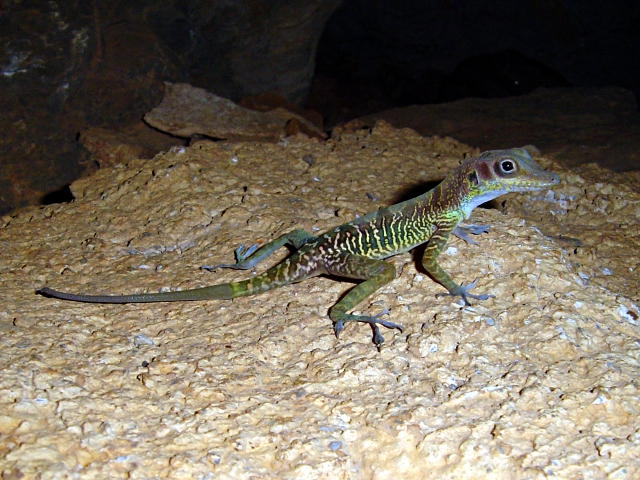
Iguanas · Difficulty: Beginner with some knowledge
Key facts and care guidance for Bartsch's anole (Anolis bartschi) (origin: Western Cuba, Pinar del Río province, especially the Viñales valley; limestone mogotes, rock faces and cave entrances). Adult size around males averaging 26 cm total length, individual animals up to 30 cm; females smaller. Life expectancy 4–8 years. The values below are carefully researched guidance.
Short answers
Bartsch's anole: How big does the enclosure need to be?
At least 60×60×100 cm in tall format for a pair, with a rock-like background including crevices and hollows, plus sturdy vertical and horizontal branches and lush planting with ferns, vines and epiphytes.
Bartsch's anole: What temperature does it need?
Daytime 25–30 °C, basking spot Basking spot 32–35 °C, at night 19–22 °C.
Bartsch's anole: Does it need UVB lighting?
UVB: Essential (UVB 5.0).
Bartsch's anole: How long do they live?
Life expectancy: 4–8 years.
Bartsch's anole: Is it suitable for beginners?
Partly – manageable with some prior knowledge (difficulty: Beginner with some knowledge).
Climate
- Daytime temperature
- 25–30 °C
- Night temperature
- 19–22 °C
- Basking spot
- Basking spot 32–35 °C
- Humidity
- 65–85 %, mist in the morning
- UVB
- Essential (UVB 5.0)
Enclosure
- Minimum size
- at least 60×60×100 cm in tall format for a pair, with a rock-like background including crevices and hollows, plus sturdy vertical and horizontal branches and lush planting with ferns, vines and epiphytes
- Substrate
- Moist forest-floor substrate on the enclosure floor, but the background matters more: a limestone or rock-face replica with crevices and hollows, plus cork and sturdy branches
Feeding
- Food
- Crickets, house crickets, flies, firebrats and wax moths, dusted regularly with calcium and vitamins
- Feeding interval
- adults 3–4×/week
Key facts
- Adult size
- males averaging 26 cm total length, individual animals up to 30 cm; females smaller
- Life expectancy
- 4–8 years
- Origin
- Western Cuba, Pinar del Río province, especially the Viñales valley; limestone mogotes, rock faces and cave entrances
- Protection status
- Not listed under CITES
- Brumation
- No winter rest; somewhat cooler in winter with a shorter photoperiod
- Cohabitation
- In pairs (1.1); never keep males together — they fight until serious injuries occur. Because the males mate roughly, you must be able to separate one animal at any time even with a pair; additional females are not recommended.
Notes
A rock dweller of the mogotes. Stone structures rather than branches.
Do you keep this species?
Add your animal to Reptoria – Reptoria reminds you about feeding and shedding. Add your animal for free →
Look for Bartsch's anole (Anolis bartschi) in the marketplace →
Related species
- Ghost anole (Anolis lemurinus) – Intermediate
- Ahl's anole (Anolis ahli) – Intermediate
- Aliniger anole (Anolis aliniger) – Beginner with some knowledge
- Allogus anole (Anolis allogus) – Beginner with some knowledge
- Bahaman green anole (Anolis smaragdinus) – Beginner
- Bahoruco anole (Anolis bahorucoensis) – Beginner with some knowledge
- Baleatus giant anole (Anolis baleatus) – Intermediate
- Baracoa giant anole (Anolis baracoae) – Intermediate
What you need to start
To keep Bartsch's anole (Anolis bartschi) you typically need: a suitable enclosure (at least 60×60×100 cm in tall format for a pair, with a rock-like background including crevices and hollows, plus sturdy vertical and horizontal branches and lush planting with ferns, vines and epiphytes), substrate (Moist forest-floor substrate on the enclosure floor, but the background matters more: a limestone or rock-face replica with crevices and hollows, plus cork and sturdy branches), a heat source with a thermostat, UVB lighting, thermometer and hygrometer, a water dish and hides. You will find equipment in the Reptoria marketplace.
The complete, interactive care database is in the Reptoria app.
Last updated: 2 November 2026 · Editor: Reptoria editorial team · Sources include: royal-anolis.com, reptile-database.reptarium.cz, anoleannals.org, Wikipedia EN, caribbeanherpetology.org (Hedges 2019, Checkliste)
All values are non-binding guidance and do not replace expert advice. Research thoroughly from several sources before acquiring and keeping an animal, and observe the applicable law (species and animal protection in particular).