Bastard's big-headed gecko (Paroedura bastardi)
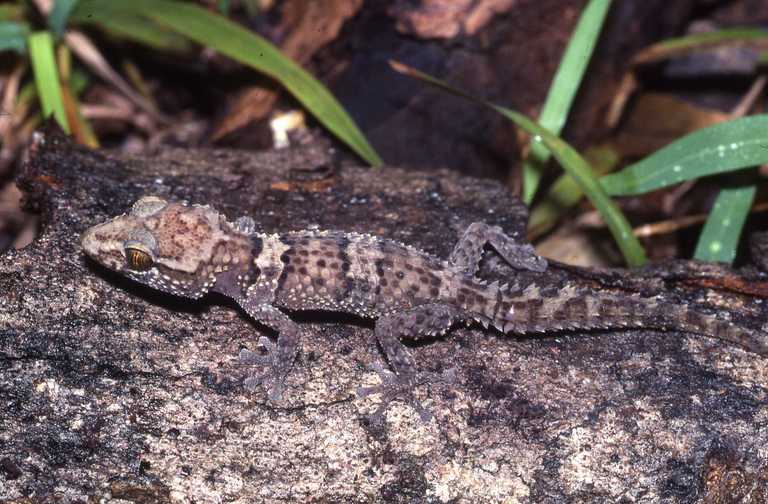
Geckos · Difficulty: Beginner
Key facts and care guidance for Bastard's big-headed gecko (Paroedura bastardi) (origin: The extreme southeast of Madagascar (as delimited by Miralles et al. 2021); dry forest, scrubland and rocky terrain). Adult size around 13–16 cm. Life expectancy 6–10 years. The values below are carefully researched guidance.
Short answers
Bastard's big-headed gecko: How big does the enclosure need to be?
From 60×40×40 cm.
Bastard's big-headed gecko: What temperature does it need?
Daytime 25–29 °C, basking spot 30–35 °C local warm spot, at night 18–22 °C.
Bastard's big-headed gecko: Does it need UVB lighting?
UVB: Not essential (weak UVB is possible).
Bastard's big-headed gecko: How long do they live?
Life expectancy: 6–10 years.
Bastard's big-headed gecko: Is it suitable for beginners?
Yes – it is considered suitable for beginners (difficulty: Beginner).
Climate
- Daytime temperature
- 25–29 °C
- Night temperature
- 18–22 °C
- Basking spot
- 30–35 °C local warm spot
- Humidity
- 45–65 %, plus a permanently humid hide and a damp spot on the substrate
- UVB
- Not essential (weak UVB is possible)
Enclosure
- Minimum size
- from 60×40×40 cm
- Substrate
- Sand-loam, a damp corner with a hide
Feeding
- Food
- Insects of all kinds
- Feeding interval
- Adults 2–3×/week
Key facts
- Adult size
- 13–16 cm
- Life expectancy
- 6–10 years
- Origin
- The extreme southeast of Madagascar (as delimited by Miralles et al. 2021); dry forest, scrubland and rocky terrain
- Protection status
- Captive-bred animals only
- Brumation
- No — a slight winter drop is enough
- Cohabitation
- A pair or 1.2 — never keep males together. The reason: several males fight over territory and the warm spot until one is injured or spends its life in a corner. Females usually get on, but each needs its own warm spot and hide; feed them separately once they differ in size.
Notes
A ground dweller, nocturnal. It breeds readily — eggs turn up regularly, and that is worth thinking about beforehand.
Do you keep this species?
Add your animal to Reptoria – Reptoria reminds you about feeding and shedding. Add your animal for free →
Look for Bastard's big-headed gecko (Paroedura bastardi) in the marketplace →
Related species
- Masobe gecko (Paroedura masobe) – Expert
- Androy ground gecko (Paroedura androyensis) – Beginner
- Slender ground gecko (Paroedura gracilis) – Beginner with some knowledge
- Stumpff's ground gecko (Paroedura stumpffi) – Beginner with some knowledge
- Ocelot gecko (Paroedura picta) – Beginner
- Arabian short-fingered gecko (Stenodactylus arabicus) – Beginner with some knowledge
- Common barking gecko (Ptenopus garrulus) – Intermediate
- Boettger's wall gecko (Tarentola boettgeri) – Beginner
What you need to start
To keep Bastard's big-headed gecko (Paroedura bastardi) you typically need: a suitable enclosure (from 60×40×40 cm), substrate (Sand-loam, a damp corner with a hide), a heat source with a thermostat, UVB lighting, thermometer and hygrometer, a water dish and hides. You will find equipment in the Reptoria marketplace.
The complete, interactive care database is in the Reptoria app.
Last updated: 9 October 2026 · Editor: Reptoria editorial team · Sources include: Wikipedia EN, novataxa.blogspot.com (Miralles et al. 2021), reptile-database.reptarium.cz, dragonzoo.de, eu_annex.txt (lokal, VO (EU) 2026/1383)
All values are non-binding guidance and do not replace expert advice. Research thoroughly from several sources before acquiring and keeping an animal, and observe the applicable law (species and animal protection in particular).