Bearded pygmy chameleon (Rieppeleon brevicaudatus)
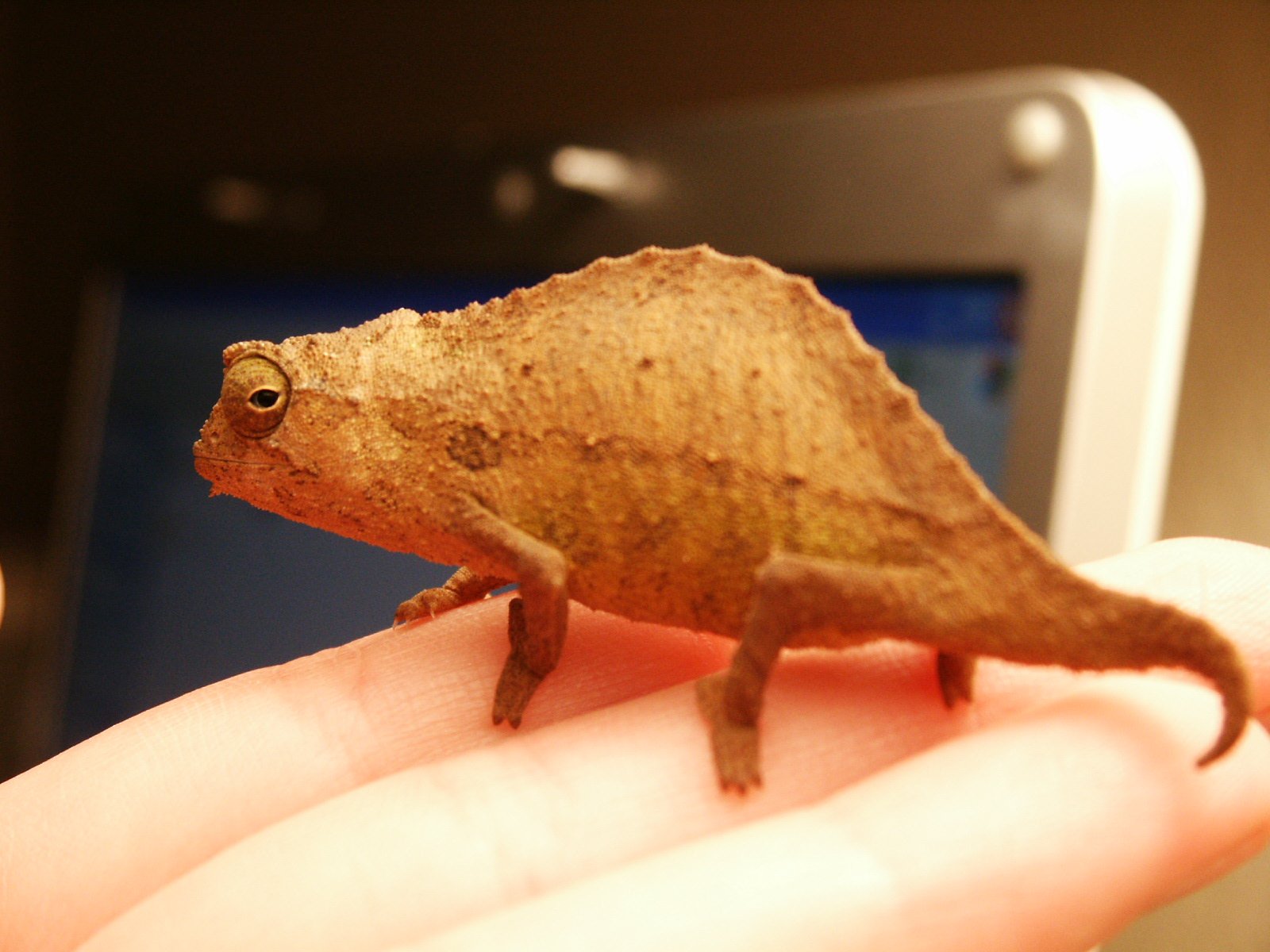
Chameleons · Difficulty: Intermediate
Key facts and care guidance for Bearded pygmy chameleon (Rieppeleon brevicaudatus) (origin: North-eastern Tanzania (East Usambara, Uluguru) and Kenya – rainforest floor). Adult size around ~6–8 cm with the tail. Life expectancy ~3–5 years (usually ~3). The values below are carefully researched guidance.
Short answers
Bearded pygmy chameleon: How big does the enclosure need to be?
40×30×40 cm planted, with fine branches and a cork back wall.
Bearded pygmy chameleon: What temperature does it need?
Daytime 22–25 °C (sensitive to heat, not above ~24–25 °C), at night below 20 °C (18–20 °C).
Bearded pygmy chameleon: Does it need UVB lighting?
UVB: Low UVB recommended (Ferguson zone 1–2, UV index 1–2).
Bearded pygmy chameleon: How long do they live?
Life expectancy: ~3–5 years (usually ~3).
Bearded pygmy chameleon: Is it suitable for beginners?
Rather not – it is considered an intermediate species (difficulty: Intermediate).
Climate
- Daytime temperature
- 22–25 °C (sensitive to heat, not above ~24–25 °C)
- Night temperature
- below 20 °C (18–20 °C)
- Basking spot
- —
- Humidity
- 60–80 %, briefly up to ~90 % (well ventilated)
- UVB
- Low UVB recommended (Ferguson zone 1–2, UV index 1–2)
Enclosure
- Minimum size
- 40×30×40 cm planted, with fine branches and a cork back wall
- Substrate
- Loose, absorbent peat or coco humus; at least 10 cm deep in one spot (for egg-laying!), with fallen leaves
Feeding
- Food
- Small insects: fruit flies, small house crickets or crickets, springtails, firebrats, small roaches
- Feeding interval
- adults every 2–3 days, juveniles daily
Key facts
- Adult size
- ~6–8 cm with the tail
- Life expectancy
- ~3–5 years (usually ~3)
- Origin
- North-eastern Tanzania (East Usambara, Uluguru) and Kenya – rainforest floor
- Protection status
- CITES Appendix II / EU Regulation Annex B; usually wild-caught, proof of origin required
- Brumation
- No winter rest
- Cohabitation
- Group possible: one male with several females in a sufficiently large, well-structured enclosure. Never house males together.
Notes
Heat-sensitive – above 24–25 °C is risky (metabolic disorders, MBD, vitamin deficiency). Deep enough ground is essential against egg binding. A small species: keeping mistakes quickly turn fatal. Often recommended as a beginner's leaf chameleon, but demanding all the same.
Do you keep this species?
Add your animal to Reptoria – Reptoria reminds you about feeding and shedding. Add your animal for free →
Look for Bearded pygmy chameleon (Rieppeleon brevicaudatus) in the marketplace →
Related species
- Kenya pygmy chameleon (Rieppeleon kerstenii) – Intermediate
- Betsch's leaf chameleon (Brookesia betschi) – Expert
- Boulenger's pygmy chameleon (Rhampholeon boulengeri) – Expert
- Brygoo's leaf chameleon (Brookesia brygooi) – Expert
- Chapman's pygmy chameleon (Rhampholeon chapmanorum) – Expert
- Decary's leaf chameleon (Brookesia decaryi) – Intermediate
- Ebenau's leaf chameleon (Brookesia ebenaui) – Expert
- Armoured leaf chameleon (Brookesia perarmata) – Expert
What you need to start
To keep Bearded pygmy chameleon (Rieppeleon brevicaudatus) you typically need: a suitable enclosure (40×30×40 cm planted, with fine branches and a cork back wall), substrate (Loose, absorbent peat or coco humus; at least 10 cm deep in one spot (for egg-laying!), with fallen leaves), a heat source with a thermostat, UVB lighting, thermometer and hygrometer, a water dish and hides. You will find equipment in the Reptoria marketplace.
The complete, interactive care database is in the Reptoria app.
Last updated: 9 October 2026 · Editor: Reptoria editorial team · Sources include: https://de.wikipedia.org/wiki/Rieppeleon_brevicaudatus, https://reptile-database.reptarium.cz/species?genus=Rieppeleon&species=brevicaudatus
All values are non-binding guidance and do not replace expert advice. Research thoroughly from several sources before acquiring and keeping an animal, and observe the applicable law (species and animal protection in particular).