Boyd's forest dragon (Lophosaurus boydii)
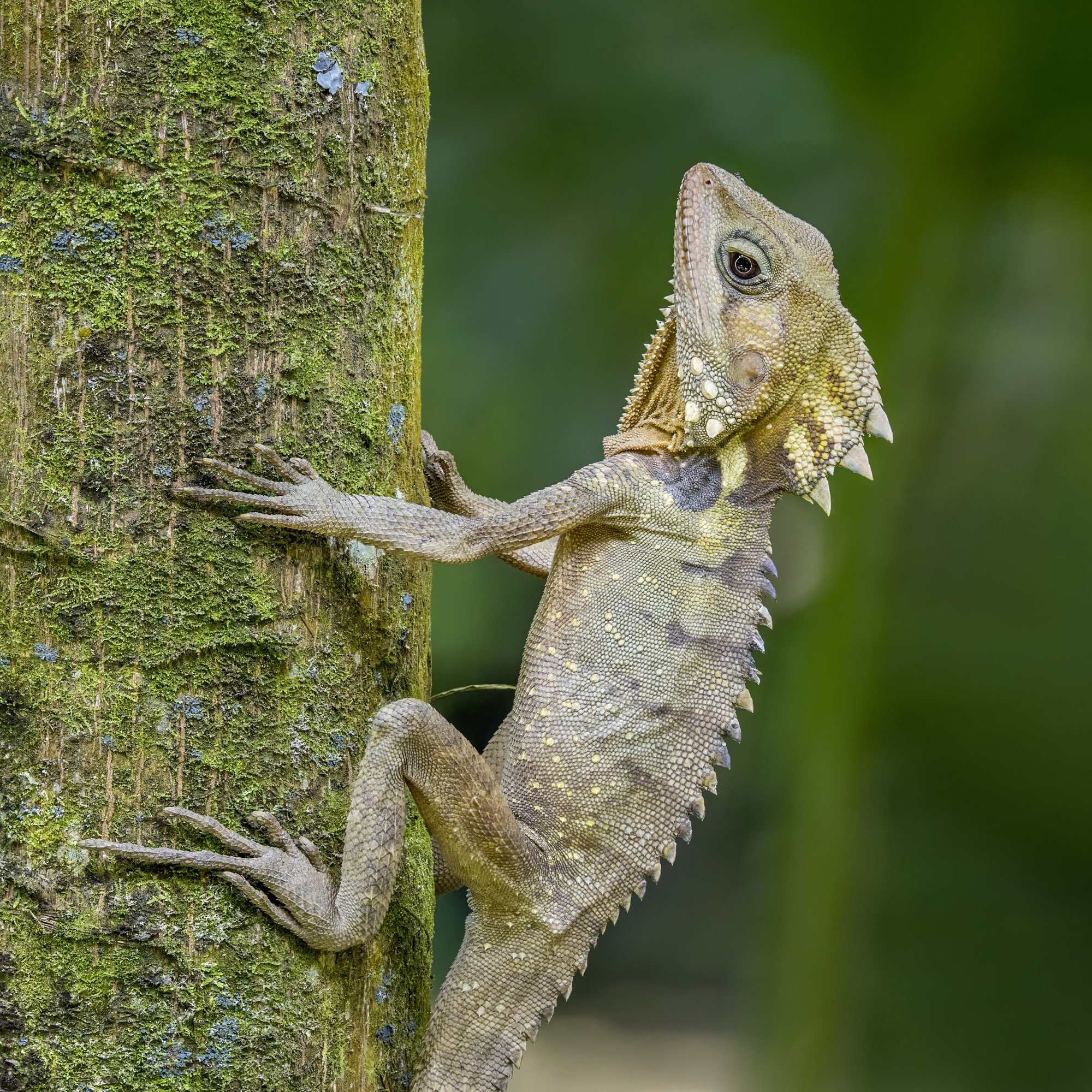
Agamas · Difficulty: Intermediate
Key facts and care guidance for Boyd's forest dragon (Lophosaurus boydii) (origin: North-eastern Queensland (Australia), rainforest). Adult size around approx. 45–50 cm total length. Life expectancy approx. 10–15 years. The values below are carefully researched guidance.
Short answers
Boyd's forest dragon: How big does the enclosure need to be?
From 120×60×150 cm for a pair; experienced keepers recommend 120–150 cm length, 60–100 cm depth and 150–200 cm height.
Boyd's forest dragon: What temperature does it need?
Daytime 20–28 °C, with a focus of 22–26 °C, basking spot No classic basking spot needed — this species doesn't bask but takes on the ambient temperature. If a warm area is provided, it should be no more than around 30 °C; sustained temperatures above 32 °C are harmful, at night 18–22 °C.
Boyd's forest dragon: Does it need UVB lighting?
UVB: UVB needed (5–7 %).
Boyd's forest dragon: How long do they live?
Life expectancy: approx. 10–15 years.
Boyd's forest dragon: Is it suitable for beginners?
Rather not – it is considered an intermediate species (difficulty: Intermediate).
Climate
- Daytime temperature
- 20–28 °C, with a focus of 22–26 °C
- Night temperature
- 18–22 °C
- Basking spot
- No classic basking spot needed — this species doesn't bask but takes on the ambient temperature. If a warm area is provided, it should be no more than around 30 °C; sustained temperatures above 32 °C are harmful
- Humidity
- 70–85 %
- UVB
- UVB needed (5–7 %)
Enclosure
- Minimum size
- from 120×60×150 cm for a pair; experienced keepers recommend 120–150 cm length, 60–100 cm depth and 150–200 cm height
- Substrate
- Coco humus or forest soil with leaf litter, damp; a back wall and plenty of vertical branches
Feeding
- Food
- Crickets, roaches, locusts, superworms; occasionally snails and earthworms
- Feeding interval
- adults 2–3× a week, juveniles daily; mist daily
Key facts
- Adult size
- approx. 45–50 cm total length
- Life expectancy
- approx. 10–15 years
- Origin
- North-eastern Queensland (Australia), rainforest
- Protection status
- Not listed under CITES. Australia has not exported wildlife since 1960 — the entire European stock comes from captive breeding
- Brumation
- None
- Cohabitation
- In pairs (1.1) or as a trio of 1.2. Males are incompatible. Females can get along given enough space and visual barriers, but need separate perching trunks.
Notes
The most keepable species in the group and the only one regularly available as a captive-bred animal — hence "advanced" rather than "expert". By day it often sits motionless and vertical on trunks; that is normal behaviour, not a sign of illness.
Do you keep this species?
Add your animal to Reptoria – Reptoria reminds you about feeding and shedding. Add your animal for free →
Look for Boyd's forest dragon (Lophosaurus boydii) in the marketplace →
Related species
- Southern angle-headed dragon (Lophosaurus spinipes) – Intermediate
- Eared forest dragon (Hypsilurus auritus) – Expert
- Bell's angle-headed dragon (Gonocephalus bellii) – Intermediate to expert
- Borneo angle-headed lizard (Gonocephalus bornensis) – Expert
- Bruijn's forest dragon (Hypsilurus bruijnii) – Expert
- Chameleon angle-headed lizard (Gonocephalus chamaeleontinus) – Expert
- Indonesian forest dragon (Hypsilurus dilophus) – Expert
- Doria's angle-headed lizard (Gonocephalus doriae) – Intermediate
What you need to start
To keep Boyd's forest dragon (Lophosaurus boydii) you typically need: a suitable enclosure (from 120×60×150 cm for a pair; experienced keepers recommend 120–150 cm length, 60–100 cm depth and 150–200 cm height), substrate (Coco humus or forest soil with leaf litter, damp; a back wall and plenty of vertical branches), a heat source with a thermostat, UVB lighting, thermometer and hygrometer, a water dish and hides. You will find equipment in the Reptoria marketplace.
The complete, interactive care database is in the Reptoria app.
Last updated: 9 October 2026 · Editor: Reptoria editorial team · Sources include: Wikipedia EN, aussiepythons.com, australian-monitors.jimdofree.com, eur-lex.europa.eu, livefoods.com.au
All values are non-binding guidance and do not replace expert advice. Research thoroughly from several sources before acquiring and keeping an animal, and observe the applicable law (species and animal protection in particular).