Bronze anole (Anolis aeneus)
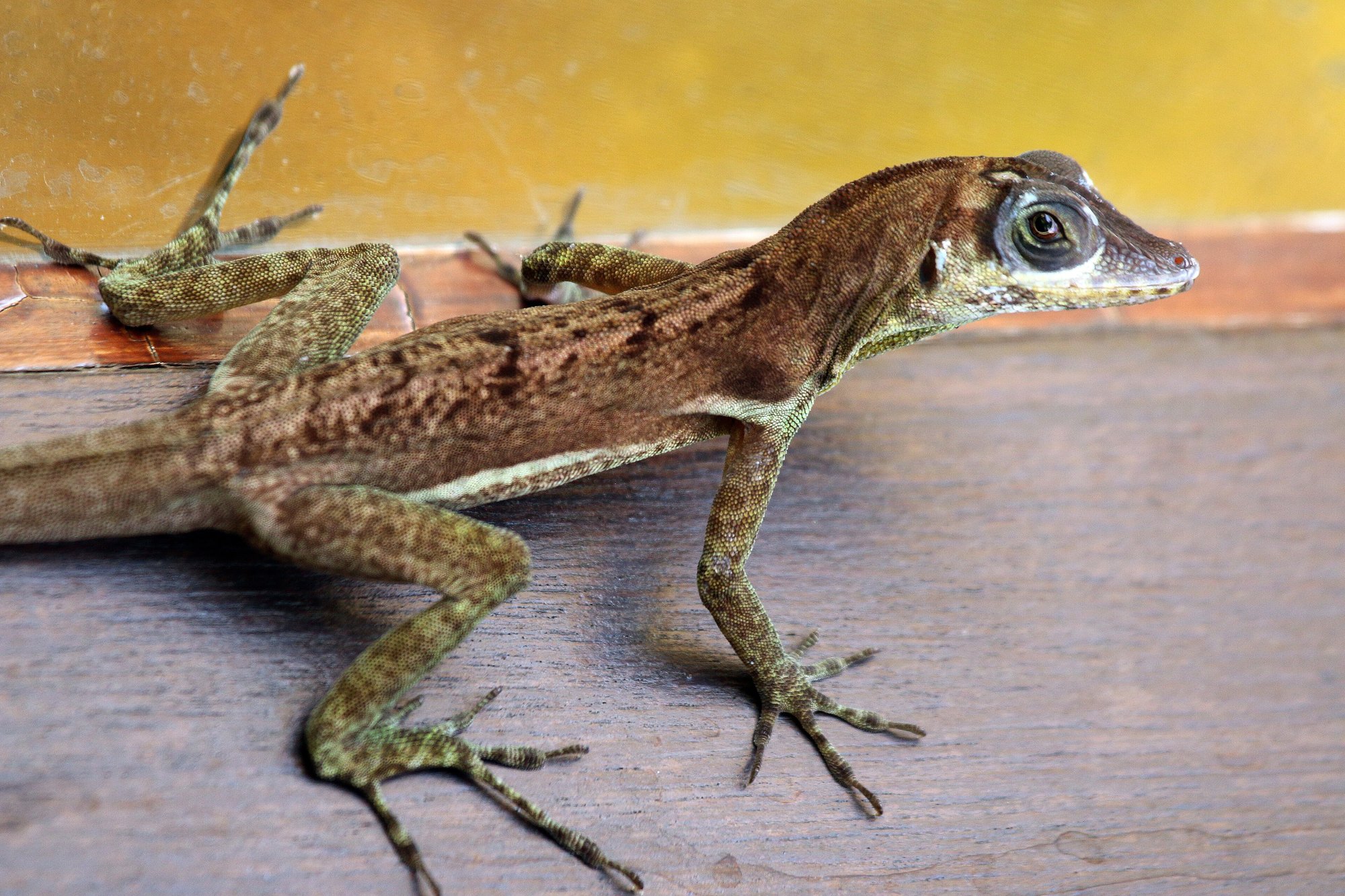
Iguanas · Difficulty: Beginner to intermediate
Key facts and care guidance for Bronze anole (Anolis aeneus) (origin: Grenada and the Grenadines (including Petit Martinique), naturalised on Trinidad, Tobago and in Guyana; from coastal areas up to about 600 m, in dry-warm to humid-warm areas with acacia and mesquite vegetation, in mangroves and in tropical rainforest). Adult size around ~18–20 cm total length (SVL of males ~7.7 cm). Life expectancy ~4–6 years. The values below are carefully researched guidance.
Short answers
Bronze anole: How big does the enclosure need to be?
A pair ~60×50×80 cm (tall format).
Bronze anole: What temperature does it need?
Daytime 27–30 °C, basking spot warm spot ~32 °C, at night 20–23 °C.
Bronze anole: Does it need UVB lighting?
UVB: Recommended.
Bronze anole: How long do they live?
Life expectancy: ~4–6 years.
Bronze anole: Is it suitable for beginners?
Partly – manageable with some prior knowledge (difficulty: Beginner to intermediate).
Climate
- Daytime temperature
- 27–30 °C
- Night temperature
- 20–23 °C
- Basking spot
- warm spot ~32 °C
- Humidity
- 60–80 %
- UVB
- Recommended
Enclosure
- Minimum size
- a pair ~60×50×80 cm (tall format)
- Substrate
- Forest floor or soil, planted, climbing branches
Feeding
- Food
- Crickets, house crickets, small grasshoppers, flies, maggots and spiders, plus regular fruit, seeds, flowers and nectar; dust insects with calcium and vitamins
- Feeding interval
- Several times a week
Key facts
- Adult size
- ~18–20 cm total length (SVL of males ~7.7 cm)
- Life expectancy
- ~4–6 years
- Origin
- Grenada and the Grenadines (including Petit Martinique), naturalised on Trinidad, Tobago and in Guyana; from coastal areas up to about 600 m, in dry-warm to humid-warm areas with acacia and mesquite vegetation, in mangroves and in tropical rainforest
- Protection status
- —
- Brumation
- None
- Cohabitation
- In pairs (1.1). The species is markedly territorial — even juveniles defend their spots fiercely against each other. Two males never work together, and even with several females one usually occupies the best spot while the other is pushed back and loses condition.
Notes
A trunk and ground anole; it eats plant material too. The figures are derived from general anole husbandry plus its origin.
Do you keep this species?
Add your animal to Reptoria – Reptoria reminds you about feeding and shedding. Add your animal for free →
Related species
- Ghost anole (Anolis lemurinus) – Intermediate
- Ahl's anole (Anolis ahli) – Intermediate
- Aliniger anole (Anolis aliniger) – Beginner with some knowledge
- Allogus anole (Anolis allogus) – Beginner with some knowledge
- Bahaman green anole (Anolis smaragdinus) – Beginner
- Bahoruco anole (Anolis bahorucoensis) – Beginner with some knowledge
- Baleatus giant anole (Anolis baleatus) – Intermediate
- Baracoa giant anole (Anolis baracoae) – Intermediate
What you need to start
To keep Bronze anole (Anolis aeneus) you typically need: a suitable enclosure (a pair ~60×50×80 cm (tall format)), substrate (Forest floor or soil, planted, climbing branches), a heat source with a thermostat, UVB lighting, thermometer and hygrometer, a water dish and hides. You will find equipment in the Reptoria marketplace.
The complete, interactive care database is in the Reptoria app.
Last updated: 9 October 2026 · Editor: Reptoria editorial team · Sources include: Wikipedia DE, anoleannals.org, reptile-database.reptarium.cz, caribbeanherpetology.org (Hedges 2019, Checkliste), eu_annex.txt (lokal, VO (EU) 2026/1383)
All values are non-binding guidance and do not replace expert advice. Research thoroughly from several sources before acquiring and keeping an animal, and observe the applicable law (species and animal protection in particular).