Brown anole (Anolis sagrei)
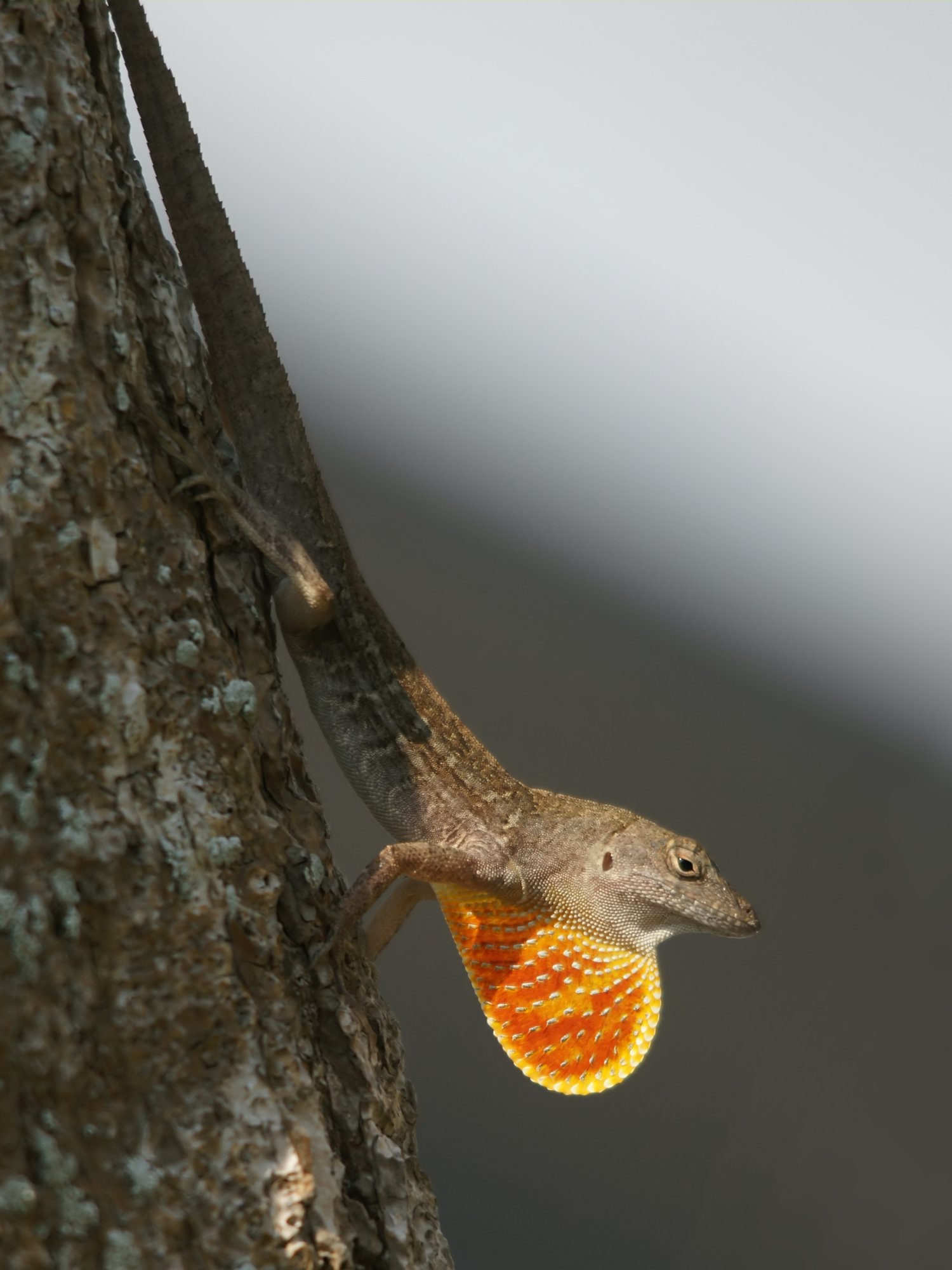
Iguanas · Difficulty: Beginner
Key facts and care guidance for Brown anole (Anolis sagrei) (origin: Cuba and the Bahamas (naturalised worldwide, invasive in Florida for example)). Adult size around ~18–21 cm total length (SVL ~6–7 cm). Life expectancy 4–7 years in the terrarium, up to 8 years with very good care. The values below are carefully researched guidance.
Short answers
Brown anole: How big does the enclosure need to be?
A pair at least 100×60×80 cm; larger for a group.
Brown anole: What temperature does it need?
Daytime 25–30 °C, local basking spot up to about 40 °C surface temperature, basking spot Basking spot up to 35 °C, at night 20–24 °C.
Brown anole: Does it need UVB lighting?
UVB: Recommended (5–10 % UVB).
Brown anole: How long do they live?
Life expectancy: 4–7 years in the terrarium, up to 8 years with very good care.
Brown anole: Is it suitable for beginners?
Yes – it is considered suitable for beginners (difficulty: Beginner).
Climate
- Daytime temperature
- 25–30 °C, local basking spot up to about 40 °C surface temperature
- Night temperature
- 20–24 °C
- Basking spot
- Basking spot up to 35 °C
- Humidity
- about 60 % during the day, rising to about 80 % at night
- UVB
- Recommended (5–10 % UVB)
Enclosure
- Minimum size
- a pair at least 100×60×80 cm; larger for a group
- Substrate
- Forest floor or soil, planted, with places to climb
Feeding
- Food
- Insects (crickets, house crickets, flies)
- Feeding interval
- Several times a week
Key facts
- Adult size
- ~18–21 cm total length (SVL ~6–7 cm)
- Life expectancy
- 4–7 years in the terrarium, up to 8 years with very good care
- Origin
- Cuba and the Bahamas (naturalised worldwide, invasive in Florida for example)
- Protection status
- —
- Brumation
- A slight winter rest at ~20–24 °C is possible
- Cohabitation
- Pairs (1.1) are the safest option; males are incompatible. The reason: several males fight over territory and the basking spot until one is injured or sits permanently in a corner. One male with three to four females only works in a large, well-structured enclosure; two females, on the other hand, often do not get along: one occupies the basking spot, the other sits in a corner and loses weight — usually without a single visible bite wound.
Notes
A robust, good beginner's anole; it climbs close to the ground. An invasive species — never release it.
Do you keep this species?
Add your animal to Reptoria – Reptoria reminds you about feeding and shedding. Add your animal for free →
Related species
- Ghost anole (Anolis lemurinus) – Intermediate
- Ahl's anole (Anolis ahli) – Intermediate
- Aliniger anole (Anolis aliniger) – Beginner with some knowledge
- Allogus anole (Anolis allogus) – Beginner with some knowledge
- Bahaman green anole (Anolis smaragdinus) – Beginner
- Bahoruco anole (Anolis bahorucoensis) – Beginner with some knowledge
- Baleatus giant anole (Anolis baleatus) – Intermediate
- Baracoa giant anole (Anolis baracoae) – Intermediate
What you need to start
To keep Brown anole (Anolis sagrei) you typically need: a suitable enclosure (a pair at least 100×60×80 cm; larger for a group), substrate (Forest floor or soil, planted, with places to climb), a heat source with a thermostat, UVB lighting, thermometer and hygrometer, a water dish and hides. You will find equipment in the Reptoria marketplace.
The complete, interactive care database is in the Reptoria app.
Last updated: 2 November 2026 · Editor: Reptoria editorial team · Sources include: animaldiversity.org, einrichtungsbeispiele.de, Wikipedia DE (Unionsliste invasiver Arten), Wikipedia EN, caribbeanherpetology.org (Hedges 2019, Checkliste)
All values are non-binding guidance and do not replace expert advice. Research thoroughly from several sources before acquiring and keeping an animal, and observe the applicable law (species and animal protection in particular).