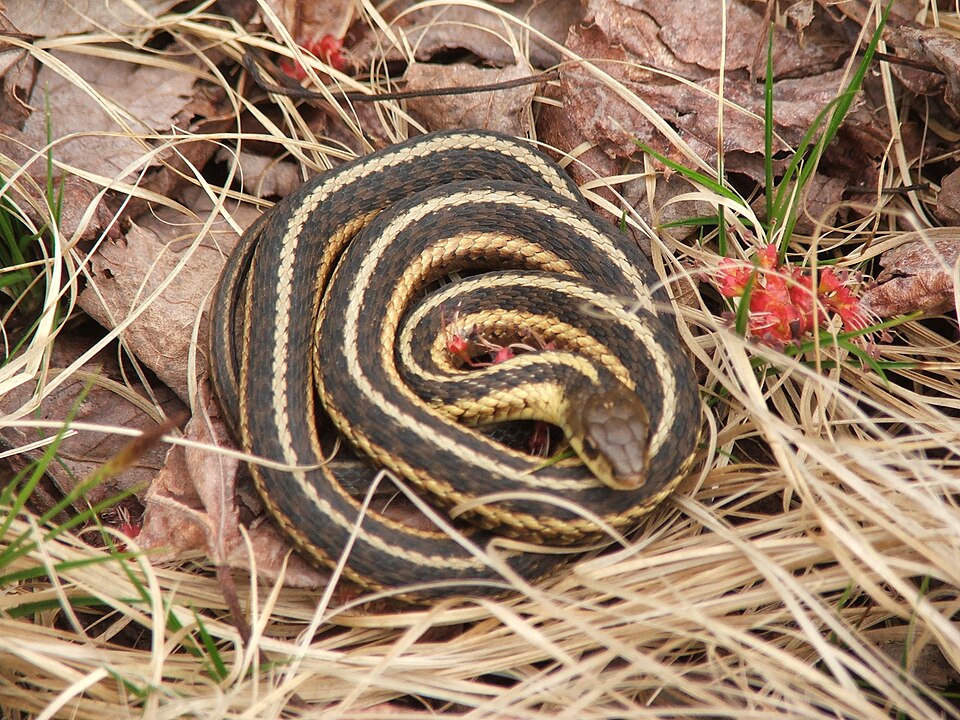
Butler's garter snake (Thamnophis butleri)
Snakes · Difficulty: Intermediate
Key facts and care guidance for Butler's garter snake (Thamnophis butleri) (origin: North-eastern USA and Canada: Ohio, Indiana, Michigan, southern Ontario, isolated in south-eastern Wisconsin). Adult size around 38–55 cm (rarely up to 74 cm). Life expectancy 6–10 years. The values below are carefully researched guidance.
Short answers
Butler's garter snake: How big does the enclosure need to be?
From 70×40×30 cm (minimum size per the 1997 expert report, garter snakes; considerably more floor space for each additional animal).
Butler's garter snake: What temperature does it need?
Daytime 22–27 °C, basking spot Basking spot 29–31 °C, at night 16–20 °C.
Butler's garter snake: Does it need UVB lighting?
UVB: Recommended (low UVB output, basking spot with shade to retreat to).
Butler's garter snake: How long do they live?
Life expectancy: 6–10 years.
Butler's garter snake: Is it suitable for beginners?
Rather not – it is considered an intermediate species (difficulty: Intermediate).
Climate
- Daytime temperature
- 22–27 °C
- Night temperature
- 16–20 °C
- Basking spot
- Basking spot 29–31 °C
- Humidity
- 50–70 % (substrate partly damp, humid hide)
- UVB
- Recommended (low UVB output, basking spot with shade to retreat to)
Enclosure
- Minimum size
- from 70×40×30 cm (minimum size per the 1997 expert report, garter snakes; considerably more floor space for each additional animal)
- Substrate
- Loose, moisture-holding soil with a layer of moss and leaf litter, flat bark pieces and slate as hides, a shallow water dish
Feeding
- Food
- An earthworm specialist (around 80 % of its natural diet), plus leeches and occasionally small amphibians. In captivity earthworms (no red wigglers), sometimes also small pieces of fish or mouse fillet scented with worm; dust worms with calcium/vitamins occasionally.
- Feeding interval
- adults 2×/week, juveniles more often
Key facts
- Adult size
- 38–55 cm (rarely up to 74 cm)
- Life expectancy
- 6–10 years
- Origin
- North-eastern USA and Canada: Ohio, Indiana, Michigan, southern Ontario, isolated in south-eastern Wisconsin
- Protection status
- Not listed under CITES
- Brumation
- A winter rest of 10–14 weeks at 4–8 °C
- Cohabitation
- Can be kept in pairs or as a small group of similarly sized animals; in the wild they overwinter together and gravid females gather. If you want to avoid any stress, keep them singly. Only ever feed them separately – two animals on the same earthworm is the typical feeding accident.
Notes
Little captive experience; the care values are derived from its cool, damp habitat and from close relatives (T. radix, T. sirtalis). A small worm-eating species – a year-round supply of earthworms must be ensured.
Do you keep this species?
Add your animal to Reptoria – Reptoria reminds you about feeding and shedding. Add your animal for free →
Look for Butler's garter snake (Thamnophis butleri) in the marketplace →
Related species
- Ahumada's alpine garter snake (Thamnophis ahumadai) – Expert
- Bogert's garter snake (Thamnophis bogerti) – Expert
- Cope's mountain meadow snake (Thamnophis copei) – Expert
- Fox's mountain meadow snake (Thamnophis foxi) – Expert
- Yellow-throated garter snake (Thamnophis pulchrilatus) – Expert
- Common garter snake (Thamnophis sirtalis) – Beginner
- Godman's garter snake (Thamnophis godmani) – Expert
- Goldenhead garter snake (Thamnophis chrysocephalus) – Expert
What you need to start
To keep Butler's garter snake (Thamnophis butleri) you typically need: a suitable enclosure (from 70×40×30 cm (minimum size per the 1997 expert report, garter snakes; considerably more floor space for each additional animal)), substrate (Loose, moisture-holding soil with a layer of moss and leaf litter, flat bark pieces and slate as hides, a shallow water dish), a heat source with a thermostat, UVB lighting, thermometer and hygrometer, a water dish and hides. You will find equipment in the Reptoria marketplace.
The complete, interactive care database is in the Reptoria app.
Last updated: 27 October 2026 · Editor: Reptoria editorial team · Sources include: Michigan Natural Features Inventory, Species Abstract Thamnophis butleri – Länge 38–73,7 cm, Aktivität, Lebensraum – https://mnfi.anr.msu.edu/abstracts/zoology/Thamnophis_butleri.pdf, ReptiFiles Garter Snake Care Sheet (PDF) – getrennt füttern, Gruppen brauchen mehr Platz – https://reptifiles.com/wp-content/uploads/2022/04/Garter-Snake-Care-Sheet-PDF.pdf, Wisconsin DNR, Butler's Gartersnake Species Guidance – trächtige Weibchen sammeln sich, gemeinsame Überwinterung – https://wiseye.org/wp-content/uploads/Butlers-Guidance.pdf, Wisconsin DNR, Butler's Gartersnake Species Guidance (PUB-ER-665) – 83 % Regenwürmer – https://wiseye.org/wp-content/uploads/Butlers-Guidance.pdf, Wisconsin DNR, Butler's Gartersnake Species Guidance – Paarung März/April, 4–20 Junge von Anfang Juli bis Mitte September, Reife im zweiten Jahr – https://wiseye.org/wp-content/uploads/Butlers-Guidance.pdf
All values are non-binding guidance and do not replace expert advice. Research thoroughly from several sources before acquiring and keeping an animal, and observe the applicable law (species and animal protection in particular).