California legless lizard (Anniella pulchra)
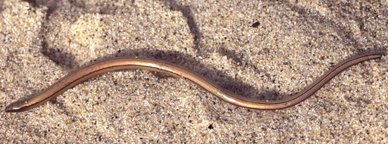
Lizards · Difficulty: Intermediate
Key facts and care guidance for California legless lizard (Anniella pulchra) (origin: California (coastal and central valleys, dunes, chaparral, pine-oak woodland with loose sandy soil)). Adult size around approx. 11–18 cm head-and-body length, up to ~25 cm with the tail; very slender. Life expectancy probably 10–20 years (barely documented). The values below are carefully researched guidance.
Short answers
California legless lizard: How big does the enclosure need to be?
60×40×30 cm for one animal; what matters is deep (at least 20 cm) sand they can dig in.
California legless lizard: What temperature does it need?
Daytime 18–24 °C (in the substrate; does not bask), basking spot — (thermoregulates underground, no classic basking spot), at night 12–16 °C.
California legless lizard: Does it need UVB lighting?
UVB: No UVB needed (burrowing, hardly ever at the surface).
California legless lizard: How long do they live?
Life expectancy: probably 10–20 years (barely documented).
California legless lizard: Is it suitable for beginners?
Rather not – it is considered an intermediate species (difficulty: Intermediate).
Climate
- Daytime temperature
- 18–24 °C (in the substrate; does not bask)
- Night temperature
- 12–16 °C
- Basking spot
- — (thermoregulates underground, no classic basking spot)
- Humidity
- slightly damp substrate; surface 50–70 %
- UVB
- No UVB needed (burrowing, hardly ever at the surface)
Enclosure
- Minimum size
- 60×40×30 cm for one animal; what matters is deep (at least 20 cm) sand they can dig in
- Substrate
- A deep, loose, slightly damp fine sand or sand-humus mix (at least 15–20 cm), with surface hides (slabs, leaf litter)
Feeding
- Food
- Small invertebrates: insect larvae, beetles, termites, spiders, small crickets
- Feeding interval
- adults 2–3×/week
Key facts
- Adult size
- approx. 11–18 cm head-and-body length, up to ~25 cm with the tail; very slender
- Life expectancy
- probably 10–20 years (barely documented)
- Origin
- California (coastal and central valleys, dunes, chaparral, pine-oak woodland with loose sandy soil)
- Protection status
- A California Species of Special Concern (NatureServe G3); since 2013 all Anniella in California have been protected from collection, and collecting is prohibited. Not in CITES, and effectively hardly ever legally in the trade
- Brumation
- A cooler, damper winter spell (several weeks at 10–14 °C) is recommended, matching the Californian winter climate
- Cohabitation
- Keeping them singly is the standard. Not markedly territorial (it lives sociably within a small area in the soil), but keeping it is barely documented at all – so keep them singly to be safe, or as a pair only temporarily
Notes
Highly fossorial (almost entirely underground), it tolerates cool temperatures and does not bask. Very rare and, because of its protected status, barely in captivity; the husbandry figures are derived from field ecology (uncertain). Deep, permanently slightly damp sandy ground is essential.
Do you keep this species?
Add your animal to Reptoria – Reptoria reminds you about feeding and shedding. Add your animal for free →
Look for California legless lizard (Anniella pulchra) in the marketplace →
Related species
- Madrean alligator lizard (Elgaria kingii) – Intermediate
- Asian glass lizard (Dopasia gracilis) – Intermediate
- Slow worm (Anguis fragilis) – Intermediate
- Hart's glass lizard (Dopasia harti) – Intermediate
- Italian slow worm (Anguis veronensis) – Intermediate
- Moroccan glass lizard (Ophisaurus koellikeri) – Intermediate
- Imbricate alligator lizard (Barisia imbricata) – Intermediate
- Eastern slow worm (Anguis colchica) – Intermediate
What you need to start
To keep California legless lizard (Anniella pulchra) you typically need: a suitable enclosure (60×40×30 cm for one animal; what matters is deep (at least 20 cm) sand they can dig in), substrate (A deep, loose, slightly damp fine sand or sand-humus mix (at least 15–20 cm), with surface hides (slabs, leaf litter)), a heat source with a thermostat, UVB lighting, thermometer and hygrometer, a water dish and hides. You will find equipment in the Reptoria marketplace.
The complete, interactive care database is in the Reptoria app.
Last updated: 9 October 2026 · Editor: Reptoria editorial team · Sources include: https://en.wikipedia.org/wiki/Anniella_pulchra, https://reptile-database.reptarium.cz/species?genus=Anniella&species=pulchra
All values are non-binding guidance and do not replace expert advice. Research thoroughly from several sources before acquiring and keeping an animal, and observe the applicable law (species and animal protection in particular).